THE DIGITAL MARKETING COMMUNICATION STRATEGIES FOR A HEALTHY FOOD BUSINESS: CASE STUDY IN BEHAVIORS AND BELIEFS AROUND ALMS-GIVING AMONG THAI BUDDHISTS
คำสำคัญ:
Behaviors and Beliefs, Buddhists in Almsgiving, Digital Marketing, Healthy Food Businessบทคัดย่อ
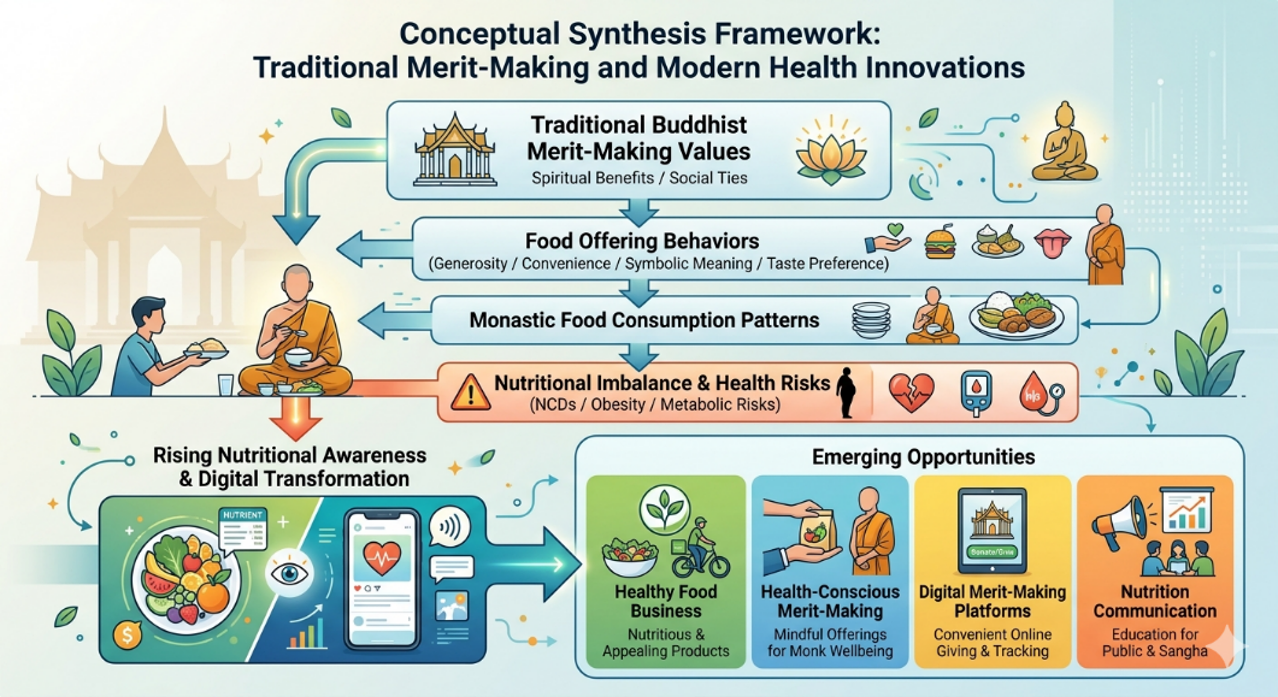
This conceptual article examines the intersection between Buddhist food-offering practices, monks’ nutritional well-being, healthy food businesses, and digital consumption trends in contemporary Thai society. Rising rates of non-communicable diseases (NCDs) among Thai monks are partly associated with dietary patterns shaped by almsgiving practices, in which food offerings are often influenced by symbolic beliefs, perceptions of generosity, personal preferences, and convenience rather than the nutritional needs of monks. These practices may unintentionally contribute to long-term health concerns within the monastic community.
Although previous studies have largely focused on monks’ health conditions and dietary behaviors, less attention has been given to the socio-cultural and consumer-related factors shaping food-offering practices in Buddhist contexts. The expansion of social media, food delivery platforms, and digitally mediated merit-making practices has also begun to transform how urban Buddhists purchase, select, and offer food, creating new opportunities to connect health-conscious consumption with religious practices. The article argues that integrating nutritional knowledge, Buddhist ethical principles, and digital technology may support the development of more nutritionally appropriate food offerings for monks while preserving the cultural and spiritual significance of almsgiving traditions. In this context, healthy food businesses and digital platforms may serve as important channels for promoting greater awareness regarding nutritional quality and encouraging more health-conscious forms of merit-making in contemporary Thai society.
เอกสารอ้างอิง
Angkatavanich, J. et al. (2016). Situation of Nutritional Problem in Buddhist Monks from Project “Sonkthaiglairok”. Bangkok: Panyamit Printing.
Anonjarn, B. et al. (2026). Walking Barefoot, Eating Once, Stilling the Mind: Insights from Thai Buddhist Monastic Practices for Holistic Well-Being in the 21st Century. Thai Journal of Health Education, 49(1), 1–9.
Aonchai, S. et al. (2022). The Application of Food Consumption Along The Buddhist Way. Saint John’s Journal for Humanities and Social Sciences, 25(37), 262–276.
Bureau of Nutrition. (2007). The Nutrition Flag: Healthy Eating for Thai People. Retrieved December 12, 2025, from https://shorturl.asia/TqVJx.
Bureau of Nutrition. (2009). The 2:1:1 Meal Planning for Weight Control. Retrieved December 12, 2025, from https://shorturl.asia/BCx6J.
Butchant, S. (2016). A Study on Buddhists’ Behaviours in Offering Alms-food to Buddhist Monks, Looksue Sub-district, Onggarak District, Nakhon Nayok Province (Master’s Thesis, Buddhist Studies). Ayutthaya: Mahachulalongkornrajavidyalaya University.
DataReportal. (2024). Digital 2024: Thailand. Retrieved December 20, 2025, from https://shorturl.asia/Ml4O1.
Jaroenwanit, P. et al. (2022). Determinants of Customers’ Intention to Use Online Food Delivery Platforms in Thailand. Uncertain Supply Chain Management, 10(3), 747–758.
Kamkokgruad, T. et al. (2019). Nutritional Value of Popular Foods Offered to Monks By Thai Buddhists. Naresuan University Journal: Science and Technology, 27(1), 32–43.
Kittiyanamedhi, P. et al. (2018). Promoting Holistic Health Care of The Monks in Lopburi. Rajapark Journal, 12(25), 94–107.
Ko-amornsup, W. et al. (2024). Health Survey of Monks Residing in Urban Areas: The Bangkok Noi Model. Siriraj Medical Journal, 76(11), 746–757.
Kuramasuwan, B. et al. (2013). Diabetes, Impaired Fasting Glucose, Daily Life Activities, Food and Beverage Consumption Among Buddhist Monks in Chanthaburi Province, Thailand. International Journal of Diabetes in Developing Countries, 33, 23–28.
Major-Smith, D. et al. (2023). Associations Between Religious/Spiritual Beliefs and Behaviours and Dietary Patterns: Analysis of The Parental Generation in A Prospective Cohort Study (ALSPAC) in Southwest England. Public health nutrition, 26(12), 2895–2911.
Mattson, M. P. et al. (2019). Intermittent Metabolic Switching, Neuroplasticity and Brain Health. Nature Reviews Neuroscience, 20(2), 63–80.
Nonlaopon, N. et al. (2024). The Effects of a Disease Prevention Program of Health Belief Model on Health Behaviors and Blood Pressure Levels among Pre - Hypertension of Group Monks. Journal of Health and Nursing Research, 40(2), 1–11.
Phachan, S. & Muktabhant, B. (2015). Nutritional Status and Food Consumption of Buddhist Monks in Mueang District, Khon Kaen Province. Srinagarind Medical Journal, 30(6), 552–561.
Phra Suriyon Tassneeyo (Noisangoun). (2013). An Analytical Study of Pindapata as a Skillful means for Buddhism Propagation (Master’s Thesis, Buddhist Studies). Ayutthaya: Mahachulalongkornrajavidyalaya University.
Puangkaew, O. et al. (2018). Development of A Model for Promoting Food Consumption Behaviors of Monks: Perspectives of Monks. Journal of Health Science Research, Boromarajonani College of Nursing, Nonthaburi, 12(1), 81–91.
Rakmak, T. et al. (2024). Speed Up the Good Deeds: New-Normal Thailand and Linguistic Construction of Buddhist ‘Dana’ Giving Through A Practice of Online Merit-Making. Cogent Arts & Humanities, 11(1), Article 2365527.
Roongsathaporn, T. & Satawedin, P. (2021). Consumer Behavior and Shopping Online in The Amidst of COVID-19 in Bangkok Metropolitan and Phitsanulok. Journal of Communication Arts, 39(2), 119–133.
Sirimongkon, P. et al. (2025). A Qualitative Exploration of Diet-Related Noncommunicable Diseases from the Perspectives of Thai Buddhist Monks in Chiang Mai Province, Thailand. Journal of Population and Social Studies, 33, 844–858.
Sirivongs, P. et al. (2019). General health status of Thai monks living in Bangkok. Journal of the Medical Association of Thailand, 102(Suppl. 8), 1–9.
Srimanee, S. et al. (2013) Factors Related to Consumption Behavior of Monks and Food Offering Behavior of People in Phasi Charoen District, Bangkok. Journal of Nursing, Siam University, 19(37), 22–38.
Statista. (2022). Digital and Social Media Usage in Thailand: Key Statistics. Retrieved December 16, 2025, from https://www.statista.com/statistics/490455/number-of-social-network-users-in-thailand/.
Suvittawat, A. & Suvittawat, N. (2024). Influential Factors on Clean Food Purchasing Decisions: A Case Study of Consumers in the Lower Northeastern Region of Thailand. World, 5(3), 683–699.
Tasen, R. & Tuongratanaphan, S. (2019). Beliefs and Behaviors of Making Merit By Offering Foods of Buddhist People Support Monks’ Health: A Case Study in Nan Province. KKU Journal for Public Health Research, 12(4), 81–87.
Wanvoraset, S. & Monjagapate, J. (2024). The Determinants of Customer Satisfaction on Food Delivery Platforms: A Case Study in Thailand. Srinakharinwirot Business Journal, 15(2), 113–128.
World Health Organization. (2022). Invisible Numbers: The True Scale of Noncommunicable diseases. Retrieved January 31, 2026, from https://shorturl.asia/M8lRs.
_____. (2023). Healthy Diet. Retrieved January 31, 2026, from https://www.who.int/news-room/fact-sheets/detail/healthy-diet.
Yamada Consulting & Spire Research and Consulting. (2018). Thailand’s Food Market Overview. Retrieved February 3, 2026, from https://shorturl.asia/QVvdk.
Yavaprabhas, K. (2024). Making Merit, Making Movement: The Thai Bhikkhuni Movement and Social Media. The International Journal of Religion and Spirituality in Society, 14(3), 115–129.
ดาวน์โหลด
เผยแพร่แล้ว
รูปแบบการอ้างอิง
ฉบับ
ประเภทบทความ
สัญญาอนุญาต
ลิขสิทธิ์ (c) 2026 วารสารสหวิทยาการนวัตกรรมปริทรรศน์

อนุญาตภายใต้เงื่อนไข Creative Commons Attribution-NonCommercial-NoDerivatives 4.0 International License.
เพื่อให้เป็นไปตามกฎหมายลิขสิทธิ์ ผู้นิพนธ์ทุกท่านต้องลงลายมือชื่อในแบบฟอร์มใบมอบลิขสิทธิ์บทความให้แก่วารสารฯ พร้อมกับบทความต้นฉบับที่ได้แก้ไขครั้งสุดท้าย นอกจากนี้ ผู้นิพนธ์ทุกท่านต้องยืนยันว่าบทความต้นฉบับที่ส่งมาตีพิมพ์นั้น ได้ส่งมาตีพิมพ์เฉพาะในวารสารสหวิทยาการนวัตกรรมปริทรรศน์ เพียงแห่งเดียวเท่านั้น หากมีการใช้ภาพหรือตารางหรือเนื้อหาอื่นๆ ของผู้นิพนธ์อื่นที่ปรากฏในสิ่งตีพิมพ์อื่นมาแล้ว ผู้นิพนธ์ต้องขออนุญาตเจ้าของลิขสิทธิ์ก่อน พร้อมทั้งแสดงหนังสือที่ได้รับการยินยอมต่อบรรณาธิการ ก่อนที่บทความจะได้รับการตีพิมพ์ หากไม่เป็นไปตามข้อกำหนดเบื้องต้น ทางวารสารจะถอดบทความของท่านออกโดยไม่มีข้อยกเว้นใดๆ ทั้งสิ้น