
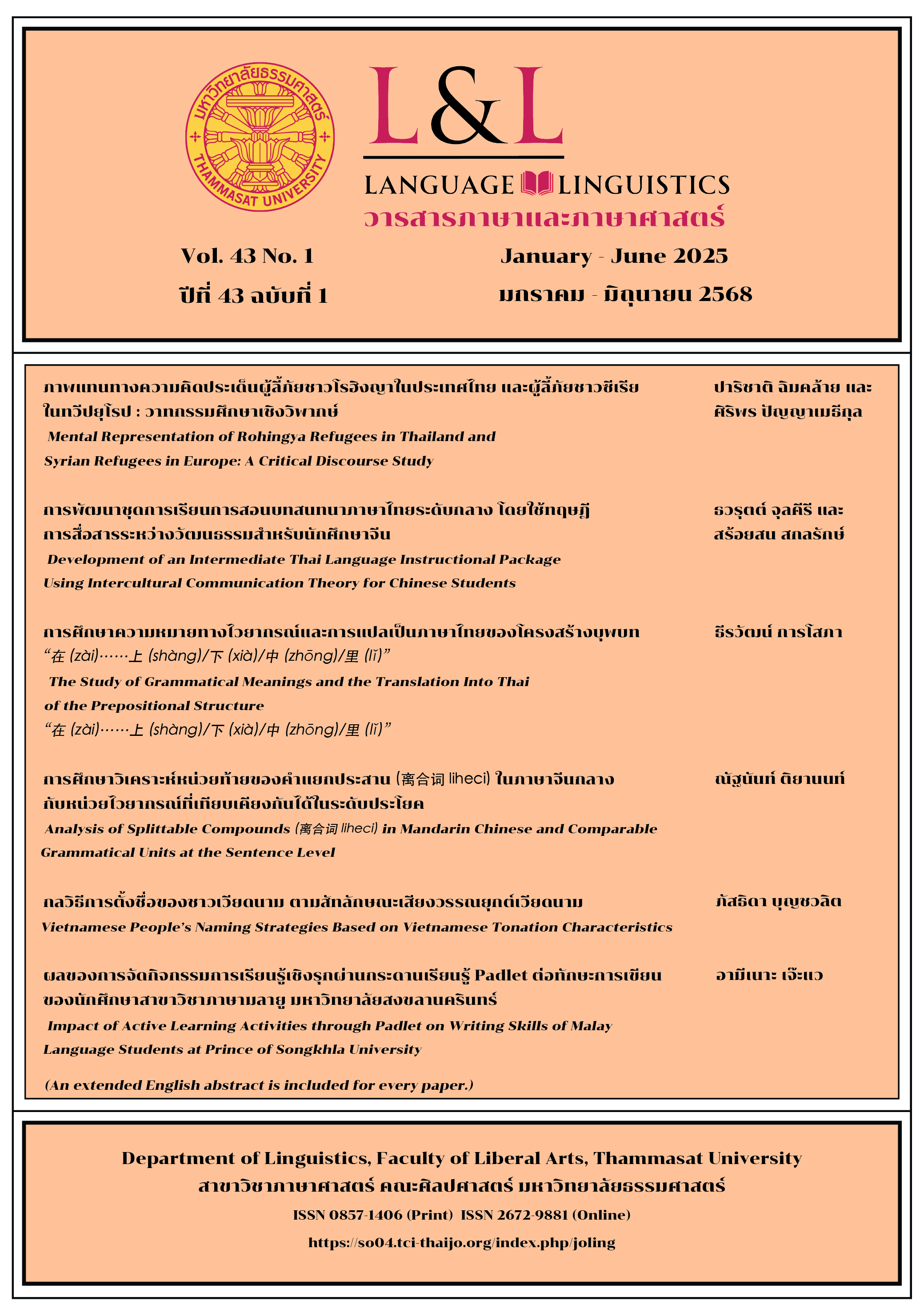
Analysis of Splitable Compounds (离合词liheci) in Mandarin Chinese and Comparable Grammatical Units
Article Sidebar
Main Article Content
Abstract
Academic studies often explain the usage patterns of separable words (离合词 liheci) in Mandarin Chinese by stating that, when other semantic constituents, such as noun modifiers, verb complements, or aspect markers, are present, they must be inserted between the two morphemes of the separable word. However, in this language corpus, separable words were found to appear as post-elements in certain contexts. Based on this linguistic phenomenon, the aims of this study were: 1) to investigate the use of separable words as post-elements, 2) to analyze their syntactic characteristics at the sentence level, and 3) to discuss notable findings arising from the analysis. The methodology comprised an analysis of separable words functioning as post-elements, as identified from the new Level 1–9 HSK test manual according to specific criteria; an examination of grammatical units comparable to these separable words at the sentence level; and a discussion of notable findings from the study.
The findings showed that the post-elements of separable words may take the form of a noun, a predicate, or a clause. When these final units co-occur with separable words at the sentence level, the separable words function in ways that are comparable to other grammatical units.
Article Details

This work is licensed under a Creative Commons Attribution-NonCommercial-NoDerivatives 4.0 International License.
บทความทุกบทความเป็นลิขสิทธิ์ของภาษาและภาษาศาสตร์
References
ราชบัณฑิตยสถาน. (2560). พจนานุกรมศัพท์ภาษาศาสตร์ (ภาษาศาสตร์ทั่วไป). เอบิซอินเตอร์กรุ๊ป.
วาริ ว่องวโรปกรณ์. (2019). “LIHECI” ข้อพึงระมัดระวัง สำหรับผู้เรียนและผู้สอนชาวไทย. วารสารมหาจุฬานาครทรรศน์, 6(4), 1645-1669.
วิจินตน์ ภาณุพงศ์. (2532). โครงสร้างของภาษาไทย: ระบบไวยากรณ์. สำนักพิมพ์มหาวิทยาลัยรามคำแหง.
Basciano, B. (2010). Verbal compounding and causativity in Mandarin Chinese. [Doctoral Dissertation, Università Degli Studi Di Verona] Retrieved from https://iris.unive.it/retrieve/e4239ddb-726c-7180-e053-3705fe0a3322/TESI%20DI%20DOTTORATO%20-%20Verbal%20compounding%20and%20causativity%20in%20Mandarin%20Chinese.pdf
Gao Yong’an高永安. (2009). 边听边记HSK离合词. 北京语言大学出版社.
Guojia Yuyan Wenzi Gongzuo Weiyuanhui国家语言文字工作委员会. (2021). 国际中文教育中文水平等级标准. 中华人民共和国教育部.
Huang Borong & Liao Xudong黄伯荣, 廖序东. (2017). 现代汉语. 高等教 育出版社.
Li Lili & Chen Biyin李丽丽, 陈碧银. (2012). 留学生汉语离合词习得偏误调查研究——越南留学生的视角, 重庆工商大学学报(社会科 学版), 29(5), 134-138.
Liu Zhiyou刘志友. (2019) .外国留学生学习汉语离合词的偏误分析, 中国多 媒体与网络教学学报, (11), 137-138.
Mateja, P. (2016). Word sketches of separable words liheci in Chinese. Acta Linguistica Asiatica, 6(1), 47-57.
Ma Zhen马真. (2009). 简明实用汉语语法教程. 北京大学出版社.
Meng Xueping & Chen qixiang 孟雪萍, 陈启祥. (2023). 基于HSK动态作 文语料库的动宾式离合词偏误分析. 语言文学学术研究, 语言文学学 术研究, (4), 14-16.
Olga, B. (2014). Argument structure in morphology and syntax: An introduction. Lingua, 141(3), 1-7.
Zhao, Y. (1968). A grammar of spoken Chinese. University of California.
Zheng Xiaojiao郑小姣. (2023). 对外汉语教材《发展汉语》中离合词的 考察与分析. 汉语文教学, (9), 144-147.
Zhu Dexi朱德熙. (1982). 语法讲义. 商务印书馆.
