
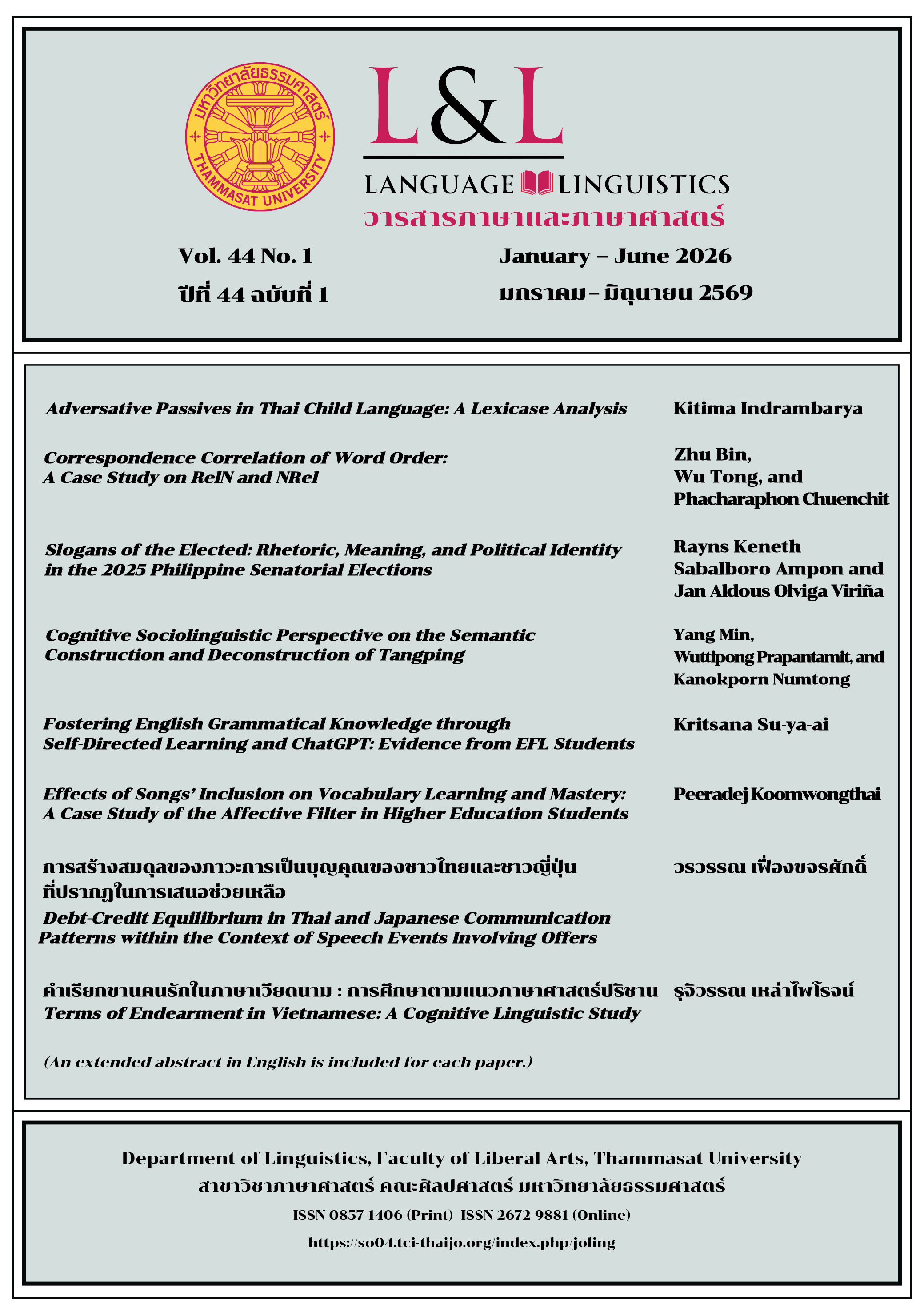
Terms of Endearment in Vietnamese: A Cognitive Linguistic Study
Article Sidebar
Main Article Content
Abstract
The objective of this article is to examine the types of terms of endearment, their metaphorical meanings, and the underlying conceptualizations reflected in Vietnamese expressions for lovers. The study employs the framework of Conceptual Metaphor Theory within the field of cognitive linguistics. Data were collected online from three Vietnamese websites presenting terms of endearment used in Messenger and Zalo applications. The researcher further verified the usage of these terms through interviews with six native Vietnamese speakers: three males and three females, representing three age groups: 20-29, 30-39, and 40-49 years.
The findings reveal that gender-neutral terms of endearment are the most frequent, totaling 75 terms, followed by 55 terms used specifically for females and 30 terms used for males. Vietnamese terms of endearment appear in three main forms: Vietnamese words or phrases used to refer to a lover, Vietnamese abbreviations, and numbers or scientific formulas used as symbolic references to lovers.
Metaphorical analysis identified eight types of metaphors in Vietnamese terms of endearment. For male referents, four metaphor types were found: human metaphor, animal metaphor, occupational metaphor, and belief metaphor. For female referents, five metaphor types were identified: human metaphor, animal metaphor, plant metaphor, occupational metaphor, and belief metaphor. For gender-neutral terms, six metaphor types were observed: human metaphor, animal metaphor, nature metaphor, occupational metaphor, property metaphor, and place metaphor.
The metaphorical meanings found in Vietnamese terms of endearment reflect conceptualizations among Vietnamese speakers that portray lovers as exalted beings, adorable living creatures, fierce beings, valuable possessions, and essential parts of life. These conceptualizations vary according to the couple’s relationship context and individual experiences with their partners.
Article Details

This work is licensed under a Creative Commons Attribution-NonCommercial-NoDerivatives 4.0 International License.
บทความทุกบทความเป็นลิขสิทธิ์ของภาษาและภาษาศาสตร์
References
Aungsuwattanakul, M. (2016). Address term used by dating couples [in Thai], [Master’s thesis, Thammasat University]. Ethesis Archive Library Thammasat University. https://ethesisarchive.library.tu.ac.th/thesis/2016/TU_2016_5506032399_6882_4923.pdf.
Braun, F. (1988). Terms of address: Problems of patterns and usage in various languages and cultures. Mouton de Gruyter.
Brown, R. & Gilman, A. (1972). The Pronoun of Power and Solidarity. In Fishman (ed.), Rearing in The Sociology of Language.
Cameron, D. (2003). Gender and language ideologies. In J. Holmes & M. Meyerhoff (Eds.), The handbook of language and gender (pp. 447–467). Blackwell Publishing.
Chan-aphiban, N. (2011). The use of address terms for unfamiliar interlocutors [in Thai], [Master’s independent study, Srinakharinwirot University]. https://thesis.swu.ac.th/swuthesis/Ed_Lin/Nanthikan_C.pdf
Ding, F. (2005). A comparison of the use of address terms in Thai and Chinese [in Thai], [Master’s thesis, Srinakharinwirot University]. Unpublished.
Doan, T. T. (1999). Vietnamese phonetics [in Vietnamese]. Hanoi: Vietnam National University.
Hanchaiyopoom, J. (1995). The use of address terms among Thai army officers in Bangkok [in Thai], [Master’s thesis, Thammasat University]. https://digital.library.tu.ac.th/tu_dc/frontend/Info/item/dc:138343
Kasornsiri, C. (2021). Metaphors used among Thai adults for addressing themselves and their
beloved ones [in Thai]. Liberal Arts Journal, Mahidol University, 4(2), 376-409.
Khuat, T. L. (2014). Terms of address in communication between Vietnamese rural husbands
and wives (Based on literary works from 1930–1945) [in Vietnamese]. Vietnam Journal of Online Science, 7(225), 18–25.
Kövecses, Z. (2010). Metaphor: A practical introduction (2nd ed.). Oxford University Press.
Lakoff, G. & Johnson, M. (2003). Metaphor We Live By. London: The University of Chicago Press.
Le, T. K. (2002). Terms of address and address usage in Vietnamese dialects [in Vietnamese], [PhD dissertation, Institute of Linguistics, Hanoi]. http://luanan.nlv.gov.vn/luanan?a=d&d=TTbFlGuwFyAG2002.1.1&e=-------vi-20--1--img-txIN-------
Lotrakoolwat, J. (1994). A comparison of the use of address terms in Thai and French [in Thai], [Master’s thesis, Chulalongkorn University]. Chulalongkorn University Intellectual Repository. http://cuir.car.chula.ac.th/handle/123456789/13799.
Nguyen, S. P. (2000). Vietnamese–English dictionary. Culture and Information Publishing House.
Nguyen T. T. C., Anansiriwat, P., & Kongsirirat, S. (2017). Cultural characteristics reflected through the use of person-reference terms in Vietnamese [in Thai]. Journal of Liberal Arts, Ubon Ratchathani University, 13(1), 32–67.
Nguyen, T. T. T. (2007). Distinguishing between address terms and personal pronouns [in Vietnamese]. Journal of Language and Life, 137(3), 1–3.
Nguyen, V. C. (1993). Address terms in Vietnamese [in Vietnamese]. Journal of Science, Hanoi University, 3, 8–13.
Nusartlert, A. (2013). The use of address terms in Thai Political, Legal, Media, and academic registers [in Thai]. Journal of Humanities and Social Sciences (HUSOKKU), 30(3), 117-130.
Rodsap, N. (2007). Address Terms of Thai Monks [in Thai], [Master’s thesis, Srinakharinwirot University]. http://thesis.swu.ac.th/swuthesis/Tha(M.A.)/Narongkan_R.pdf
Saralamba, C. (2005). Metaphor in Cognitive Linguistics Theory [in Thai]. Journal of Language
and Linguistics, Thammasat University, 5(1), 1-16.
Saralamba, C. (2014). Colors as conceptual metaphors of emotions in English and Thai : A Cognitive linguistics in focus [in Thai]. Journal of Language and Linguistics, Thammasat University, 33(1), 87-106.
Siriphanich, P. (2007). Occupational and Positional Terms of Address in Japanese and Thai [in Thai], [Master’s Thesis, Chulalongkorn University].
Taimienphi.vn. (n.d.-a). Biệt danh hay cho người yêu bạn trai gái. Retrieved May 11, 2024, from http://thuthuat.taimienphi.vn/biet-danh-hay-cho-nguoi-yeu-ban-trai-gai-28821n.asp
Taimienphi.vn. (n.d.-b). Biệt danh hay cho bạn trai. Retrieved May 11, 2024, from http://thuthuat.taimienphi.vn/biet-danh-hay-cho-ban-trai-32466n.aspx
Tingsabadh, K. M.R., & Prasithrathsint, A. (1986). The Use of Address Terms in Thai during the
Ratanakosin Period [in Thai]. The Research Dissemination Project, Research Division, Chulalongkorn University.
Ungerer, F and Schmid, H-J. (1999). An Introduction to Cognitive Linguistics. London: Longman.
Vforum.vn. (n.d.). Top những tên hay biệt danh dễ thương cho người yêu lưu trên điện thoại.
Retrieved May 11, 2024, from http://vforum.vn/diendan/showthread.php?112153-Top-nhung-ten-hay-biet-danh-de-thuong-cho-nguoi-yeu-luu-tren-dien-thoai
Wongsa-nga, P. (2002). The use of address terms in a multilingual village: The case of Samrongrawee Village, Srikaew Subdistrict, Srirattana District, Sisaket Province [in Thai], [Independent study report Mahasarakham University]. Unpublished.
Wongthai, N. (2012). Conceptual metaphor of death in Thai [in Thai]. Journal of Language and Culture, 31(1), 43.
