ปัจจัยที่มีผลต่อการเลือกรับชมรายการข่าวเช้าเวิร์คพอยท์ ของประชากร GENERATION X ในเขตกรุงเทพมหานคร
Article Sidebar
Main Article Content
บทคัดย่อ
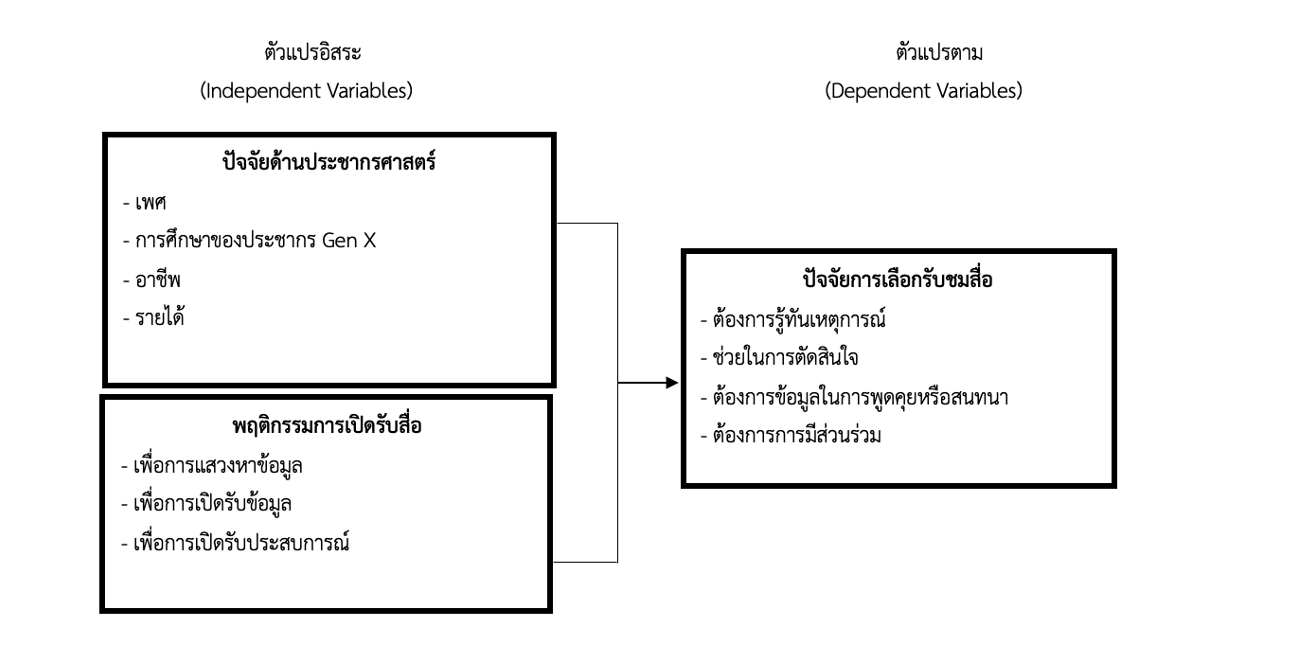
บทนำ: ปัจจุบันรายการข่าวเช้าทางโทรทัศน์แต่ละสถานีโทรทัศน์มีการนำเสนอในรูปแบบที่หลากหลายและมีการพัฒนาคุณภาพเนื้อหามาอย่างต่อเนื่องเพื่อเป็นการตอบสนองให้กับผู้ชมที่ต้องการรับรู้ข่าวสารเพื่อให้ทันต่อสถานการณ์บ้านเมืองที่ผู้รับชมให้ความสนใจ วัตถุประสงค์ของการวิจัย: 1) ศึกษาพฤติกรรมผู้ชมในการเลือกชมรายการข่าวเช้าเวิร์คพอยท์ 2) ศึกษาการรับชมข่าวเช้าเวิร์คพอยท์ของประชากร Generation X ในเขตกรุงเทพมหานคร และ 3) ศึกษาปัจจัยที่มีผลต่อการเลือกรับชมรายการข่าวเช้าเวิร์คพอยท์ของประชากร Generation X ในเขตกรุงเทพมหานคร ระเบียบวิธีวิจัย: การวิจัยเชิงปริมาณ (Quantitive Research) รูปแบบวิจัยเชิงสำรวจ (Survey Research) โดยใช้แบบสอบถาม (Questionnaire) เป็นเครื่องมือในการเก็บรวบรวมข้อมูลกับกลุ่มตัวอย่างที่เป็นประชากร Generation X ในเขตกรุงเทพมหานคร จำนวน 134 คน ผลการวิจัย: พบว่า 1) พฤติกรรมการเลือกรับชมรายการข่าวเช้าเวิร์คพอยท์ของ Generation X ในเขตกรุงเทพมหานคร มีความสัมพันธ์กับเพศ การศึกษา อาชีพ และรายได้ ซึ่งประชากรมีพฤติกรรมการเปิดรับสื่อในระดับมาก 2) ปัจจัยในการเลือกรับชมข่าวเช้าเวิร์คพอยท์ของประชากร Generation X ในเขตกรุงเทพมหานคร กลุ่มตัวอย่างส่วนใหญ่ให้ความสำคัญกับการเปิดรับสื่อผ่านรายการข่าวโทรทัศน์ซึ่งเป็นสื่อหลักที่มีความน่าเชื่อถือ 3) พฤติกรรมการเปิดรับสื่อของประชากร Generation X ในเขตกรุงเทพมหานคร มีความสัมพันธ์ต่อการเลือกรับชมรายการข่าวเช้าเวิร์คพอยท์ โดยปัจจัยที่ผู้ชมเลือกชมรายการข่าวเช้าเวิร์คพอยท์ ประกอบด้วย 3 ด้าน คือ เพื่อการแสวงหาข้อมูล เพื่อการเปิดรับข้อมูล และเพื่อเป็นการเปิดรับประสบการณ์ จากการวิจัยพบว่าประชากรที่มีพฤติกรรมการเปิดรับสื่อในระดับมาก อย่างมีนัยสำคัญทางสถิติที่ระดับ 0.05
Downloads
Article Details
เอกสารอ้างอิง
Becker, G. S. (1983). A theory of competition among pressure groups for political influence. The Quarterly Journal of Economics, 98(3), 371–400.
Bencharongkit, Y. (1991). Kan wikhro phu rap san [Audience analysis]. Chulalongkorn University.
Hunt, T., & Ruben, B. D. (1993). Mass communication: Producers and consumers. HarperCollins College Publishers.
Kaewthep, K. (2004). Suesan manachon: Thritsadi lae naeo thang kan sueksa [Mass communication: Theories and approaches]. Love and Sif Publishing.
Kaewthep, K., & Sirikaya, S. (1988). Thritsadi kan suesan [Communication theory]. Faculty of Communication Arts, Chulalongkorn University.
Klapper, J. T. (1960). Effects of mass communication. Free Press.
McCombs, M. E., & Becker, L. B. (1979). Using mass communication theory. Prentice Hall.
McLeod, J. M., & O’Keefe, G. J. (1972). The socialization perspective and communication behavior. In D. Nimmo & K. Sanders (Eds.), Current perspectives in mass communication research (pp. 123]). Sage Publications.
Muthathip, A. (1999). Thatsanathi khwam phuengphochai lae kan chai prayot khong phuchom raingan “Tee Sip” thang Sathani Witthayu Thorasat Thai Thiwi Si Chong 3 A.S.M.T. [Attitudes, satisfaction, and utilization of viewers of “Tee Sip” program on Channel 3 TV Station] (Master's thesis, Thammasat University).
Namlin, T. (2017). Kan sueksa khwam phuengphochai to khunnaphap kan hai borikan samnak witthay borikan Mahawitthayalai Mahasarakham pra cham pi kan sueksa 2560 [A study of satisfaction with the quality of service at the Office of Academic Resources, Mahasarakham University, academic year 2017] (Independent study, Mahasarakham University).
Office of the National Broadcasting and Telecommunications Commission (NBTC). (2024). Phang rai kan thiwi digital [Digital TV program schedule]. https://dttguide.nbtc.go.th/dttguide/
Phatthana, P. (2020). Naokhit kiew kap khwam phuengphochai lae kan sang baep soptham khwam phuengphochai nai ngan [Concepts of satisfaction and developing satisfaction questionnaires in work]. Journal of Association of Private Higher Education Institutions of Thailand, 26(1), 60
Rujivorachot, K. (2020). Kan sueksa khwam phuengphochai lae khwam chueaman khong phu rap borikan na sun borikan baep betset krom sanapsanun borikan sukhaphap [A study of satisfaction and confidence of clients at the One Stop Service Center, Department of Health Service Support]. Department of Health Service Support, Ministry of Public Health.
Samakom Thorasat Rabob Digital (Prathet Thai). (2024). Raingan khomun kan wat rating kham platform (Cross-Platform Ratings) pra cham duean Kumpaphan 2024 [Cross-Platform Ratings Report, February 2024].
Siriwananon, S. (2007). Khunnasombat phu suekhao (Qualifications of reporter). http://elearning.nsru.ac.th/2550/report_beginning/บทที่%202%20หน้า%201.html
Somwong, P. (2007). Klet mai lap kan marketing borikan [Secrets of service marketing] (2nd ed.). UBCL Books.
Than Setthakit. (2023). “Nielsen” chi trend “content online 2024” nai somraphoom multi screen [“Nielsen” identifies online content trends 2024 in the multi-screen battlefield]. Than Setthakit. https://www.thansettakij.com/business/marketing/581578
Theerakit Nawarat Na Ayudhya. (2009). Kan marketing borikan: Naokhit lae nayayut [Service marketing: Concepts and strategies] (3rd ed.). Chulalongkorn University.
Thai Rath Online. (2023). Thiwi digital tong multi screen phuea Gen New Gen Now [Digital TV must be multi-screen for new generations]. Thai Rath Online. https://mgronline.com/business/detail/9660000106362
