AN EMPIRICAL STUDY ON OPTIMIZING THE MOOC TEACHING MODEL OF SICHUAN UNIVERSITY OF MEDIA AND COMMUNICATIONS THROUGH COLLABORATIVE LEARNING AND PERSONALIZED PATHWAYS BASED ON THE VARK LEARNING STYLE MODEL
Article Sidebar
Main Article Content
บทคัดย่อ
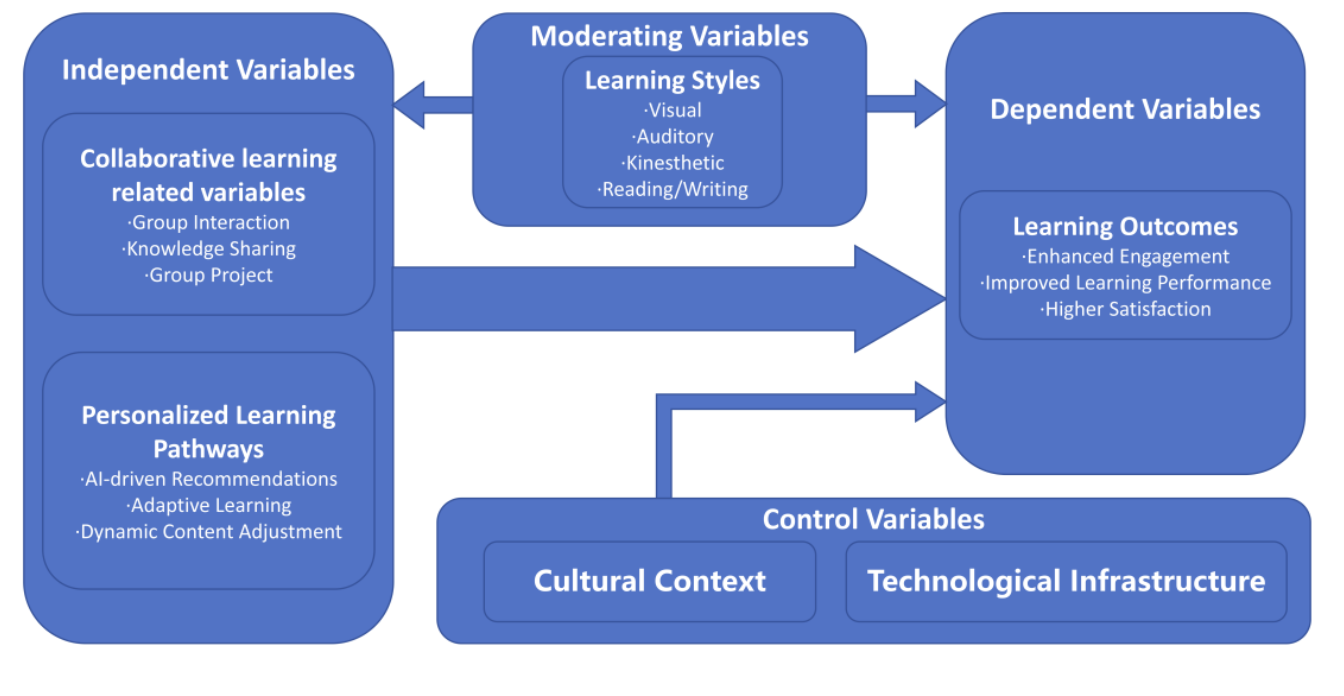
This study aimed to optimize the MOOC teaching model at Sichuan University of Media and Communications by integrating collaborative learning and personalized learning pathways based on the VARK (Visual, Auditory, Reading/Writing, Kinesthetic) learning style model. Research Objective1 Objective 1: To explore the impact of collaborative learning on learning outcomes. 2 Objective 2: To validate the effectiveness of personalized learning pathways. 3 Objective 3: To overall contribution the moderating role of learning styles. Research methodology. The research employed a mixed-methods approach, beginning with a questionnaire survey to assess the learning preferences and characteristics of 218 students from the Digital Media Art program across multiple cohorts (2021 to 2023). Research of result This was followed by in-depth interviews to collect qualitative insights into students' learning experiences and engagement with the MOOC platform. Finally, an empirical experiment was conducted to compare learning outcomes between collaborative learning groups and traditional learning groups, evaluating the effectiveness of personalized learning pathways through dynamic content adaptation and AI recommendation mechanisms. Conclusion The research also demonstrated that different learning styles moderated the impact of collaborative and personalized learning approaches, highlighting the importance of tailoring MOOC teaching strategies to accommodate diverse learning needs. These findings provide theoretical and practical insights for the design of flexible, personalized, and interactive online learning environments, contributing to improved course completion rates and overall learning outcomes.
Downloads
Article Details
เอกสารอ้างอิง
Boon, W., & Edler, J. (2018). Demand, challenges, and innovation: Making sense of new trends in innovation policy. Science and Public Policy, 45(4), 435–447.
Cheng, J., Yuen, A. H., & Chiu, D. K. (2023). Systematic review of MOOC research in mainland China. Library Hi Tech, 41(5), 1476–1497.
Deng, R., Benckendorff, P., & Gannaway, D. (2019). Progress and new directions for teaching and learning in MOOCs. Computers & Education 129(3), 48–60.
Hew, K. F., & Cheung, W. S. (2014). Students’ and instructors’ use of massive open online courses (MOOCs): Motivations and challenges. Educational Research Review, 12(4), 45–58.
Lee, C. Y., Ruan, L. M., Lee, Z. J., Huang, J. Q., Yao, J., Ning, Z. Y., & Tu, J. F. (2021). Study on the university students’ satisfaction with the Wisdom Tree massive open online course platform based on parameter optimization intelligent algorithm. Science Progress, 104(3), 34-56.
Lee, T. H. (2019). Education in traditional China. In The Routledge encyclopedia of traditional Chinese culture (pp. 238–253). Routledge.
Ma, C. (2025). China’s achievements in digital education in the wake of Education Informatization 2.0 Action Plan. Science Insights Education Frontiers, 27(1), 4435–4451.
Staubitz, T., Pfeiffer, T., Renz, J., Willems, C., & Meinel, C. (2015). Collaborative learning in a MOOC environment. In Proceedings of ICERI2015 (pp. 8237–8246). IATED Academy.
Trehan, S., Sanzgiri, J., Li, C., Wang, R., & Joshi, R. (2017). Critical discussions on the massive open online course (MOOC) in India and China. International Journal of Education and Development Using Information and Communication Technology, 13(2), 44-67.
Xu, D., Sun, B., Wan, X., & Ke, Y. (2010). Reformation of medical education in China. The Lancet, 375(9725), 1502–1504.
https://www.thelancet.com/journals/lancet/article/PIIS0140673610602413/abstract
Xu, K. (2008). Engineering education and technology in a fast-developing China. Technology in Society, 30(3–4), 265–274.
Zhang, C. (2016). MOOC in China: Comparison study in XuetangX, CNMOOC and Chinese MOOCs.
Zheng, S., Rosson, M. B., Shih, P. C., & Carroll, J. M. (2015, March). Designing MOOCs as interactive places for collaborative learning. In Proceedings of the Second (2015) ACM Conference on Learning @ Scale (pp. 343–346). Association for Computing Machinery. https://doi.org/10.1145/2724660.2724677
