A STUDY ON THE CONSTRUCTION OF AN EDUCATION MODEL INTEGRATING PSYCHOLOGICAL HEALTH AND CULTURAL QUALITY EDUCATION TAKING UNIVERSITIES IN SICHUAN PROVINCE OF CHINA AS AN EXAMPLE
Article Sidebar
Main Article Content
บทคัดย่อ
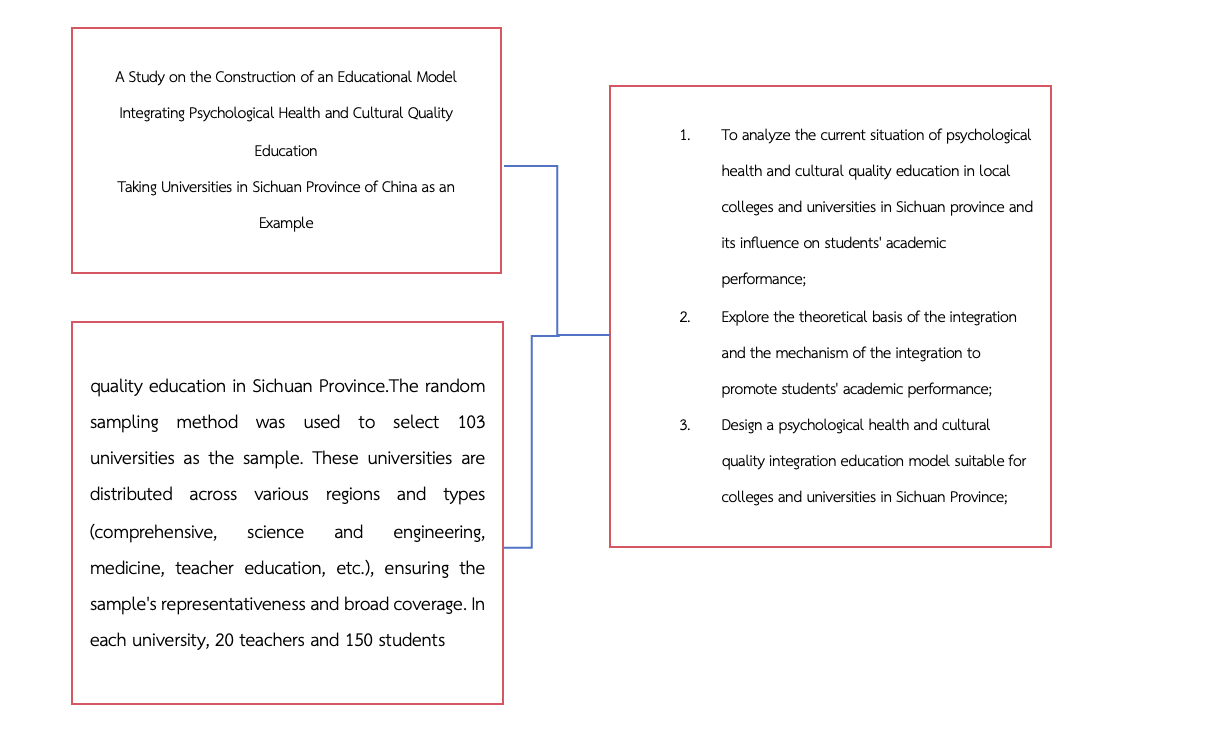
Introduction: The higher education becomes more widespread and competition intensifies, the academic pressure on college students is increasing, and psychological. Objective: This paper focuses on local universities in Sichuan Province, systematically exploring the integration mechanisms and pathways of Psychological Health Education (PHE) and Cultural Quality Education (CQE). The aim is to develop a localized, high-quality, and sustainable integrated education model. Within the context of relevant policies in China. Method: the study involves surveys of 30 Sichuan universities, interviews with faculty and students, and analysis of practical cases. It reveals the status and issues of integrated education in terms of concept updating, curriculum development, and mechanism support, and proposes a three-dimensional integration path model of 'synergy, connectivity, and embedding. Results: The research indicates that integrated education not only enhances college students' psychological adaptability and cultural identity but also strengthens their personality development, social responsibility, and national consciousness, contributing to the high-quality transformation of higher education. Conclusion: The integration of Psychological Health Education and Cultural Quality Education provides a systematic approach to promoting students’ holistic development. The proposed three-dimensional model of synergy, connectivity, and embedding offers a practical pathway for integrated education. This model can support universities in enhancing students’ psychological adaptability, cultural identity, and overall development.
Downloads
Article Details
เอกสารอ้างอิง
Amirova, N. (2025). Traditional vs. non-traditional teaching in secondary education: A comparative analysis. Porta Universorum, 1(3), 101-109.
Annahatak, B. (1994). Quality education for Inuit today Cultural strengths, new things, and working out the unknowns: A story by an Inuk. Peabody Journal of Education, 69(2),12-18.
Bar-On, R. (2010). Emotional intelligence: An integral part of positive psychology. South African Journal of Psychology, 40(1), 54-62.
Chemagosi, M. J. (2024). Student well-being in higher education institutions: academic pressures. In Student well-being in higher education institutions (pp. 81-106). IGI Global Scientific Publishing.
Costigan, C. L., Koryzma, C. M., Hua, J. M., & Chance, L. J. (2010). Ethnic identity, achievement, and psychological adjustment: Examining risk and resilience among youth from immigrant Chinese families in Canada. Cultural Diversity & Ethnic Minority Psychology, 16(2), 264.
Crystal, D. S., Chen, C., Fuligni, A. J., Stevenson, H. W., Hsu, C. C., Ko, H. J., & Kimura, S. (1994). Psychological maladjustment and academic achievement: A cross-cultural study of Japanese, Chinese, and American high school students. Child development, 65(3), 738-753.
Davydov, V. (1998). The concept of developmental teaching. Journal of Russian & East European Psychology, 36(4),11-36.
Jiao, Y. (2025). Psychological & Mental Health Education. Psychological Reports, 128(1), 12-227.
Keyes, C. L. (2007). Promoting and protecting mental health as flourishing: a complementary strategy for improving national mental health. American psychologist, 62(2), 95.
Korobeinikova, L., Iermakov, S., & Korobeynikov, G. (2024). Modern pedagogical aspects in the
context of improving physical and psychological health: a comprehensive analysis. Pedagogy of Health, 3(2), 77-87.
Liu, X. (2018). Institutional governance in the development of Chinese private universities: three cases study from Sichuan province [Unpublished doctoral dissertation] University College London.
Liu, Y., Yang, R., Sun, M., Zhang, L., Li, X., Meng, L., ... & Liu, Q. (2022). Regional sustainable development strategy based on the coordination between ecology and economy: A case study of Sichuan Province, China. Ecological Indicators, 13(4), 108445.
McLellan, D., Moore, W., Nagler, E., & Sorensen, G. (2017). Implementing an integrated approach:Weaving worker health, safety, and well-being into the fabric of your organization.
Mitchell, D. (2015). Integrated education. In Handbook of Educational Ideas and Practices (Routledge Revivals) (pp. 1046-1057). Routledge.
Mushonga, D. R., & Henneberger, A. K. (2020). Protective factors associated with positive mental health in traditional and nontraditional Black students. American Journal of Orthopsychiatry, 90(1), 147.
Nightingale, S. M., Roberts, S., Tariq, V., Appleby, Y., Barnes, L., Harris, R. A., ... & Qualter, P. (2013). Trajectories of university adjustment in the United Kingdom: Emotion management and emotional self-efficacy protect against initial poor adjustment. Learning and Individual differences, 27(5), 174-181.
Pirson, M. (2020). A humanistic narrative for responsible management learning: An ontological perspective. Journal of business ethics, 162(4), 775-793.
Rennie, L., Wallace, J., & Venville, G. (2012). Exploring curriculum integration: Why integrate. In Integrating science, technology, engineering, and mathematics (pp.1-11). Routledge.
Roberts, L. W. (Ed.). (2018). Student mental health: a guide for psychiatrists, psychologists, and leaders serving in higher education. American Psychiatric Pub. Schotte, K., Stanat, P., & Edele, A. (2018). Is integration always most adaptive. The role of
cultural identity in academic achievement and in psychological adaptation of immigrant students in Germany. Journal of youth and adolescence, 47(1), 16-37.
Sheldon, K. M., & Kasser, T. (2001). Goals, congruence, and positive well-being: New empirical support for humanistic theories. Journal of humanistic psychology, 41(1), 30-50.
Shweder, R. A., & Sullivan, M. A. (1993). Cultural psychology: Who needs it. Annual review of psychology, 44(1), 497-523.
Suldo, S. M., Gormley, M. J., DuPaul, G. J., & Anderson-Butcher, D. (2014). The impact of school mental health on student and school-level academic outcomes: Status of the research and future directions. School Mental Health, 6(2), 84-98.
Taylor, S. E., & Brown, J. D. (1988). Illusion and well-being: a social psychological perspective on mental health. Psychological bulletin, 103(2), 193.
Ward, C., & Kennedy, A. (1993). Psychological and socio-cultural adjustment during cross-cultural transitions: A comparison of secondary students overseas and at home. International journal of psychology, 28(2), 129-147.
Zhu, Q., & Yuan, J. (2023). The Role and Mechanism of Excellent Traditional Culture in Enhancing the Effectiveness of Ideological and Political Education in Higher Education under the Background of Balanced Development of Five Education. Creative Education, 14(12), 2520-2530.
