THE FACTORS EXPRESSING TO THE IDENTITY OF SOMPOTE SAENGDUENCHAI'S FILMS
Article Sidebar
Main Article Content
Abstract
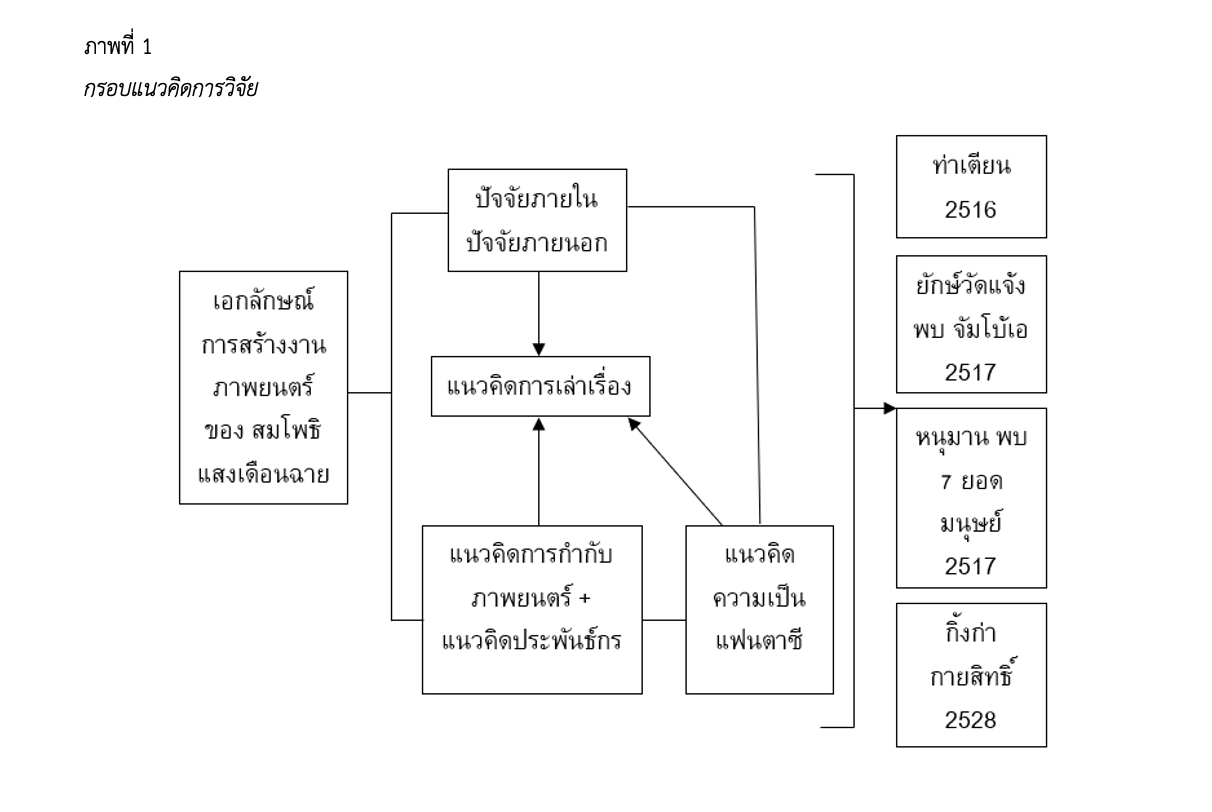
The purpose of this research was to analyze the identity of Sompote Saengduenchai in filmmaking. To analyze internal and external factors related to Sompote's uniqueness in filmmaking. Saengduenchai by studying the life of Sompote Saengduenchai since childhood, beginning to learn to make movies. Until the making of the movie by studying the uniqueness of character creation and special techniques of Sompote famous moonlight by selecting a sample group purbability sampling was used, including 17 films of Sompote Saengduenchai. from all samples according to the criteria with a total of 4 stories as follows:
- 1973 Tha Tien 2. 1974 Yak Wat Chaeng found Jumbo A 3. 1974 Hanuman found 7 superhumans 4. 1985 Magical Lizard and received various awards. The researcher takes into account 1. Academic or practical benefits due to this research is a case study aimed at analyzing the life and works of Sompote Sangduenchai, who collects what has been experienced in life until it can be used as a guideline for creative works. That is unique, which may be applied to the idea of creating a movie with each person that uniqueness may comes from one of the factors in the life of that director.
- Academic benefits the knowledge from the study of the case of Sompote Saengduenchai is an increase in the study of Thai film history.
The analysis results showed that uniqueness in the movie, the nature of the fantasy. from 4 films with magic and the supernatural. Fantasy from local tales It's a real world scene, but there are some supernatural occurrences. Such as talking animals, characters adapted from local fairy tales and special effects are used.
Tokusatsu movies with real humans or TV dramas that use special effects to create small town scenes for filming. It's a special technique to create a picture. Types of special effects Imaging reproduction of a scene or character in miniature or filming an object that is different in size from the real object by creating make realistic movements with the actors, and use explosion and spark effects to add realism.
In the creation of Sompote's work, it consists of beliefs in Buddhism, believe in teachings, do good things get good things, do bad things get bad things interested in literature and legends therefore saw stories in movies related to fairy tales legend good, evil, sacrifice and the preservation of Thai culture and beliefs external factors affecting Sompote's work creation are: Growing up in a family that ran a photography business attended college majoring in photography.
Have the opportunity to study film technical work in Japan. As a result, Sompote's work is a combination of Thai culture, stories, and beliefs. and the use of mechanical techniques reproduction of a Japanese drama scene.
Summarizes the identity that appears in Sompote's movies. Comes from internal factors since he was a child who went to study at the temple, so he believed in Buddhism, magic, supernatural things, and a penchant for taking pictures and watching outdoor movies. External factors come from education driven by internal factors that are cultivated. Causing Sompote to be interested in photography and film.
Also learned shooting techniques from Japan, makeing it unique in the technique of creating a simulation scene. Prop simulation creating a set of character tires have a fun story fantasy but when the technology of animation effects has developed more and more. The repetitive storyline is not new. Original footage is used to edit again. Makes creating work in a simulated scene is therefore less interesting.
Downloads
Article Details
References
กาญจนา แก้วเทพ. (2542). การวิเคราะห์สื่อ แนวคิดและเทคนิค. เอดิสัน เพรส โพรดักส์ จำกัด
ขจร ฝ้ายเทศ. (2540). ปัจจัยที่มีผลต่อการสร้างสรรค์ผลงานของผู้ประพันธ์เพลงลูกทุ่ง ลพ บุรีรัตน์. [วิทยานิพนธ์ปริญญามหาบัณฑิต ไม่ได้ตีพิมพ์]. จุฬาลงกรณ์มหาวิทยาลัย.
ขจีรัตน์ หินสุวรรณ. (2540). การวิเคราะห์วิธิการเขียนบทละครสำหรับสื่อมวลชน:บทเรียนจากงานของสมสุข กัลย์จาฤก. [วิทยานิพนธ์ปริญญามหาบัณฑิต ไม่ได้ตีพิมพ์]. จุฬาลงกรณ์มหาวิทยาลัย.
บรรจง โกศัลวัฒน์. (2543). การกำกับและการแสดงภาพยนตร์. มหาวิทยาลัยธรรมศาสตร์
เบญจา ยอดดำเนิน แอ็ตติกส์ และคณะ.(2541). การศึกษาเชิงคุณภาพ: เทคนิคการวิจัยภาคสนาม.โครงการเผยแพร่ข่าวสารและการศึกษาด้านประชากร. มหาวิทยาลัยมหิดลม.
ปนัดดา สดุดีวิถีชัย. (2545). การศึกษาเปรียบเทียบวรรณกรรมเด็กแนวแฟนตาซีของโรอัลด์ ดาห์ล กับ มิชาเอล เอนเดอ. [วิทยานิพนธ์ปริญญามหาบัณฑิต ไม่ได้ตีพิมพ์]. จุฬาลงกรณ์มหาวิทยาลัย.
พิชญา แหลมหลวง. (2561, 23 มีนาคม). การเก็บข้อมูลด้วยวิธีการสัมภาษณ์. https://www.scribd.com. 2561
พิสณฑ์ สุวรรณภักดี. (2555). ความเป็นประพันธกรในภาพยนตร์ของ อังเดร ทาร์คอฟสกี้. [วิทยานิพนธ์ปริญญามหาบัณฑิต ไม่ได้ตีพิมพ์]. จุฬาลงกรณ์มหาวิทยาลัย.
มาโนช ชุ่มเมืองปัก. (2547). การเล่าเรื่องของภาพยนตร์ตลกไทยยอดนิยมชุด "บุญชู" กับการสร้างสรรค์ของผู้กำกับภาพยนตร์. [วิทยานิพนธ์ปริญญามหาบัณฑิต ไม่ได้ตีพิมพ์]. จุฬาลงกรณ์มหาวิทยาลัย.
วิสิทธิ์ อนันต์ศิริประภา. (2547). ชีวิตและผลงานของยุทธนา มุกดาสนิท : การต่อรองของความเป็นผู้กำกับภาพยนตร์กับระบบธุรกิจภาพยนตร์. [วิทยานิพนธ์ปริญญามหาบัณฑิต ไม่ได้ตีพิมพ์]. มหาวิทยาลัยรังสิต.
วรรณี สําราญเวทย์. (2537). เอกสารการสอนชุดวิชาการผลิตภาพยนตร์ขั้นสูง หน่วยที่ 1-7 สาขาวิชานิเทศศาสตร์. สํานักพิมพ์มหาวิทยาลัยสุโขทัยธรรมมาธิราช.
วิศิษฎ์ ศุภางคะรัตน์. (2549). การสร้างภาพยนตร์โฆษณาทางโทรทัศน์โดยใช้ทฤษฎีแฟนตาซี. [วิทยานิพนธ์ปริญญามหาบัณฑิต ไม่ได้ตีพิมพ์]. จุฬาลงกรณ์มหาวิทยาลัย.
ศรายุทธ กุลราช. (2557). ธรรมชาตินิยมในการสร้างสรรค์ภาพยนตร์ของฌอง-ปิแอร์ ดาร์เดนน์ และลุค ดาร์ เดนน์. [วิทยานิพนธ์ปริญญามหาบัณฑิต ไม่ได้ตีพิมพ์]. จุฬาลงกรณ์มหาวิทยาลัย.
สุภางค์ จันทวานิช. (2542). การวิจัยเชิงคุณภาพ (พิมพ์ครั้งที่8). สำนักพิมพ์แห่งจุฬาลงกรณ์มหาวิทยาลัย
อวยพร แสงคำ. (2557). ลักษณะเด่นของนวนิยายไทยที่มีตัวละครเป็นครุฑและนาค. [วิทยานิพนธ์ปริญญามหาบัณฑิต ไม่ได้ตีพิมพ์]. จุฬาลงกรณ์มหาวิทยาลัย.
อนุสรณ์ ศรีแก้ว. (2534). ปัญหาสังคมในภาพยนตร์ของ มจ.ชาตรีเฉลิม ยุคล. [วิทยานิพนธ์ปริญญามหาบัณฑิต ไม่ได้ตีพิมพ์]. จุฬาลงกรณ์มหาวิทยาลัย.
Frank Eyre. (1971). British Chidren’s Book in the Twentieth Century. Longman Group,
Kenneth J.Zahorski and Robert H. Boyer. (1994). The Aesthetice of Fantasy Literature and Art.Roger C.Schlobin.
