THE FACTORS AFFECTING CONSUMER'S INTENTION TO BUY AGRICULTURAL FOOD INNOVATION PRODUCT VIA ONLINE IN THE PERSPECTIVE OF UNIFIED THEORY OF ACCEPTANCE AND USE OF TECHNOLOGY (UTAUT2) AND PERCEIVED ATTRIBUTES OF INNOVATION THEORY
Article Sidebar
Main Article Content
Abstract
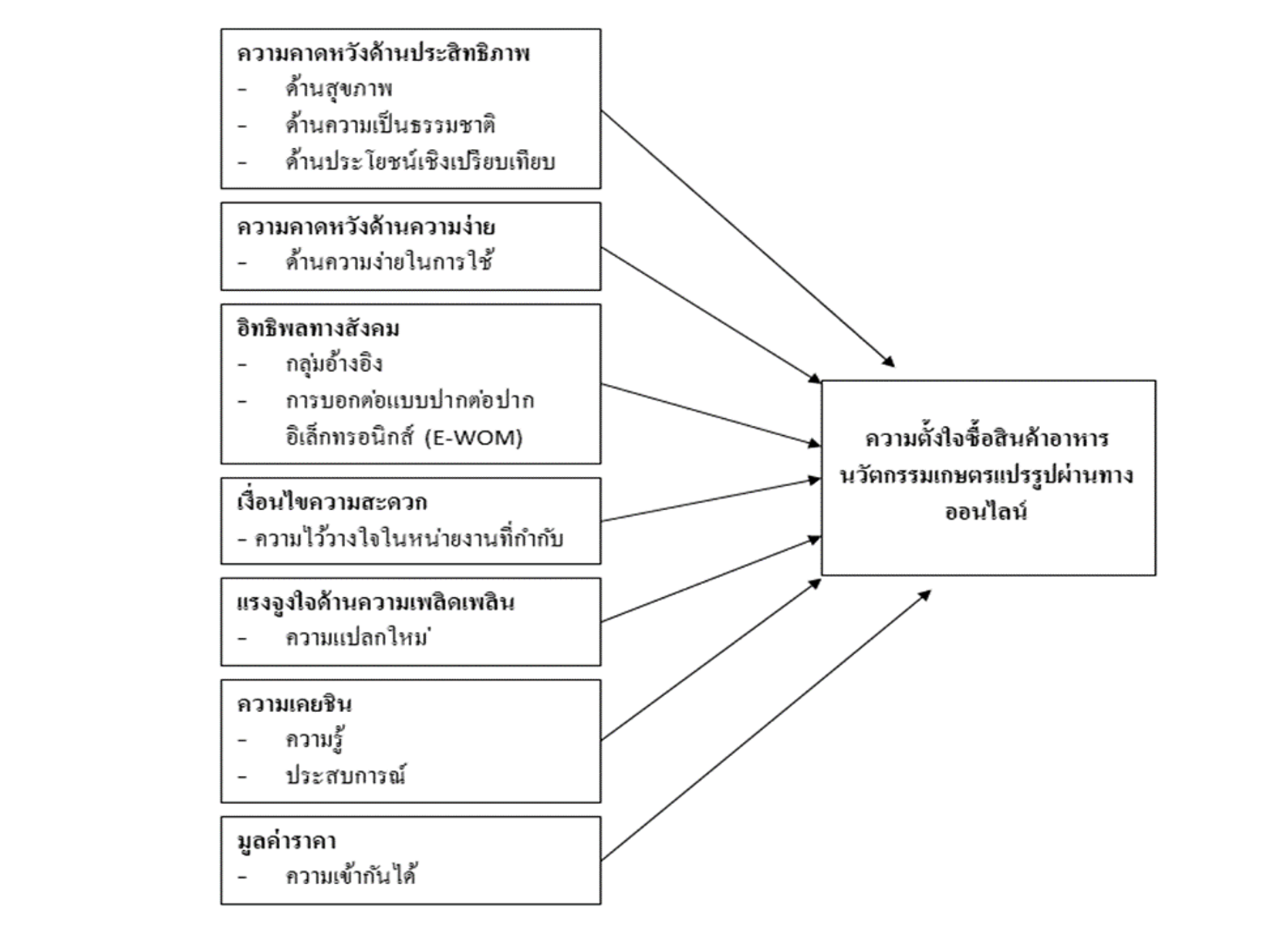
Introduction: Innovation is a key driver in enhancing product quality and value, especially in the agricultural sector where raw materials are increasingly transformed into innovative food products. The rapid expansion of online media further supports production and distribution by increasing accessibility for consumers. Objective: This study aims to examine the factors influencing consumers’ purchase intention toward innovative agricultural food products online using the Unified Theory of Acceptance and Use of Technology 2 (UTAUT2) and the theory of perceived innovation attributes. Methods: A mixed-methods approach was employed. The qualitative phase involved interviews with 10 consumers in Thailand’s eastern region who had experience purchasing innovative processed agricultural food products. The quantitative phase collected data from 400 consumers in the same region using structured questionnaires. Data analysis was conducted using multiple regression analysis. Result: The qualitative findings helped identify and categorize supporting factors related to perceived innovation attributes. The quantitative results revealed five key factors that significantly influenced consumers’ online purchase intention at the 0.05 level: 1. Performance expectancy (health benefits) 2. Social influence (reference groups) 3. Hedonic motivation (novelty) 4. Habit (experience) 5. Price value (compatibility). These findings provide valuable insights for developing marketing strategies that effectively promote innovative food products in the online market.
Downloads
Article Details
References
Albertsen, L. (2020). The impact of innovation-related perception on consumer acceptance of food innovations – Development of an integrated framework of the consumer acceptance process. Food Quality and Preference, 84, 103958.
Blaise, R., Halloran, M., & Muchnick, M. (2018). Mobile Commerce Competitive Advantage: A Quantitative Study of Variables that Predict M-Commerce Purchase Intentions. Journal of Internet Commerce, 17(2), 96-114.
Biondi, B. (2020). Nutrition, hedonic or environmental? The effect of front-of-pack messages on consumers’ perception and purchase intention of a novel food product with multiple attributes. Food Research International, 130, 108962.
Buntornwon, T. (2017). Perceived Risks Affecting Perceived Brand Image, Trust and Intention to Purchase Perfume via Online of Consumers in Bangkok. http://dspace.bu.ac.th/jspui/handle/123456789/2581 [In Thai]
Chu, K. M. (2018). Mediating Influences of Attitude on Internal and External Factors Influencing Consumers’ Intention to Purchase Organic Foods in China. Sustainability, 10(12), 4690.
Connor, M., & Siegrist, M. (2010). Factors Influencing People’s Acceptance of Gene Technology: The Role of Knowledge, Health Expectations, Naturalness, and Social Trust. Science Communication, 32(4), 514-538.
Cummings, C. L. (2018). Protection Motivation and Communication through Nanofood Labels: Improving Predictive Capabilities of Attitudes and Purchase Intentions toward Nanofoods. Science, Technology, & Human Values, 43(5), 888-916.
Ding, S. (2020). Influences of Reference Group on Users’ Purchase Intentions in Network Communities: From the Perspective of Trial Purchase and Upgrade Purchase. Sustainability, 12(24), 10619.
Electronic Transactions Development Agency. (2021). Value of e-Commerce Survey in Thailand. https://www.etda.or.th/th/
Fischer. (2016). Consumer Acceptance of Novel Foods. Innovation Strategies in the Food Industry, 271-292.
Frewer, L. J. (2011). Consumer response to novel agri-food technologies: Implications for predicting consumer acceptance of emerging food technologies. Trends in Food Science & Technolog, 22(8), 442-256.
Jirasawadpong, N. & Srisai, S. (2020). Experience through Touchpoints of Made to Order Restaurant Consumers. Journal of Communication Arts, 38(2), 105-122. [In Thai]
Kaplan, A. M., & Haenlein, M. (2010). Users of the world, unite! The challenges and opportunities of Social Media. Business Horizons, 53(1), 59-68.
Kim, S., & Pysakchik, D. T. (2000). Predicting purchase intentions for uni-national and bi-national products. International Journal of Retail & Distribution Management, 28(6), 280-291.
Kotler, P. (2016). Marketing Management (15th Edition). New Jersey: Prentice Hall
Nazzaro, C. (2019). Do consumers like food product innovation? An analysis of willingness to pay for innovative food attributes. British Food Journal, 121(6), 1413-1427.
Noojan, C. (2016)., Effect Integrated Marketing Communications and Perceived Image on Purchase Decision of Processed Agricultural Products in Nonthaburi Province. http://dspace.bu.ac.th/jspui/handle/123456789/2364 [In Thai]
Premsawat, P. (2019). The Influences of Trust, Perceived Price, and Website Efficiency on Online Purchases from Reputed Department Stores by Buyers in Sathon District, Bangkok. http://dspace.bu.ac.th/bitstream/123456789/4294/3/parunya_prea.pdf [In Thai]
Rather, R. A. (2019). Customer experience and engagement in tourism destination: the experiential marketing perspective. Journal of Travel and Tourism Marketing, 37(1), 15-32.
Rogers, E. M. (2003). Diffusion of Innovation. New York: The Free Press.
Shen, Y. C., & Chen, H. S. (2020). Exploring Consumers’ Purchase Intention of an Innovation of the Agri-Food Industry: A Case of Artificial Meat. Foods, 9(6), 745.
Siegrist, M., & Hartmann, C. (2020). Consumer acceptance of novel food technologies. Nature Food, 1(6), 343-350.
Tantitaweewattana, T. (2017). The Factors Positively Relating and Influencing Healthy Food’s PurchaseIntention of Consumers in Bangkok. http://dspace.bu.ac.th/jspui/handle/123456789/2558 [In Thai]
Thawadi, S. A. (2018). Public perception of algal consumption as an alternative food in the Kingdom of Bahrain. Arab Journal of Basic and Applied Sciences, 15(1), 1-12.
Vanichbuncha, K. (2001). SPSS for Windows. (3), 7-10. Bangkok: CK AND S PHOTO STUDIO LTD., PART.
Venkatesh, V., Thong, J. Y., & Xu, X. (2012). Consumer Acceptance and Use of Information Technology: Extending the Unified Theoryof Acceptance and Use of Technology. MIS Quarter, 36(1), 157-178.
Yujin, X., Wei, G., & Pei, Y. (2018). Research on Influencing Factors of Consumer' Wellingness to Purchase Fresh E-commerce Products Based on UTAUT Model. International Conference on Education Technology, Economic Management and Social Sciences.
Yeh, J. Y., Liao, S. C., Wang, Y. T., & Chen, Y. J. (2019). Understanding Consumer Purchase Intention in a Blockchain Technology for Food Traceability and Transparency context. Japan: IEEE.
Yusuf, A. S., Che Hussin, A. R., & Busalim, A. H. (2018). Journal of Services Marketing. Journal of Services Marketing, 32(4), 493-504.
Zhao, X., Deng, S., & Zhou, Y. (2017). The impact of reference effects on online purchase intention of agricultural products: The moderating role of consumers’ food safety consciousness. Internet Research, 27(2), 233-255.
