GUIDELINES FOR SUSTAINABLE SMART CITY DEVELOPMENT IN MUANG MAI BANG BUA THONG MUNICIPALITY
Article Sidebar
Main Article Content
Abstract
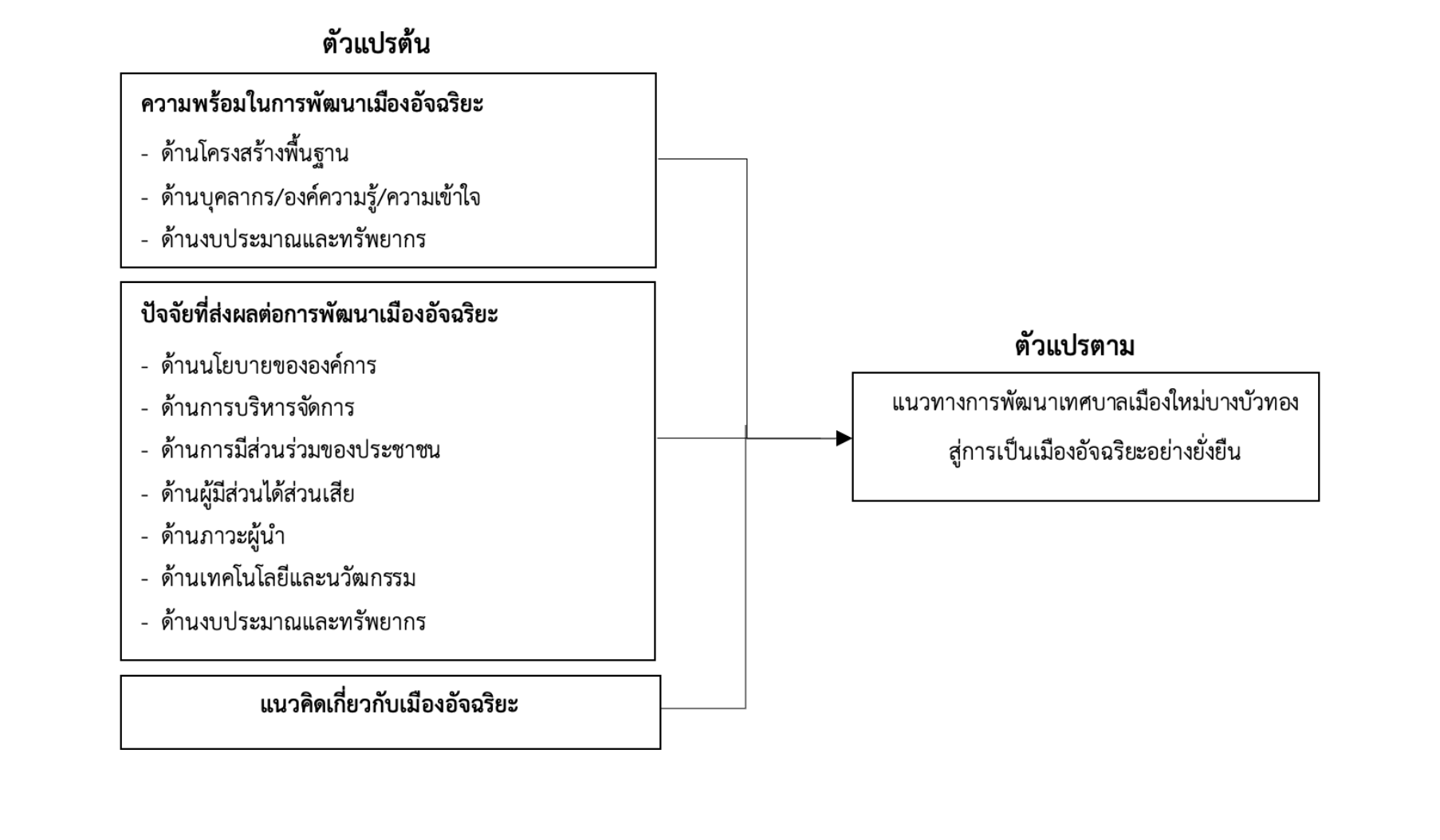
Introduction: Research on the Guidelines for Sustainable Smart City Development in Muang Mai Bang Bua Thong Municipality. objectives: To study the readiness of Bang Bua Thong New Municipality to develop into a smart city, to study the factors affecting the development of Bang Bua Thong New Municipality to become a smart city, and to propose guidelines for the development of Bang Bua Thong New Municipality to become a sustainable smart city. Methods: A mixed-method research approach was used. Quantitative research using a questionnaire as a tool to collect data from people living in Bang Bua Thong New Municipality using statistical data analysis and qualitative research methods. Interviews using the Delphi Technique were conducted with
3 rounds of data collection from experts in smart city development. Results: The sample group expressed their opinions on the readiness of Bang Bua Thong New Municipality to develop a smart city at a high level. The highest average score was for budget and resources ( = 4.26, S.D. = 0.87), followed by infrastructure ( = 4.05, S.D. = 0.87), and human resource potential and knowledge ( = 4.05, S.D. = 0.85), respectively. In terms of factors affecting smart city development, the sample group also had high opinions, with leadership receiving the highest average score ( = 4.29, S.D. = 0.90), followed by budget and resource management
( = 4.26, S.D. = 0.87), and organizational policies ( = 4.19, S.D. = 0.87), respectively. Conclusion: The qualitative research findings indicate that, although the municipality possesses strengths in infrastructure, personnel, and budget, it still faces limitations such as outdated technology, a lack of budgetary flexibility, personnel with insufficient digital skills, and inefficient management practices.
Downloads
Article Details
References
Bang Bua Thong Municipality. (2025). Development plan report, fiscal year 2025 [in Thai] Bang Bua Thong Municipality.
Bhattacharya, S. C., Bhattacharya, D., McLellan, B. C., & Tezuka, T. (2018). Smart communities for addressing energy and environmental challenges: An overview. Energy Procedia, 15(3), 16 - 21. https://doi.org/10.1016/j.egypro.2018.10.004
Box, I. (2014). Smart city: Leading the way to better urban living. Urban Innovation Press.
Department of Provincial Administration. (2025). Population and housing statistics 2025 [in Thai] Ministry of Interior.
Digital Economy Promotion Agency [DEPA]. (2018). Thailand digital economy strategic plan [in Thai] Ministry of Digital Economy and Society.
Digital Economy Promotion Agency [DEPA]. (2025). Smart city plan 2025.
Kim, H. W., Galliers, R. D., Shin, N., Ryoo, J. H., & Kim, J. (2012). Factors influencing Internet shopping value and customer repurchase intention. Electronic Commerce Research and Applications, 11(4), 374 - 387. https://doi.org/10.1016/j.elerap.2012.04.002
Nonthaburi Provincial Office. (2018). Nonthaburi provincial development plan 2018–2022 [in Thai]Ministry of Interior.
Radsanui, K., & Waiyawutthinan, B. (2022). Factors influencing the sustainable development of smart cities of municipalities in Thailand [Article in Thai]. Journal of Public Administration, 22(2), 45 - 59.
Yamane, T. (1973). Statistics: An introductory analysis. (3rd ed). Harper & Row.
