INNOVATION FACTORS INFLUENCING THE PERFORMANCE OF THAI EXPORT BUSINESSES OF FRESH FRUITS TO CHINA: A CASE STUDY AT THE FOURTH THAI-LAO FRIENDSHIP BRIDGE BORDER CHECKPOINT (CHIANG KHONG), CHIANG RAI PROVINCE
Article Sidebar
Main Article Content
Abstract
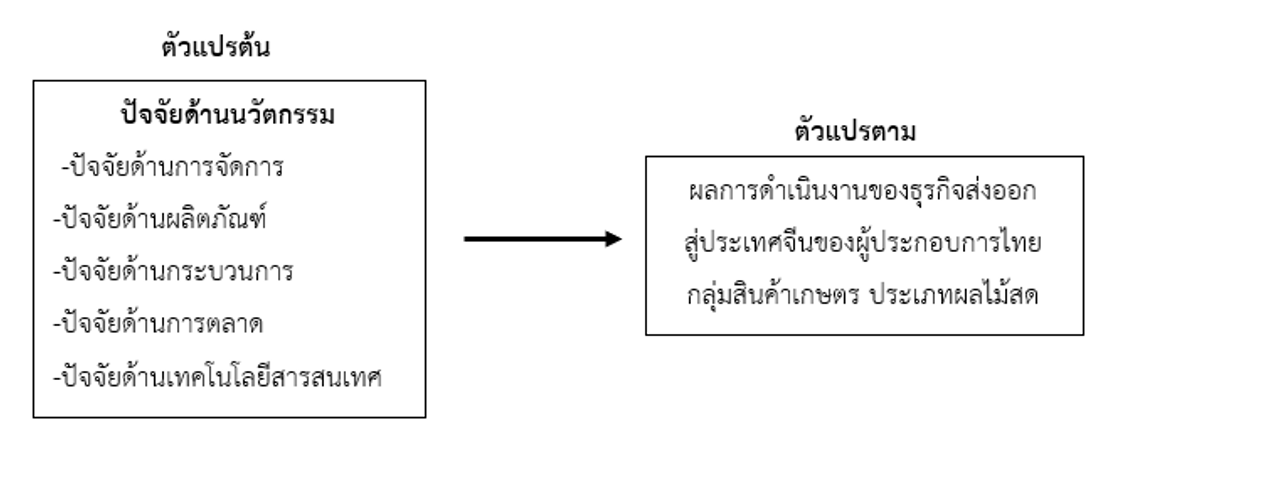
Introduction: Thailand’s current economic system relies significantly on international trade-including border and transit trade with neighboring countries-as a primary engine to drive investment and domestic production. Objectives: This research aimed to: 1) study innovation factors in the export of fresh fruit to China by Thai entrepreneurs; 2) examine the business performance of these exporters; and 3) analyze the influence of innovation factors on their business performance. Method: This quantitative study employed questionnaires to gather data from 110 Thai entrepreneurs exporting fresh fruit to China via the 4th Thai-Lao Friendship Bridge (Chiang Khong), Chiang Rai Province. Purposive sampling was used for participant selection. Data were analyzed using frequency, percentage, mean, standard deviation, and multiple regression analysis. Results: The findings revealed that all five innovation factors significantly influenced the business performance of Thai exporters. Overall, innovation factors were rated at a high level. When ranked by mean, process innovation scored the highest, followed by product, information technology, management, and marketing innovations, respectively. Regarding business performance, all four dimensions were also at a high level. Customer-related performance achieved the highest mean, followed by learning and development, and internal processes, while the financial dimension received the lowest mean score. Conclusion: These findings highlight that innovation is a critical key to enhancing competitive advantage. Consequently, the government and relevant agencies should implement proactive policies to support access to information technology and improve management processes to drive the sustainable growth of Thai agricultural exports to the Chinese market.
Downloads
Article Details
References
Chaisanit, S. (2010). Innovation and technology [In Thai]. http://it.east.spu.ac.th/
Samerjai, C. (2018). Marketing management and performance of SMEs in Nonthaburi Province [Article in Thai]. Journal of Humanities and Social Sciences, 4(2), 77 - 92.https://so03.tci-thaijo.org/index.php/rpu/article/view/144188/106662
Choosakuljit, C. (2016). Balanced scorecard performance evaluation [Article in Thai]. Journal of Business Administration, 13(2), 55–64.
Thongkuea, C., & Phromyoo, T. (2020). Business innovation factors affecting the success of Thai border trade businesses in Ranong Province [Article in Thai]. Journal of Innovation and Management, 5(Special Issue), 31–42. https://so03.tci- thaijo.org/index.php/journalcim/article/view/244327/172903
Pundang, C. (2021). The Management of Business Innovation to Impact SMEs Performance in Northeastern Thailand [Article in Thai]. Thonburi University Journal of Humanities and Social Sciences, 15(2), 44–53. https://so03.tci- thaijo.org/index.php/trujournal/article/view/249284/168885
Pundang, P. (2021). Business innovation in the northeastern region [In Thai]. Khon Kaen University.
Karabulut, A. T. (2015). Effects of innovation types on performance of manufacturing firms in Turkey. Procedia - Social and Behavioral Sciences, 195(3), 1355–1364.
Kulrattanawijitra, W. (2017). Business innovation factors affecting the performance of small and medium-sized enterprises (service sector) [In Thai]. Thammasat University.
Lin, R. J., Chen, R. H., & Chiu, K. K. (2010). Customer relationship management and innovation capability: An empirical study. Industrial Management & Data Systems, 110(1), 111–133.
Ministry of Finance. (2018). Annual fiscal and economic report 2018 [In Thai]. https://www.mof.go.th
Office of Trade Policy and Strategy, Macroeconomic Trade Research Division. (2024). Thailand export situation report 2024 [In Thai]. Ministry of Commerce.
Department of International Trade Promotion. (2023). Annual export performance report [In Thai]. Office of Export Promotion.
Decharin, P. (2008). Balanced scorecard: In-depth practical implementation (6th ed.) [In Thai].Chulalongkorn University Press.
Thianwisitsakul, P. (2017). Innovation leading Thailand toward the future [In Thai].https://www.nesdc.go.th/
Pruksapitikul, S. (2003). Strategic management and organizational performance using the balanced scorecard approach [In Thai]. Technology Promotion Association (Thailand–Japan).
Warakitphokhathorn, R. (2004). Innovation management for executives [In Thai]. National Innovation Agency, Ministry of Science and Technology.
Wang, C. L., & Ahmed, P. K. (2004). The development and validation of the organizational innovativeness construct using confirmatory factor analysis. European Journal of Innovation Management, 7(4), 303 - 313.
Watjinda, A. (2020). Innovation [In Thai]. https://shorturl.asia/tM3bwinformatics/admin/knowledge/A307Innovation%20and%20Technology.pdf
Yamane, T. (1973). Statistics: An introductory analysis (2nd ed.). Harper & Row.
