CREATING PATTERNS ON BANANA LEAF PAPER USING THE METHOD OF PRINTING FROM WOODCUTS. CASE STUDY : BAN ANG ET COMMUNITY FOREST DEVELOPMENT PROJECT (CHAIPATTANA FOUNDATION), TOK PHROM SUBDISTRICT, KHLUNG DISTRICT, CHANTHABURI PROVINCE
Article Sidebar
Main Article Content
Abstract
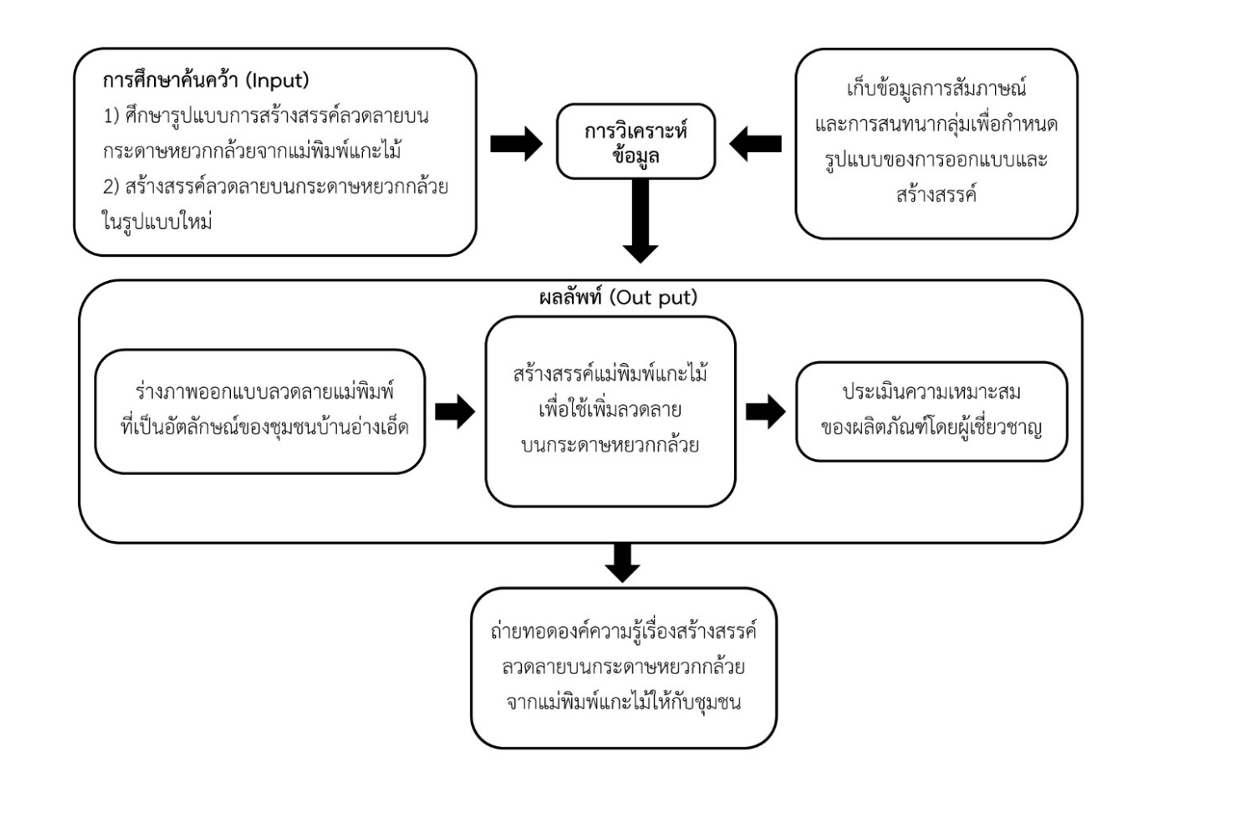
Introduction: The development of local products is crucial for adding value and meeting consumer demands. Chanthaburi Province, with its diverse natural resources, holds great potential for the sustainable advancement of community-based products. In Tok Phrom Subdistrict, banana trunks are transformed into banana sheath paper and further developed into creative products such as photo frames, gemstone boxes, and animal sculptures that reflect the community’s unique identity. However, these products still lack distinctive patterns that appeal to consumers. This research was therefore initiated with the objective of developing new designs using printmaking techniques in order to enhance product value, generate income, and reduce waste materials within the community. Objectives: The research aimed to experiment with pattern creation using woodblock printing on banana paper, to develop novel patterns on banana paper, and to transfer knowledge of woodblock pattern-making to the community through participatory methods. Methodology: The study employed purposive group interviews and evaluated pattern suitability through expert assessment. Data were analyzed using content analysis techniques. Results: The creation of woodblocks provided design guidelines for patterns with community identity. Woodblocks were produced in sizes suitable for printing by dipping them in ink. Conclusion: Developing of banana-sheath paper products through woodblock printing techniques integrates local wisdom with contemporary art. The printing process enhances the clarity and precision of patterns, allowing for the improvement and refinement of banana-sheath paper quality. Additionally, the reusable woodblocks promote sustainable production practices. This creative innovation not only adds economic value but also strengthens the cultural identity of community products and supports their advancement into the sustainable creative market.
Downloads
Article Details
References
Ang-ed Community Forest Development Project. (2020). Banana sheath paper [Online resource]. Retrieved November 11, 2023, from https://shorturl.asia/pcVUQ
Bunlenglol, W., et al. (2022). Clothing design using plant-pattern printed fabric [Online resource]. Retrieved November 11, 2023, from https://shorturl.asia/zcIb4
Chotithammaporn, W. (2023). Handmade paper production from pineapple leaf pulp, rice straw pulp, and bark fiber.
Chuarun, A. (2000). Knowledge about printmaking art. Bangkok: Odeon Store.
Chutaviphat, W. (2002). Folk art. Bangkok: Sippapha.
Hokusai, K. (2021). [Online resource]. Retrieved November 11, 2023, from https://shorturl.asia/XnvUh
Kongkanan, M. (1995). The art of design. Bangkok: Thai Watthana Panich.
Kongthong, K. (2000). Printmaking art in Thailand. Bangkok: O.S. Printing House.
Leesuwan, V. (1995). Traditional handicrafts. Bangkok: Ton-Or Publishing.
Patcharametha, T., & Suthakham, O. (2014). A study on paper production from lathe mango wood waste and its effect on community product development. Journal of the Faculty of Architecture, KMITL, 19(2), pp. 64–80.
Pineapple paper and Takhop paper. (n.d.). [Online resource]. Retrieved November 11, 2023, from https://shorturl.asia/73Nrj
Sirisawasdikul, S. (1986). Pattern design. Bangkok: Odeon Store.
Tangcharoen, V. (1983). Design. Bangkok: Krung Siam Printing.
Vanichakorn, O. (2016). Local product design. Bangkok: Chulalongkorn University Press.
Yodbangtoey, M. (1995). Product design. Bangkok: O.S. Printing House.
