
EVOLUTION AND TRENDS OF 3D MODELING TECHNOLOGIES
Article Sidebar
Main Article Content
Abstract
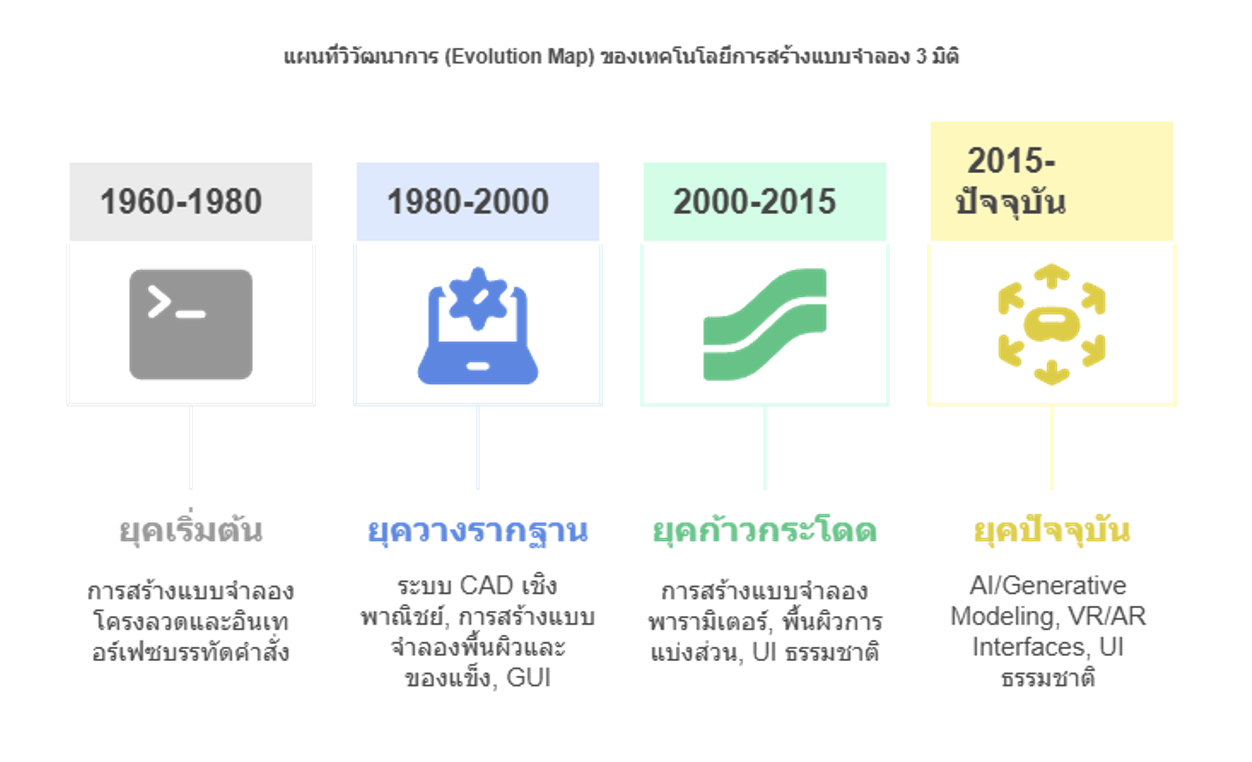
Three-dimensional (3D) modeling technology plays a crucial role in the development of design, engineering, and creative industries across various domains. This article aims to review the evolution of and analyze current trends in 3D modeling technologies, covering the period from the early era of computer graphics in the 1960s to contemporary developments. The study adopts a historical analysis approach combined with a synthesis of relevant scholarly literature, focusing on the progression of core technologies, modeling techniques, and application practices in modern contexts. The analysis highlights the technological transition from wireframe representations to surface and solid modeling, which has significantly improved accuracy and visual realism. It also emphasizes the contributions of computer-aided design (CAD) systems and geometric modeling techniques, such as Non-Uniform Rational B-Splines (NURBS) and subdivision surfaces, in supporting the creation and manipulation of complex geometries. Furthermore, the integration of artificial intelligence and the advancement of user interface design have substantially influenced modeling workflows and user experience. Future trends indicate a shift toward more natural interaction paradigms through virtual reality, augmented reality, and intelligent systems. Nevertheless, challenges remain regarding data standardization across software platforms and the gap between digital design processes and physical manufacturing. This review provides a systematic perspective on the developmental trajectory of 3D modeling technologies and offers insights that may inform future research and technological innovation.
Downloads
Article Details
References
Dyn, N., Levine, D., & Gregory, J. (1990). A butterfly subdivision scheme for surface interpolation with tension control. ACM Transactions on Graphics, 9,(3), 160 - 169. https://doi.org/10.1145/78956.78958
Egelhoff, K., Idzi, P., Bargiel, J., Wyszynska-Pawelec, G., Zapała, J., & Gontarz, M. (2022). Implementation of cone beam computed tomography, digital sculpting and three-dimensional printing in facial epithesis - A technical note. Applied Sciences, 12(23), 11974. https://doi.org/10.3390/app122311974
Egger, B., Smith, W. A. P., Tewari, A., Wuhrer, S., Zollhoefer, M., Beeler, T., Bernard, F., Bolkart, T.,Kortylewski, A., Romdhani, S., Theobalt, C., Blanz, V., & Vetter, T. (2020). 3D morphable face models-Past, present, and future. ACM Transactions on Graphics, 39(5), 157 – 167.https://doi.org/10.1145/3395208
Ghuge, G. D. (2023). 3D Modelling: A review. International Journal of Advanced Research in Science, Communication and Technology (IJARSCT), 3(3), 614 - 623. https://doi.org/10.48175/ijarsct-14377
Giraldi, L., Burberi, M., Morelli, F., & Maini, M. (2021). A new graphic user interface design for 3D modeling software for children. Springer.
Liu, H.T. D., Kim, V. G., Chaudhuri, S., Aigerman, N., & Jacobson, A. (2020). Neural subdivision. ACM Transactions on Graphics, 39(4), 124 – 135. https://doi.org/10.1145/3386569.3392418
Majerik, J., & Jambor, J. (2015). Computer aided design and manufacturing evaluation of milling cutter when high speed machining of hardened steels. 25th DAAAM International Symposium on Intelligent Manufacturing and Automation, 2014. Procedia Engineering, 100, 450-459.
Meshy. (2023). The easiest way to create a 3D model [In Thai]. https://www.meshy.ai
Peng, M., Xing, J., & Wei, L.Y. (2017). Autocomplete 3D sculpting. ACM Transactions on Graphics,37(4), 23 – 43.
Piegl, L. A., & Tiller, W. (1996). The NURBS Book (2nd ed.). Springer.
Schmidt, R., & Singh, K. (2010). Meshmixer: an interface for rapid mesh composition. In SIGGRAPH10: ACM SIGGRAPH 2010 Talks. https://doi.org/10.1145/1837026.1837034
