FACTORS INFLUENCING THE DECISION TO USE GENERATIVE AI FOR STUDENT LEARNING: A CASE STUDY OF THE FACULTY OF MEDICINE SIRIRAJ HOSPITAL
Article Sidebar
Main Article Content
Abstract
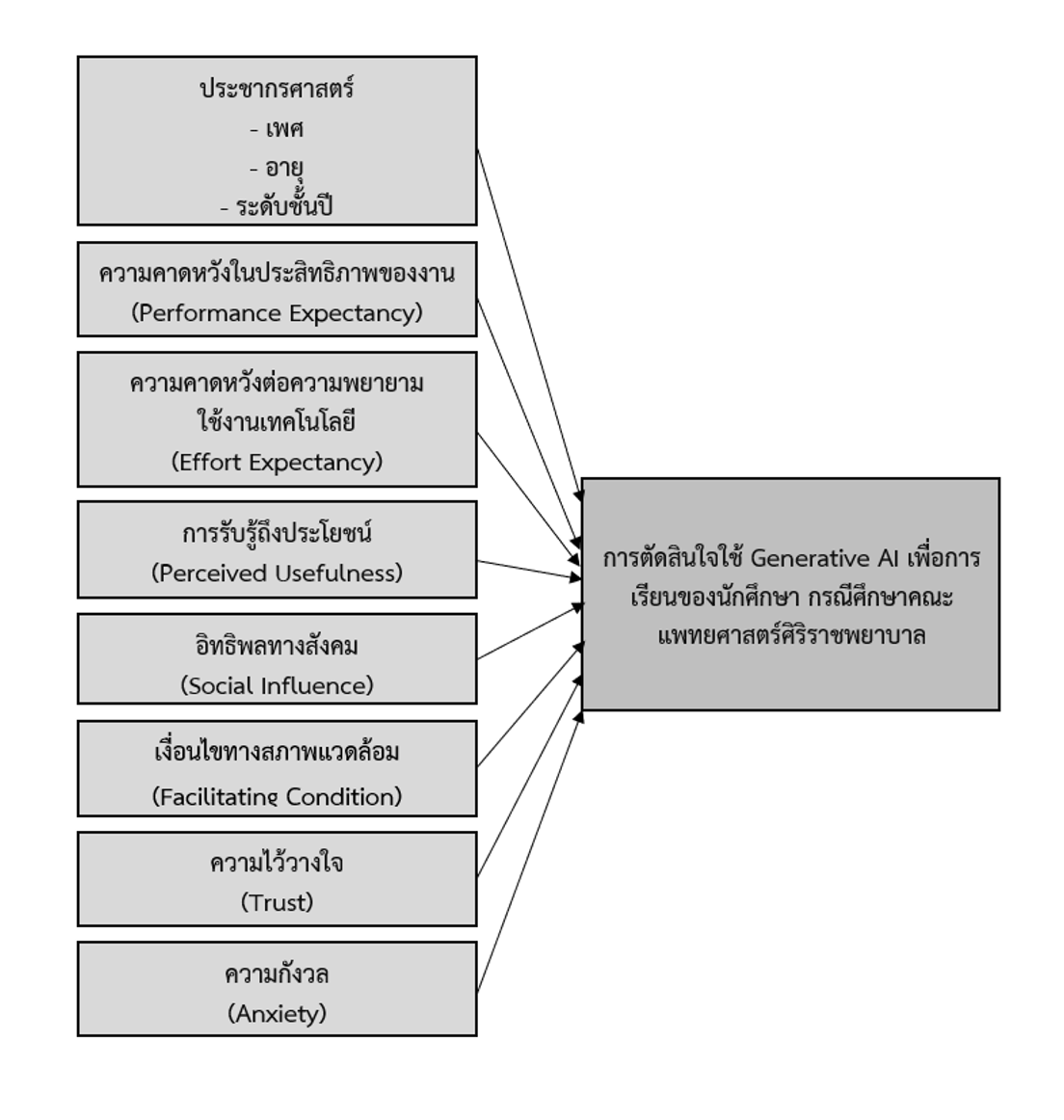
Introduction: The development of artificial intelligence technology, particularly Generative AI, is transforming learning approaches in medical education, which emphasizes high precision and ethics. Despite its potential to enhance learning efficiency, the application of this approach in medical education still raises numerous questions and concerns. Objective: This study examined factors influencing medical students' adoption of Generative AI for learning at the Faculty of Medicine Siriraj Hospital. The research applied the Unified Theory of Acceptance and Use of Technology (UTAUT) framework, extended with trust and anxiety constructs. Method: This quantitative research used a survey method via online questionnaires. The sample consisted of 412 Siriraj medical students with experience using Generative AI. Data was analyzed using Stepwise Multiple Regression. Results: Factors influencing the decision to use Generative AI, in order of importance, are perceived usefulness (strongest positive influence), followed by trust, environmental conditions (negative influence), performance expectancy, anxiety, and social influence (positive influences). All factors explained 65.7% of the variance in usage decisions. Gender significantly influenced adoption intention (p<0.05), with male students demonstrating higher acceptance rates. Age and academic year showed no significant effects. Conclusion: Medical students prioritize the benefits and reliability of technology. Educational institutions should focus on communicating clear benefits, building trust, and develop appropriate support mechanisms to maximize effective AI integration in medical education.
Downloads
Article Details
References
Ajzen, I. (1991). The theory of planned behavior. Organizational Behavior and Human Decision Processes, 50(2), 179–211. https://doi.org/10.1016/0749-5978(91)90020-T
Alkhaaldi, S. M. I., Kassab, C. H., Dimassi, Z., Oyoun Alsoud, L., Al Fahim, M., Al Hageh, C., & Ibrahim, H. (2023). Medical student experiences and perceptions of ChatGPT and artificial intelligence: Cross-sectional study. JMIR Medical Education, 9, e51302. https://doi.org/10.2196/51302
Byrnes, J. P., Miller, D. C., & Schafer, W. D. (1999). Gender differences in risk taking: A meta-analysis. Psychological Bulletin, 125(3), 367–383. https://doi.org/10.1037/0033-2909.125.3.367
Cambre, M. A., & Cook, D. L. (1985). Computer anxiety: Definition, measurement and correlates.Journal of Educational Computing Research, 1(1), 37–54.
Davis, F. D. (1989). Perceived usefulness, perceived ease of use, and user acceptance of information technology. MIS Quarterly, 13(3), 319–340. https://doi.org/10.2307/249008
Fishbein, M., & Ajzen, I. (1975). Belief, attitude, intention, and behavior: An introduction to theory and research. Addison-Wesley.
Igbaria, M., & Parasuraman, S. (1989). A path analytic study of individual characteristics, computer anxiety and attitudes toward microcomputers. Journal of Management, 15(3), 373–388.https://doi.org/10.1177/014920638901500302
Indan, R., Andika, R., Ridwan, M., & Dharma, R. (2016). The effect of usefulness, ease of use, risk, and trust on behavioral intention in the use of internet banking. UPI YPTK Journal of Business and Economic, 1(1), 1–15.
Kotler, P., & Keller, K. L. (2016). Marketing management (15th ed.). Pearson Education.
Kung, T. H., Cheatham, M., Medenilla, A., Sillos, C., De Leon, L., Elepaño, C., Madriaga, M.,Aggabao, R., Diaz-Candido, G., Maningo, J., & Tseng, V. (2023). Performance of ChatGPT on USMLE: Potential for AI-assisted medical education using large language models. PLOS Digital Health, 2(2), e0000198. https://doi.org/10.1371/journal.pdig.0000198
Sallam, M., Barakat, M., Sallam, M., Alkhazaleh, R., Al-Mahzoum, K., Al-Tammemi, A. B., Salim, N. A., AlHadidi, F., Mahafzah, A., Jardaneh, L., Al-Zubi, M., Alsanafi, M., & Malaeb, D. (2024). Anxiety among medical students regarding generative artificial intelligence models: A pilot descriptive study. Computers, 13(4), 31. https://doi.org/10.3390/computers13040031
Sharma, V., Saini, U., Pareek, V., L, S., & Kumar, S. (2023). Artificial intelligence (AI) integration in medical education: A pan-India cross-sectional observation of acceptance and understanding among students. Scripta Medica, 54(4), 343–352. https://doi.org/10.5937/scriptamed54-46267
Tyton Partners. (2023). Time for class 2023: Understanding and responding to generative AI in learning. https://tytonpartners.com/library/time-for-class-2023/
Venkatesh, V., Morris, M. G., Davis, G. B., & Davis, F. D. (2003). User acceptance of information technology: Toward a unified view. MIS Quarterly, 27(3), 425–478.https://doi.org/10.2307/30036540
