GROUP MUSIC THERAPY FOR LONELY ELDERLY AT NANCHANG FUKALAI RECREATIONAL HOME
Article Sidebar
Main Article Content
Abstract
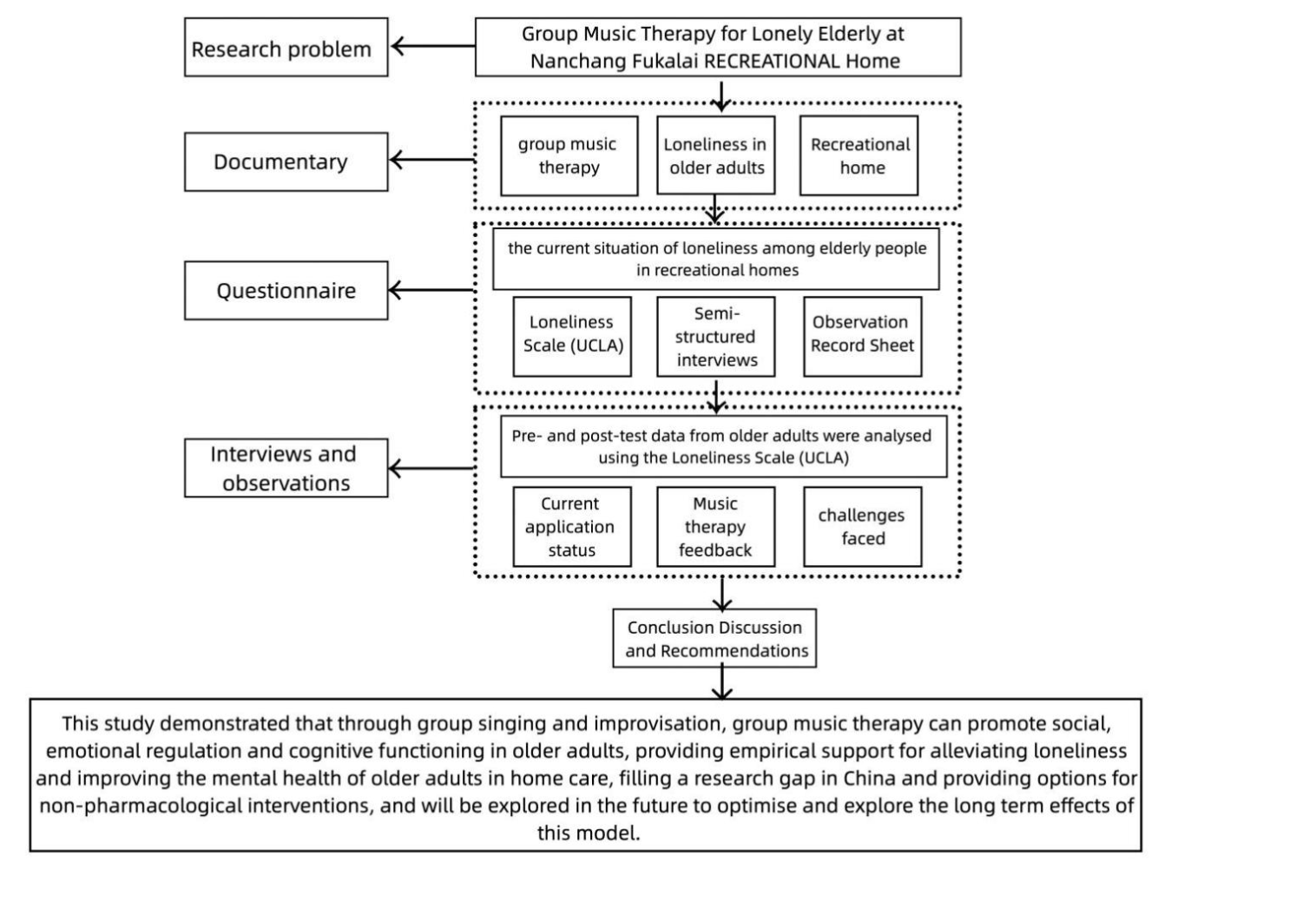
Introduction: In an aging society, loneliness has become a serious problem for the elderly, and group music therapy has emerged as an innovative intervention in the field of geriatric care, providing new ideas to alleviate loneliness in the elderly. Objective: To study group music therapy for lonely elderly people at Nanchang Fukalai Recreation and Nursing Home. Methods: A randomised controlled trial was conducted. Participants were selected for the study following a screening process that employed the UCLA Loneliness Scale. This scale was used to identify older adults aged 60–70 who scored ≥21 on the scale and who reported feelings of loneliness. In conclusion, a total of 16 widowed or divorced older adults residing independently (excluding orphans) were enrolled in the study. Following a process of adjustment for gender and educational background, the participants were divided into two groups, with each group comprising eight participants. The experimental group underwent a two-month programme consisting of 16 group music therapy sessions. Research tools included the UCLA Loneliness Scale (reliability 0.847), an interview guide, and an observation checklist. Results: It was found that the loneliness level of the elderly in the experimental group who received group music therapy decreased significantly (mean value from 50.87 to 36.50, p<0.05) from ‘moderate loneliness’ to ‘mild loneliness’, while there was no significant change in the control group . Conclusion: This study demonstrated that through group singing and improvisation, group music therapy can promote social, emotional regulation and cognitive functioning in older adults, providing empirical support for alleviating loneliness and improving the mental health of older adults in home care, filling a research gap in China and providing options for non-pharmacological interventions, and will be explored in the future to optimise and explore the long term effects of this model.
Downloads
Article Details
References
Amelia, M. M. (1982). Group therapy: A timely strategy for music therapists. Music Therapy Perspectives, 4(4), 66 - 69.
Gao, T. (2007). Basic theory of music therapy. World Book Publishing Co.
Gao, Y. (2023). A study on the generation mechanism of loneliness and intervention strategies for widowed elderly in urban communities from the perspective of life course [Unpublished Master's thesis]. Shanghai University.
Ku, M., Zhou, Q., Zhou, J., Xie, S., & Wu, H. (2020). Effects of loneliness on mild cognitive impairment in community-dwelling older adults. Modern Preventive Medicine, 47(7),1223–1226.
Liao, X., & Liao, S. (2006). Population ageing and community geriatric care services. China Primary Health Care,3(7), 73–75.
Liu, L., & Liu, Y. (2017). Intervention effects of music therapy on elderly patients with dementia. Chinese Journal of Gerontology, 37(5), 1215–1216.
National Statistical Office. (2021). Report of the seventh national population census. China Statistics Press.
Shi, M. (2022). A casework intervention study of nostalgia therapy to improve the cognitive function of older adults with mild cognitive impairment [Unpublished master's thesis]. Northwest University for Nationalities.
Wan, Y. (2021). Group music therapy. Chongqing University Press.
Werner, J., Wosch, T., & Gold, C. (2017). Effectiveness of group music therapy versus recreational group singing for depressive symptoms of elderly nursing home residents: Pragmatic trial. Aging & Mental Health, 21(2), 147–155.
Zuo, S., Wang, Z., & Ye, C. (2024). Systematic review and meta-analysis of the prevalence of loneliness among older adults in China. Military Nursing, 41(9), 1–7.
