PROMOTING NON-MOTORIZED TRANSPORT FOR URBAN SUSTAINABILITY: A FRAMEWORK BASED ON INFRASTRUCTURE ANALYSIS AT BANGKOK TRANSIT HUBS
Article Sidebar
Main Article Content
Abstract
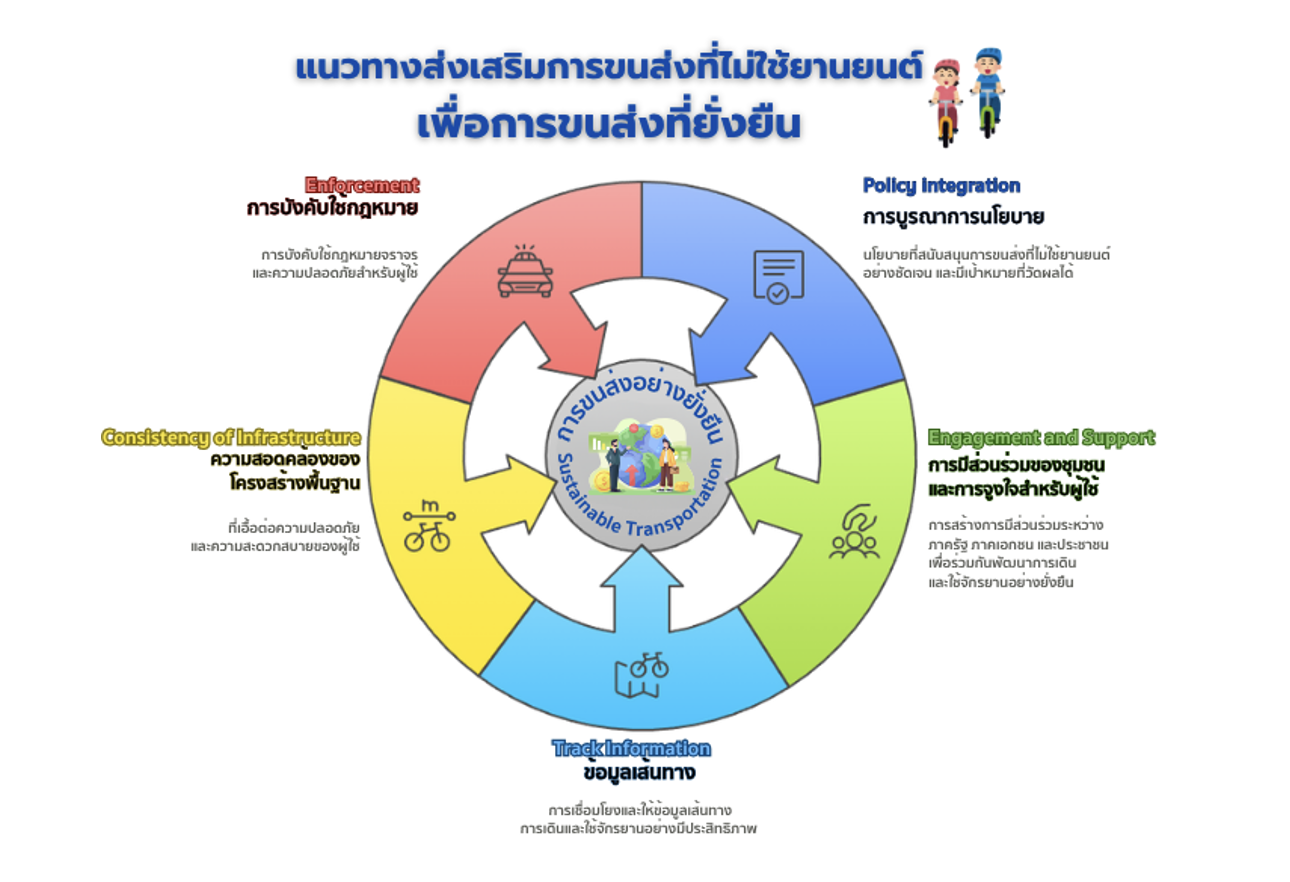
Introduction: Sustainable transportation plays a vital role in reducing environmental impacts, promoting equity, and enhancing quality of life. Previous studies emphasize that the success of NMT depends on the integration of multiple measures, including safe infrastructure, public awareness campaigns, and effective law enforcement. In the context of Thailand, reliance on private vehicles and inadequate NMT infrastructure remain major challenges. Therefore, it is necessary to study and analyze the current state of NMT infrastructure and strategies to promote sustainable non-motorized transportation. Research Objectives: (1) To analyze the conditions of infrastructure that support non-motorized transport (NMT), and (2) To propose integrated strategies for promoting NMT as part of sustainable transportation. Methodology: This study employed a qualitative research approach using both primary and secondary data sources, including laws, textbooks, academic articles, research papers, field surveys, and in-depth interviews with key informants. Results: The findings on non-motorized transport (NMT) infrastructure indicate that the study areas possess locational potential for connecting with key activity hubs and public transportation systems. However, the existing infrastructure does not yet fully support NMT utilization. For sustainable transportation in the Thai context, the findings prioritize walking and cycling as the most feasible NMT modes for strategic promotion within Thailand's urban transit context. Conclusion: Achieving sustainable transportation requires the integration of clear policy frameworks, active community engagement with appropriate incentives, accessible route information, infrastructure, and consistent enforcement of relevant laws.
Downloads
Article Details
References
Akalkotkar, S. S. M. (2015). Promoting Walking and Cycling in Indian Cities: Lessons from Netherlands, Denmark, and Germany. Spandrel, 9,(2), 45-46.
Deakin. (2002). Sustainable Transportation U.S. Dilemmas and European Experiences. Transportation Research Record, 1792(1), 1–11.
Dedele, A., & Miskinyte, A. (2021). Promoting sustainable mobility: a perspective from car and public transport users. International journal of environmental research and public health, 18(9), 4715.
Gudmundsson, H., Hall, R. P., Marsden, G., & Zietsman, J. (2015). Sustainable Transportation. Indicators, Frameworks, and Performance Measurement. Samfundslitteratur.
Gudmundsson, H., Hall, R. P., Marsden, G., & Zietsman, J. (2015). Sustainable Transportation: Indicators, Frameworks, and Performance Management. Springer.
Handy, S., Van Wee, B., & Kroesen, M. (2014). Promoting cycling for transport: research needs and challenges. Transport reviews, 34(1), 4-24.
Litman, T. (2021). Evaluating Transportation Equity: Guidance for Incorporating Distributional Impacts in Transport Planning. Victoria Transport Policy Institute.
Kigozi, J. (2020). Evaluating the Economic Benefits of Non-Motorized Transport Infrastructure (NMT) for Sustainable Development: Case Study: Non-Motorized Transport Pilot Scheme for Kampala City. In Proceedings of the 5 rd. International Conference on Civil Structural and Transportation Engineering (ICCSTE'20) Virtual Conference–November, 148.
Rodrigue, J.-P. (2020). The Geography of Transport Systems (5th ed.). Routledge.
Turner-Brady, R. (2021). An analysis of non-motorized transport: Benefits, challenges, and equitable policy strategies [Unpublished master’s thesis]. University of Washington.
Office of Transport and Traffic Policy and Planning. (2021). Master Plan for the Development of Thailand's Sustainable Transportation System. Ministry of Transport.
Pucher, J., & Buehler, R. (Eds.). (2012). City cycling. MIT press.
Vanderschuren, M., Jennings, G., Khayesi, M., & Mitullah, W. V. (2017). Introduction: Challenges and opportunities for non-motorized transport in urban Africa. Non-motorized transport integration into urban transport planning in Africa, 1-10.
Tazzie, Y. D., Adugna, D., Woldetensae, B., Fryd, O., & Ingvardson, J. B. (2024). Exploring the factors hindering the intention to adopt sustainable transportation options in Addis Ababa, Ethiopia: using structural equation modeling. Frontiers in Sustainable Cities, 6,(14), 35 - 55.
