A MULTISENSORY THEORY OF RHYTHM COGNITION: CONSTRUCTING THE PATENTED COLOR–CODED PEDAGOGY INNOVATION FRAMEWORK FOR DRUM SET EDUCATION IN THE DIGITAL ERA
Article Sidebar
Main Article Content
Abstract
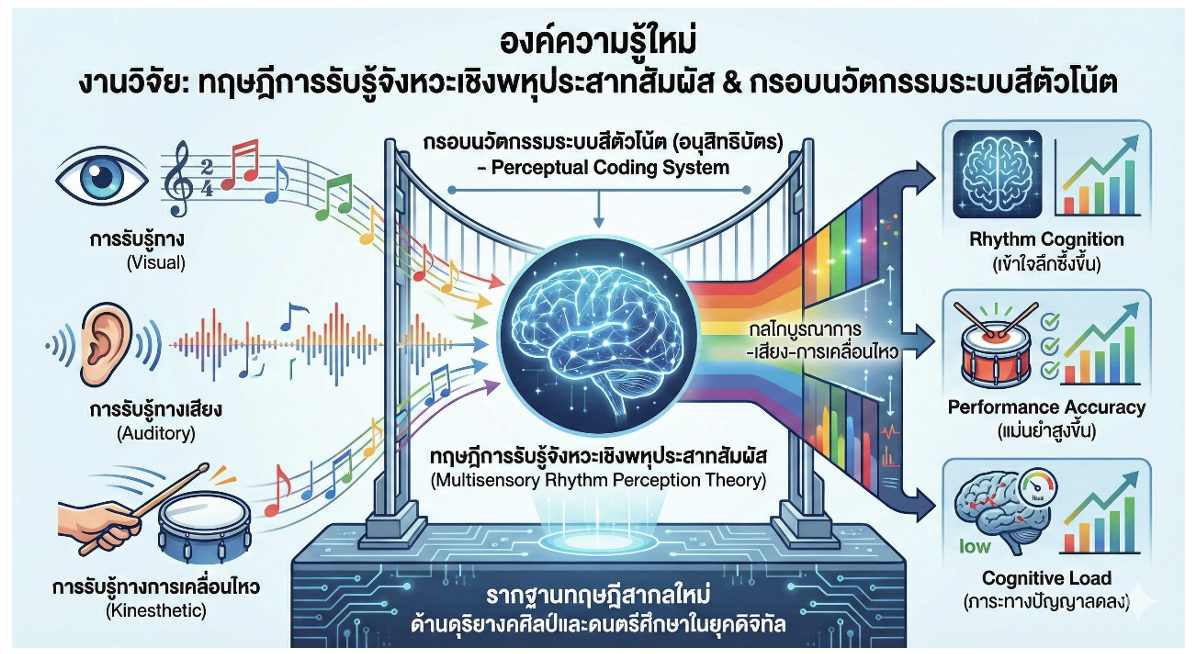
Introduction: "Multisensory Rhythm Perception Theory" through the development and empirical testing of an "Innovative Musical Note Color System Framework (Patent)" designed to function as a Perceptual Coding System to enhance rhythm perception skills, drum practice accuracy, and reduce the cognitive burden on learners in the context of digital music education. Objectives: This research aims to evaluate, examine, and theoretically explain the effectiveness of "Multisensory Rhythm Perception Theory" through the development and empirical testing of an "Innovative Musical Note Color System Framework (Patent)" as a Perceptual Coding System to enhance rhythm perception skills, drum practice accuracy, and reduce the cognitive burden on learners in the context of digital music education. Method: This research employs a quasi-experimental causal methodology combined with explanatory modeling, with a purposive sample of 45 participants. The study involved 30 students with a musical background and 15 students without a musical background. Research instruments included the Rhythm Cognition Test, Drum Performance Accuracy Scale, and Cognitive Load Index, all of which underwent content validity (IOC ≥ .80) and reliability (α > .85) testing. Results: The results indicated that the musical notation system was highly effective in developing all dimensions of musical skills. The music students showed a significant improvement in Rhythm Cognition (t = 19.82, p < .001, d = 3.62), as did the group without a musical background, which saw a growth rate of 74% (t = 14.05, p < .001, d = 3.62). In terms of practical accuracy, the novice learners reduced their temporal errors by more than 60%, consistent with auditory-motor integration theory. Cognitive burden decreased significantly in both groups. The group without a foundation showed a 40.3% reduction in performance according to the Cognitive Load Theory framework. Furthermore, correlation analysis revealed a high correlation between Rhythm Cognition and Accuracy (r = .81, p < .001), while Cognitive Load had a negative correlation with performance (r = –.68, p < .001), reflecting a multisensory mechanism consistent with current theories. Conclusion: all results clearly indicate that the patented musical note color system does not merely serve as a symbolic teaching aid but is a “cognitive coding system” capable of systematically explaining the dynamics of musical learning. It possesses strong theoretical foundations and has the potential to be developed into a “universal theory for drum teaching” in the field of music and music education, supporting application in 21st-century digital learning environments.
Downloads
Article Details
References
Grahn, J. A. (2012). Neural mechanisms of rhythm perception: Current findings and future perspectives. Topics in Cognitive Science, 4(4), 585 - 606.
Hallam, S. (2010). The power of music: Its impact on the intellectual, social and personal development of children and young people. International Journal of Music Education, 28(3), 269 - 289.
Lehmann, A. C., Sloboda, J. A., & Woody, R. H. (2007). Psychology for musicians: Understanding and acquiring the skills. Oxford University Press.
Marozeau, J., Innes-Brown, H., & Blamey, P. J. (2013). The effect of timbre and loudness on melody segregation. Journal of the Acoustical Society of America, 133(1), 468 - 476.
Patel, A. D. (2008). Music, language, and the brain (2nd ed.). Oxford University Press.
Shams, L., & Seitz, A. R. (2008). Benefits of multisensory learning. Trends in Cognitive Sciences, 12(11), 411 - 417.
Spence, C., & Di Stefano, N. (2022). Coloured hearing, colour music, colour organs, and the search for perceptually meaningful correspondences between colour and sound. i-Perception,13(3), 10 - 21.
Sweller, J. (2011). Cognitive load theory. In J. P. Mestre & B. H. Ross (Eds.), Psychology of learning and motivation. Academic Press
Tervaniemi, M. (2017). Music in learning and relearning: The life-span approach.Psychomusicology: Music, Mind, and Brain, 27(3), 223 - 226.
