Music, Terror, Disaster, Healing
DOI:
https://doi.org/10.14456/jucr.2025.1Keywords:
Music, Terror, Disaster, HealingAbstract
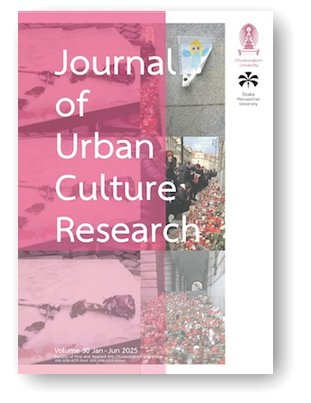
On December 21, 2023, a student of Charles University in Prague, one of the safest places in the world, shot dead 14 academics and students. Amidst omnipresent grief and mourning, the process of coping and “healing” started immediately, manifested in particular through a series of events called the “Month for the Faculty.” This text is based on participation in and research of these activities. The theoretical part uses the Durkheim's concept of piacular rites, the aim of which is to “reconfirm [a] community's solidarity.” Following the recommendations of Bin Xu (2016), we investigated who the main agents were in the decision-making regarding shapes of events, as well as tensions in its negotiations. Performed music of various genres is viewed through the perspective of affect. The following section present the process of renewal at the level of the university and its close neighborhood: events connected with the creation of commemorative sites, which became temporary “lieux de mémoire” (Nora 1989), etc. The third part is focused on two face-to-face communities where music played a crucial role. We look at the negotiations behind the organization of these (musical) events as well as their execution and what was expected from them. In the conclusion, function of music is discussed. It corresponds with what Frith (1996) calls “coming together through music as a performative social and emotional project” which is in agreement with functions of piacular rites.
Downloads
Published
How to Cite
Issue
Section
License

This work is licensed under a Creative Commons Attribution-NonCommercial-NoDerivatives 4.0 International License.
Authors authorize the JUCR to publish their materials both in print and online while retaining their full individual copyright. The copyright of JUCR volumes is retained by Chulalongkorn University.
The views and opinions expressed herein are those of the individual author(s) and do not necessarily reflect the policies or opinions of the Journal (JUCR), it editors and staff, Chulalongkorn University, or Osaka Metropolitan University.