
A Study of Needs and Teaching Approaches for English Elective Courses of Cadets at Chulachomklao Royal Military Academy
Article Sidebar
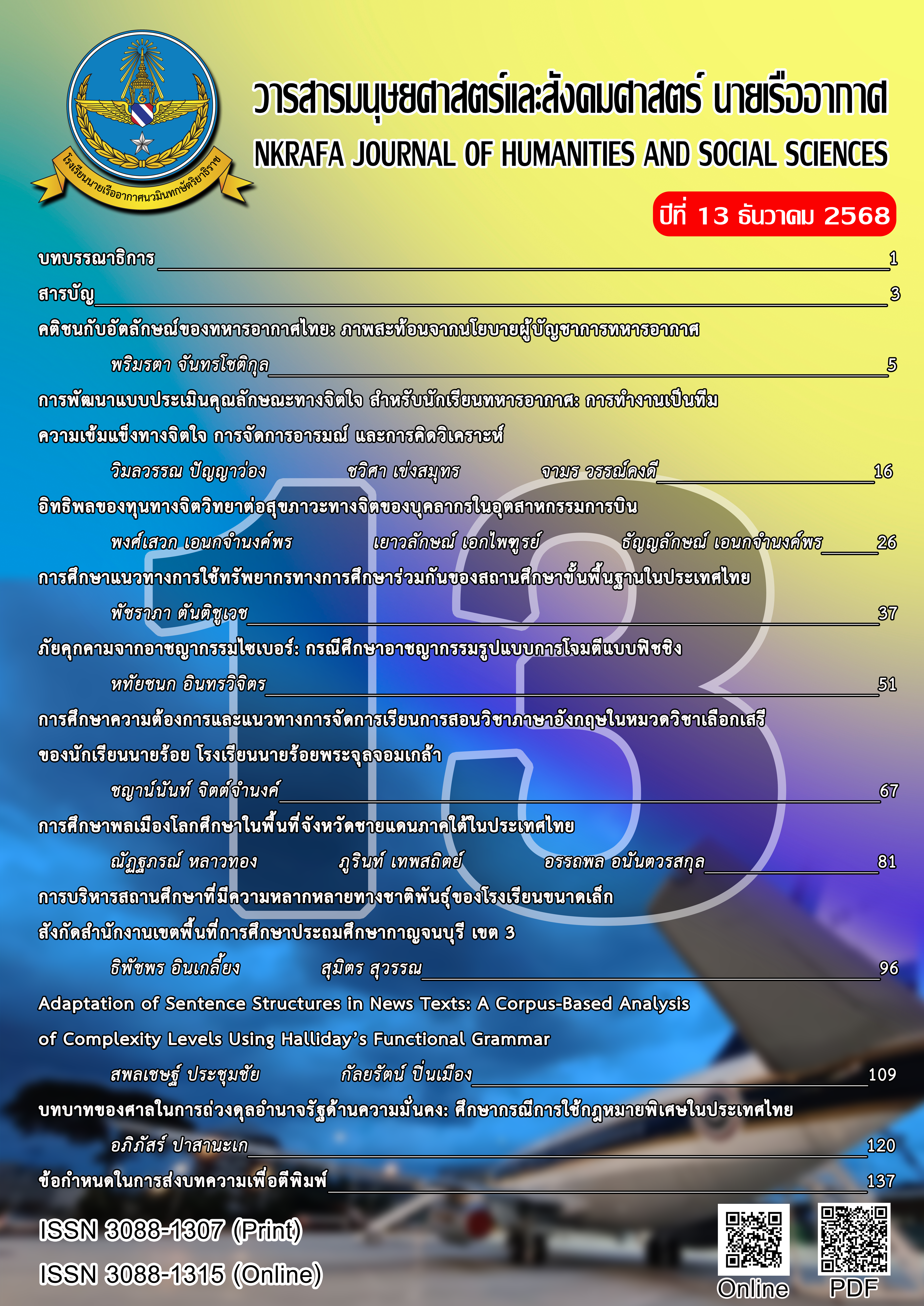
Main Article Content
Abstract
This research aimed to 1) examine the cadets’ need for English elective courses at Chulachomklao Royal Military Academy (CRMA) and 2) study instructional guidelines for English elective courses at CRMA. A mixed-methods research design was employed. The sample consisted of 324 fourth-year cadets enrolled at CRMA in the academic year 2025, selected through purposive sampling. Research instruments included a questionnaire and an interview. Data were analyzed using percentage, mean, frequency, standard deviation, and thematic analysis, which involved organizing and categorizing qualitative responses.
The research findings revealed that:
1) The majority of the sample group, 188 cadets (58.33%), conveyed the highest demand for speaking skills. They expressed the highest need for content and activities related to conversational English for use in daily life (M = 4.44, SD = 0.69), and preferred learning English primarily through various video media (M = 4.40, SD = 0.76). For assessment, their highest preference was for a combination of scoring alongside midterm and final examinations (M = 3.73, SD = 1.00). Thematic grouping of needs identified five key factors influencing the instructional guidelines: 1) the need for practical use in daily life and careers, 2) preferences for engaging and easily accessible learning media, 3) obstacles in English learning, 4) effective learning methods, and 5) expectations for English elective courses.
2) Guidelines for English instruction in elective courses include designing teaching and learning that correspond to military contexts and cadets’ needs in order to develop listening and speaking skills through authentic communicative activities, along with practical assessments. Using various learning materials and conducting activities outside the classroom increase motivation and help cadets learn more effectively.
Article Details

This work is licensed under a Creative Commons Attribution-NonCommercial-NoDerivatives 4.0 International License.
บทความที่ได้รับการตีพิมพ์เป็นลิขสิทธิ์ของวารสารมนุษยศาสตร์และสังคมศาสตร์ นายเรืออากาศ
ข้อความที่ปรากฎในบทความแต่ละเรื่องในวารสารวิชาการเล่มนี้ เป็นความคิดเห็นส่วนตัวของผู้เขียนแต่ละท่าน ไม่เกี่ยวข้องกับโรงเรียนนายเรืออากาศฯ และคณาจารย์ท่านอื่น ๆในโรงเรียนนายเรืออากาศฯ แต่อย่างใด ความรับผิดชอบขององค์ประกอบทั้งหมดของบทความแต่ละเรื่องเป็นของผู้เขียนแต่ละท่าน หากมีความผิดพลาดใด ๆ ผู้เขียนแต่ละท่านจะรับผิดชอบบทความของตนเองแต่เพียงผู้เดียว
References
กรมยุทธการทหารบก. (2563). หนังสือกรมยุทธการทหารบก ที่ กห 0403/11198 เรื่อง ขออนุมัติโครงการเสริมสร้างขีดความสามารถทางด้านภาษาอังกฤษของ ทบ. ระยะเวลา 5 ปี. (29 กรกฎาคม 2563).
กองทัพบก. (2565). คำสั่งกองทัพบก (ลับ) ที่ 1/2565 เรื่อง นโยบายการฝึกอบรมและการศึกษาของกองทัพบก พ.ศ. 2566 – 2570. (13 กันยายน 2565).
เฉลิมพล ศรีหงษ์. (2565). การประเมินความเชื่อมั่นของแบบสอบถาม: จะทำอย่างไรให้ถูกต้อง. วารสารรามคำแหง ฉบับรัฐประศาสนศาสตร์, 5(1), 28–47. สืบค้น จาก https://so16.tcithaijo.org/index.php/RJPA/ article/view/2123
ปองรัตน์ ศรีสืบ และ ปัญชลี วาสนสมสิทธิ์. (2553). การศึกษาความต้องการในการเรียนภาษาอังกฤษเป็นภาษาที่สามของนักเรียนระดับมัธยมศึกษาในโรงเรียนเอกชนสอนศาสนาอิสลามในจังหวัดนราธิวาส. Princess of Naradhiwas University Journal, 2(3). retrieved from https://li01.tci-thaijo.org/index.php/pnujr/article/view/53684
โรงเรียนนายร้อยพระจุลจอมเกล้า. (2025). มคอ.2 รายวิชา: ภาษาอังกฤษเพื่อการสื่อสาร (คศ). http://kmlo.crma.ac.th/qaedu_crma/wp-content/uploads/2025/06/มคอ-2-คศ-ส่ง-สกศ.-22022568-อนุมัติสภาฯ.pdf
สุดาวรรณ โคตรเนตร, สรรพสิริ ส่งสุขรุจิโรจน์, และ กชกร ธิปัตดี. (2568). สภาพปัญหาและความต้องการจำเป็นในการจัดการเรียนรู้ภาษาอังกฤษโดยเน้นกระบวนการอภิปัญญาเพื่อพัฒนาผลการเรียนรู้และคุณลักษณะที่จำเป็นในการเรียนภาษาอังกฤษสำหรับนักเรียนระดับชั้นมัธยมศึกษาตอนต้น. ปัญญา, 32(1), 35–47. สืบค้น จาก https://so06.tci-thaijo.org/index.php/panya-thjo/article/view/281589
Basturkmen, H. (2010). Developing courses in English for specific purposes. Palgrave Macmillan.
Best, J.W. (1977). Research in education (3rd ed.) Englewood Cliffs, NJ: Prentice Hall.
Bremner, N., Sakata, N., & Cameron, L. (2022). The outcomes of learner-centred pedagogy: A systematic review. International Journal of Educational Development, 94, 102649. https://doi.org/10.1016/j.ijedudev.2022.102649
Brown, H. D. (2020). Principles of language learning and teaching (7th ed.). Pearson Education.
Brown, J. D. (2016). Introducing needs analysis. Oxford University Press.
Flowerdew, J., & Peacock, M. (Eds.). (2017). The Routledge handbook of English for specific purposes. Routledge.
Georgiou, G. P. (2025). Enhancing nonnative speech perception and production through an AI-powered application. arXiv. https://arxiv.org/abs/2503.22705
Jantasode, C., & Ruangjaroon, S. (2025). Addressing the role of structured extensive listening among low-proficiency Thai learners of English. Studies in English Language and Education, 12(1), 118-135.
Kapp, K. M. (2021). The gamification of learning and instruction fieldbook: Ideas into practice. John Wiley & Sons.
Krashen, S. D. (2020). Second language acquisition and second language learning. University of Southern California.
Lai, P. Y. (2025). An integrated approach to language teaching and reading strategies. ResearchGate. https://www.researchgate.net/publication/389875460
Ryan, R. M., & Deci, E. L. (2020). Intrinsic and extrinsic motivation from a self-determination theory perspective: Definitions, theory, practices, and future directions. Contemporary Educational Psychology, 61, 101860. https://doi.org/10.1016/j.cedpsych.2020.101860
Schunk, D. H., & Usher, E. L. (2020). Motivation and self-regulation. In R. E. Mayer & P. A. Alexander (Eds.), Handbook of research on learning and instruction (3rd ed., pp. 128-151). Routledge.
Thorne, S. L., & Reinhardt, J. (Eds.). (2024). The Routledge handbook of language learning and technology (2nd ed.). Routledge.
Wang, Y., Chen, X., & Lin, J. (2022). Enhancing speaking confidence through collaborative learning: A study on EFL learners in military contexts. English Language Teaching Journal, 76(2), 150–162. https://doi.org/10.1093/elt/ccac045
Zhang, Y., & Tsung, L. (2021). Foreign language anxiety and oral performance: A study of Chinese EFL learners. Language Teaching Research, 25(4), 493–510. https://doi.org/10.1177/1362168820921895
