
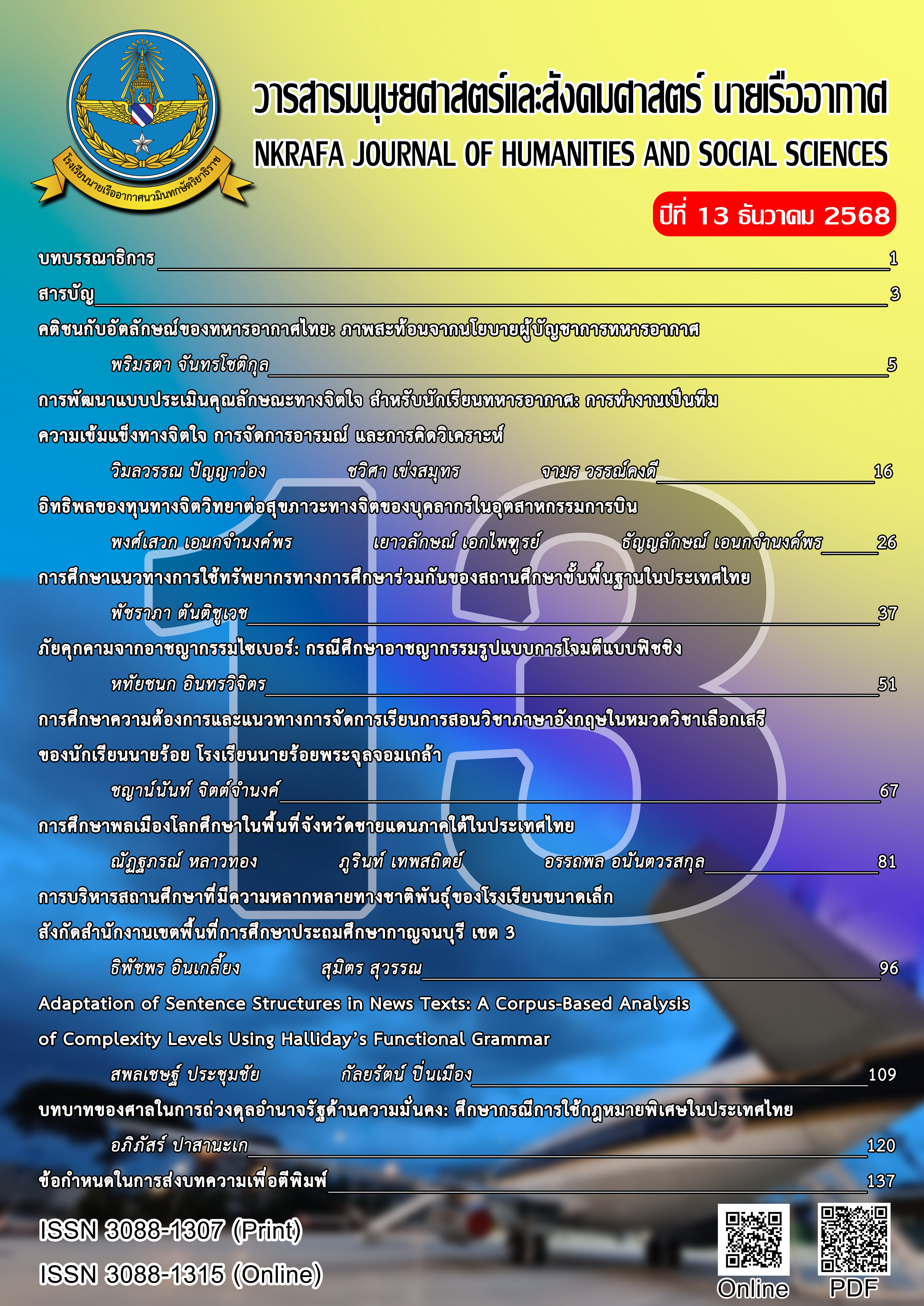
อิทธิพลของทุนทางจิตวิทยาต่อสุขภาวะทางจิตของบุคลากรในอุตสาหกรรมการบิน
Article Sidebar
Main Article Content
บทคัดย่อ
อุตสาหกรรมการบินเป็นอุตสาหกรรมที่มีการแข่งขันและความท้าทายสูงทั้งภาระงาน ความกดดัน และความไม่แน่นอนจากสภาพแวดล้อมต่าง ๆ ส่งผลโดยตรงกับสุขภาวะทางจิตของบุคลากร ดังนั้นทุนทางจิตวิทยาจึงเป็นกลไกสำคัญที่เสริมสร้างความเข้มแข็งภายในตนเพื่อรับมือกับสถานการณ์ดังกล่าว บทความวิจัยนี้มีวัตถุประสงค์เพื่อ 1) ศึกษาระดับทุนทางจิตวิทยาและสุขภาวะทางจิต 2) เปรียบเทียบสุขภาวะทางจิตกับปัจจัยชีวสังคมที่แตกต่างกัน และ 3) ศึกษาอิทธิพลของทุนทางจิตวิทยาและสุขภาวะทางจิตของบุคลากรในอุตสาหกรรมการบิน เลือกตัวอย่าง
แบบหลายขั้นตอน เก็บข้อมูลจากบุคลากรในอุตสาหกรรมการบิน จำนวน 400 คน ด้วยแบบสอบถามจากการใช้สูตรสัมประสิทธิ์แอลฟาของคอนบาร์คพบว่ามีค่าความเที่ยงของทุนทางจิตวิทยา เท่ากับ 0.89 และสุขภาวะทางจิตเท่ากับ 0.88 วิเคราะห์ข้อมูลด้วย ความถี่ ร้อยละ ค่าเฉลี่ย ส่วนเบี่ยงเบนมาตรฐาน ค่าทดสอบสอบทีแบบเป็นอิสระต่อกัน การวิเคราะห์ความแปรปรวนหนึ่งทางและการวิเคราะห์การถดถอยเชิงเส้นแบบพหุคูณ ผลการวิจัย แสดงผลว่า บุคลากรในอุตสาหกรรมการบินมีทุนทางจิตวิทยา (M = 3.94, S.D. = 0.66) และสุขภาวะทางจิต (M = 3.42, S.D. = 0.58) ระดับสูง ในขณะเดียวกันบุคลากรในอุตสาหกรรมการบินที่มีตำแหน่งงาน ประสบการณ์การทำงานต่างกัน มีสุขภาวะทางจิตแตกต่างกันอย่างมีนัยสำคัญทางสถิติที่ระดับ 0.05 และทุนทางจิตวิทยามีอิทธิพลกับสุขภาวะทางจิตของบุคลากรในอุตสาหกรรมการบินอย่างมีนัยสำคัญทางสถิติที่ระดับ 0.01 จึงเขียนสมการทำนาย คือ สุขภาวะทางจิต เท่ากับ 1.88 + 0.27*ความหวัง + 0.12*การรับรู้ความสามารถของตนเอง จึงกล่าวได้ว่าทุนทางจิตวิทยามีบทบาทสำคัญต่อการสร้างเสริมสุขภาวะทางจิตของบุคลากรในอุตสาหกรรมการบิน องค์กรควรให้ความสำคัญกับการพัฒนาศักยภาพทุนทางจิตวิทยาผ่านการสนับสนุนที่เหมาะสม เพื่อส่งเสริมความมั่นคงทางจิตใจและประสิทธิภาพการทำงานของบุคลากรอย่างยั่งยืน
Article Details

อนุญาตภายใต้เงื่อนไข Creative Commons Attribution-NonCommercial-NoDerivatives 4.0 International License.
บทความที่ได้รับการตีพิมพ์เป็นลิขสิทธิ์ของวารสารมนุษยศาสตร์และสังคมศาสตร์ นายเรืออากาศ
ข้อความที่ปรากฎในบทความแต่ละเรื่องในวารสารวิชาการเล่มนี้ เป็นความคิดเห็นส่วนตัวของผู้เขียนแต่ละท่าน ไม่เกี่ยวข้องกับโรงเรียนนายเรืออากาศฯ และคณาจารย์ท่านอื่น ๆในโรงเรียนนายเรืออากาศฯ แต่อย่างใด ความรับผิดชอบขององค์ประกอบทั้งหมดของบทความแต่ละเรื่องเป็นของผู้เขียนแต่ละท่าน หากมีความผิดพลาดใด ๆ ผู้เขียนแต่ละท่านจะรับผิดชอบบทความของตนเองแต่เพียงผู้เดียว
เอกสารอ้างอิง
กิ่งแก้ว ทรัพย์พระวงศ์. (2554). จิตวิทยาเพื่อพัฒนาคุณภาพชีวิต. มหาวิทยาลัยกรุงเทพ.
พงษ์ศักดิ์ ซิมมอนด์ส. (2560). การทดสอบข้อตกลงเบื้องต้นของการวิเคราะห์การถดถอยเชิงเส้นตรง. วารสารวิจัยและพัฒนาหลักสูตร, 7(2), 20-37.
เวิร์คพอยต์. (2566). ทำความรู้จักองค์กรที่ดูแลทุกเรื่องการบิน ให้กับประชาชนและผู้โดยสารชาวไทย. https://workpointtoday.com/caat/#google_vignette
สำนักงานสภาพัฒนาการเศรษฐกิจและสังคมแห่งชาติ. (2561). ยุทธศาสตร์ชาติ 20 ปี (พ.ศ. 2561–2580). https://www.nesdc.go.th/ewt_dl_link.php?nid=6422
Alenezi, A., Alhowaymel, F. M., Abaoud, A. F., & Mostafa, M. H. (2024). The relationship between psychological capital and humanistic caring ability among mental health nurses in Saudi Arabia. BMC Nursing, 23(1), 688.
Ashmawy, I. K. I. (2024). The influence of peer support on employee psychological capital during the COVID-19 pandemic. International Journal of Public Administration, 47(2), 130-140.
Best, J. W. (1970). Consumer behavior (2nd ed). Prentice-Hall.
Cahill, J., Cullen, P., & Gaynor, K. (2023). The case for change: aviation worker wellbeing during the COVID 19 pandemic, and the need for an integrated health and safety culture. Cognition, Technology & Work, 25(1), 75-117.
Carmine, E., & Zeller, R. (1979). Reliability and validity assessment. Sage Publications.
Chakrapani, C. (2011). Statistical reasoning vs. magical thinking: Shamanism as statistical knowledge: Is a sample size of 30 all you need?. http://www.chuckchakrapani.com/articles/pdf/0411chakrapani.pdf
Cinalioğlu, E. A., & Gazioğlu, E. İ. (2022). Psychological well-being in emerging adulthood: The role of loneliness, social support, and sibling relationships in Turkey. Canadian Journal of Family and Youth/Le Journal Canadien de Famille et de la Jeunesse, 14(1), 102-123.
Cronbach, L. J. (1990). Essential of psychological testing. Harper & Row.
Durbin, J., & Watson, G. S. (1950). Testing for serial correlation in least squares regression, I. Biometrika, 37(3-4), 409-428.
Durbin, J., & Watson, G. S. (1951). Testing for serial correlation in least squares regression, II. Biometrika, 38(1-2), 159-179.
Estiri, M., Nargesian, A., Rafiee, S. M., & Hosseinzadeh, M. A. (2024). The impact of psychological capital and organizational justice on flight attendants’ performance: The mediating role of mental health. The International Journal of Aerospace Psychology, 34(4), 225-245.
Han, E. J., & Cai, L. (2024). Impact of psychological capital on organizational commitment and turnover intention: Evidence from Korean flight attendants. Iranian Journal of Public Health, 53(7), 1578.
Heman, O. U., Olabode, O. O., & Amram, A. (2024). Work condition factors and employee engagement: The mediating role of psychological capital. Jurnal Manajemen dan Kewirausahaan, 26(1), 1-12.
Henriques, J., Luís, S., Rivero, C., Gonçalves, S. P., Tavares, L. P., & Marujo, H. Á. (2024). The impact of community resilience, well-being, and community attachment on human service workers’ burnout. Journal of Social Work, 24(3). 1-17. doi.org/10.1177/14680173231225113
Houkamau, C., Lilly, K., Newth, J., Dell, K., Mika, J., & Sibley, C. (2024). Better off solo? Comparative well-being of Māori employers, sole traders and paid employees. Economic and Industrial Democracy, 45(4), 1294-1324. doi.org/10.1177/0143831X231224587
International Air Transport Association. (2020). Aviation benefits beyond borders. https://www.iata.org/en/publications/economic-reports/aviation-benefits-beyond-borders/
International Air Transport Association. (2023). The value of air transport to Thailand. https://www.iata.org/en/iata-repository/publications/economic-reports/the-value-of-air-transport-to-thailand/
Kimbu, A. N., Adam, I., Dayour, F., & de Jong, A. (2023). COVID-19-induced redundancy and socio-psychological well-being of tourism employees: Implications for organizational recovery in
a resource-scarce context. Journal of Travel Research, 62(1), 55-74.
Kim, S., Choi, D., & Nam, H. (2024). Enhancing flight attendants’ well-being: exploring the impact of social exchange relationships and job crafting. Service Business, 18, 503-522.
Kwak, S. G., & Park, S. H. (2019). Normality test in clinical research. Journal of Rheumatic Diseases, 26(1), 5-11.
Li, X., Kan, D., Liu, L., Shi, M., Wang, Y., Yang, X., Wang, J., Wang, L., & Wu, H. (2015). The mediating role of psychological capital on the association between occupational stress and job burnout among bank employees in China. International Journal of Environmental Research and Public Health, 12(3), 2984-3001.
Likert, R. A. (1932). Technique for measurement of attitude. Archives Psychological, 3(1), 42-48.
Lilliefors, H. W. (1967). On the Kolmogorov-Smirnov test for normality with mean and variance unknown. Journal of the American statistical Association, 62(318), 399-402.
Luthans, F., Youssef, C. M., & Avolio, B. J. (2007). Psychological capital: Developing the human competitive edge. Oxford University Press.
Mahipalan, M., & Garg, N. (2024). Does workplace toxicity undermine psychological capital (PsyCap) of the employees? Exploring the moderating role of gratitude. International Journal of Organizational Analysis, 32(3), 476-503.
Mansour, S., & Faysal-Azeem, M. (2024). How do increased job demands resulting from rationalization of costs exhaust flight attendants and push them to leave? An international study. Journal of Air Transport Management, 115, 102539.
Manzanares, S., Martínez-Corts, I., Hernández, A., Demerouti, E., & Medina, F. J. (2024). Crafting behaviours and employees’ and their partners’ well-being: A weekly study. European Journal of Work and Organizational Psychology, 33(3), 340-355.
Maslach, C., & Leiter, M. P. (2016). Understanding the burnout experience: recent research and its implications for psychiatry. World Psychiatry, 15(2), 103-111.
Plessis, C., & Altintas, E. (2024). We can be heroes at work: The relationship between psychological capital, motivation and well-being during the great resignation. Journal of Organizational Change Management. 37(3), 581-602.
Rodrigues, R. I., & Junça Silva, A. (2024). Harmonizing emotions in the workplace: exploring the interaction between emotional intelligence, positive psychological capital, and flourishing. Frontiers in Psychology, 14, 1343043.
Rovinelli, R. J., & Hambleton, R. K. (1977). On the use of content specialists in the assessment of criterion-referenced test item validity. Tijdschrift voor Onderwijsresearch, 2(2), 49–60.
Ryff, C. D., & Keyes, C. M. (1995). The structure of psychological well-being revisited. Journal of Personality and Social Psychology, 69(4), 719-727.
Şeşen, H., Sürücü, L., & Maşlakcı, A. (2019). On the relation between leadership and positive psychological capital in the hospitality industry. International Journal of Business, 24(2), 182-197.
Singhal, H., & Rastogi, R. (2018). Psychological capital and career commitment: The mediating effect of subjective well-being. Management Decision, 56(2), 458-473.
Walsh, F. (2011). Strengthening family resilience (2nd ed.). Guilford Press
Wardani, L. M. I., & Noviyani, T. (2020). Employee well-being as a mediator of correlation between psychological capital and psychological climate. Journal of Educational, Health and Community Psychology, 9(2), 47-63.
Williams, L. J., & Abdi, H. (2010). Fisher’s least significant difference (LSD) test. Encyclopedia of Research Design, 218(4), 840-853.
Yamane, T. (1973). Statistics – An introductory analysis. John Weather Hill.
Ying-Sin, C., Azlan Mohamad, A., & Lo, M. C. (2023). Sustainable human resource management practices in achieving employees’ sustainable performance: Evidence in the hospitality sector. Enlightening Tourism: A Pathmaking Journal. 13(2), 106-137.
Youssef, C. M., & Luthans, F. (2007). Positive organizational behavior in the workplace: The impact of hope, optimism, and resilience. Journal of Management, 33(5), 774–800.
