CONSTRUCTION AND RENOVATION MANAGEMENT DEVELOPMENT OF MONASTERIES IN SRI SAKET PROVINCE
Keywords:
Development, Management, Temple Public Utility WorksAbstract
Objectives of this research article were: 1. To analyze general conditions of monastery construction and renovation management, 2. study the process of monastery construction and renovation management, and 3. To propose the monastery construction and renovation management development in Sisaket Province, conducted by the qualitative research using in-depth interviews with 25 key informants and focus group discussions with 10 participants who were experts. Data were analyzed by descriptive interpretation.
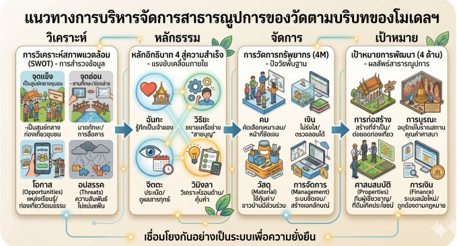
Findings were as follows: 1.General conditions of monastery construction and renovation management showed that monasteries are centers of the community, managed systematically and supported by several sectors. However, some monasteries lacked visionary leadership, sufficient budgets, and adequate support from the government sector. 2. The process of monastery construction and renovation management was found that, in terms of personnel, administrators must possess wisdom, knowledge, and competence, and personnel should be assigned appropriately to their tasks. In terms of finance, budget planning and systematic planning were necessary. In terms of materials, importance should be given to cost-effective use of materials. In terms of management, there should be clear, transparent, and auditable plans, integration with the digital era, and the application of Iddhipada 4; and 3. The development of monastery construction and renovation management in Sisaket Province revealed that, in terms of construction, necessity, appropriateness of space, and actual utilization should be evaluated, while creating distinctive identities. In terms of restoration, deterioration should be inspected and analyzed, religious values considered, and religious arts conserved. In terms of monastery property management, property should be leased or agricultural crops cultivated to generate monastery income. In terms of finance and accounting, knowledgeable and honest persons should be selected, clear financial and accounting systems established, modern technology and tools utilized, and communication skills developed.
References
กรมศิลปากร. (2538). แนวทางการจัดการโบราณสถานในบัญชีมรดกทางวัฒนธรรมของโลก. กรุงเทพฯ: บริษัทสำนักพิมพ์สัมพันธ์จำกัด.
กรมส่งเสริมการปกครองท้องถิ่น กระทรวงมหาดไทย. (2555). มาตรฐานการดูแลโบราณสถาน. กรุงเทพฯ: สำนักมาตรฐานการบริหารงานองค์กรปกครองส่วนท้องถิ่น.
พระครูเวฬุวันพัฒนาทร ชุตินธโร. (2560). การพัฒนาการบริหารจัดการสาธารณูปการของพระสังฆาธิการในจังหวัดพระนครศรีอยุธยา. วารสาร มจร สังคมศาสตร์ปริทรรศน์, 6(2-03), 203–220.
พระปลัดบุญเจิด สุจิตฺโต และคณะ. (2562). รูปแบบการบริหารจัดการที่มีประสิทธิภาพของโรงเรียนพระปริยัติธรรมแผนกสามัญศึกษา. วารสารสันติศึกษาปริทรรศน์ มจร, 7(4), 1048–1057.
พระพรหมกวี (วรวิทย์ คงฺคปญฺโญ). (2555). วินยาพระสังฆาธิการ 2 (พิมพ์ครั้งที่ 4). กรุงเทพฯ: บริษัท สหธรรมิก จำกัด.
พระมหาทวี โพธิเมธี. (2566). การบริหารจัดการงานสาธารณูปการของวัดตามหลักพุทธธรรม. วารสารพุทธนวัตกรรมและการจัดการ, 6(6), 188–197.
พระมหาวิเศษ กนฺตธมฺโม (มั่งคั่ง). (2564). พุทธบูรณาการเพื่อการพัฒนาประสิทธิผลการบริหารงานของเทศบาลเมืองในจังหวัดชลบุรี (ดุษฎีนิพนธ์ปรัชญาดุษฎีบัณฑิต สาขาวิชารัฐประศาสนศาสตร์). พระนครศรีอยุธยา: มหาวิทยาลัยมหาจุฬาลงกรณราชวิทยาลัย.
พระศิริวัฒน์ ปิยสีโล (คงสิริ). (2566). การพัฒนารูปแบบการบริหารจัดการศาสนสถานของวัดในจังหวัดพระนครศรีอยุธยา (ดุษฎีนิพนธ์ปริญญาพุทธศาสตรดุษฎีบัณฑิต สาขาวิชาการจัดการเชิงพุทธ). พระนครศรีอยุธยา: มหาวิทยาลัยมหาจุฬาลงกรณราชวิทยาลัย.
มหาจุฬาลงกรณราชวิทยาลัย. (2539). พระไตรปิฎกฉบับภาษาไทย ฉบับมหาจุฬาลงกรณราชวิทยาลัย. กรุงเทพฯ: โรงพิมพ์มหาจุฬาลงกรณราชวิทยาลัย.
สุธี สุทธิสมบูรณ์ และคณะ. (2541). หลักการบริหาร เบื้องต้น (พิมพ์ครั้งที่ 17). กรุงเทพฯ: สำนักพิมพ์ ก.พ.
Downloads
Published
How to Cite
Issue
Section
License
Copyright (c) 2026 Journal of Interdisciplinary Innovation Review

This work is licensed under a Creative Commons Attribution-NonCommercial-NoDerivatives 4.0 International License.
In order to conform the copyright law, all article authors must sign the consignment agreement to transfer the copyright to the Journal including the finally revised original articles. Besides, the article authors must declare that the articles will be printed in only the Journal of interdisciplinary Innovation Review. If there are pictures, tables or contents that were printed before, the article authors must receive permission from the authors in writing and show the evidence to the editor before the article is printed. If it does not conform to the set criteria, the editor will remove the article from the Journal without any exceptions.