DEVELOPMENT OF COMPETENCY PERFORMANCE OF PERSONNEL OF THE DIRECTORATE OF EDUCATION AND TRAINING, RTAF BY APPLYING BUDDHADHAMMA
Keywords:
Competency Performance, Application, Buddha Dhamma, Personnel of the Directorate of Education and Training RTAFAbstract
This research aimed to: 1. study the performance competence of personnel of the Air Force Education Department, 2. study the factors affecting performance competence, and 3. propose guidelines for competence development by applying Buddhist principles. The research uses a mixed-methods approach. Quantitative research: the sample group was 127 personnel of the Air Force Education Department. The instrument used was a questionnaire with a reliability coefficient of 0.986. The statistics used for data analysis were descriptive statistics and stepwise multiple regression analysis. Qualitative research: the key informants were administrators of the Air Force Education Department, department staff, experts in public administration, and experts in Buddhism, totaling 18 people. The research instrument used was a structured interview guide. Data was analyzed using descriptive content analysis.
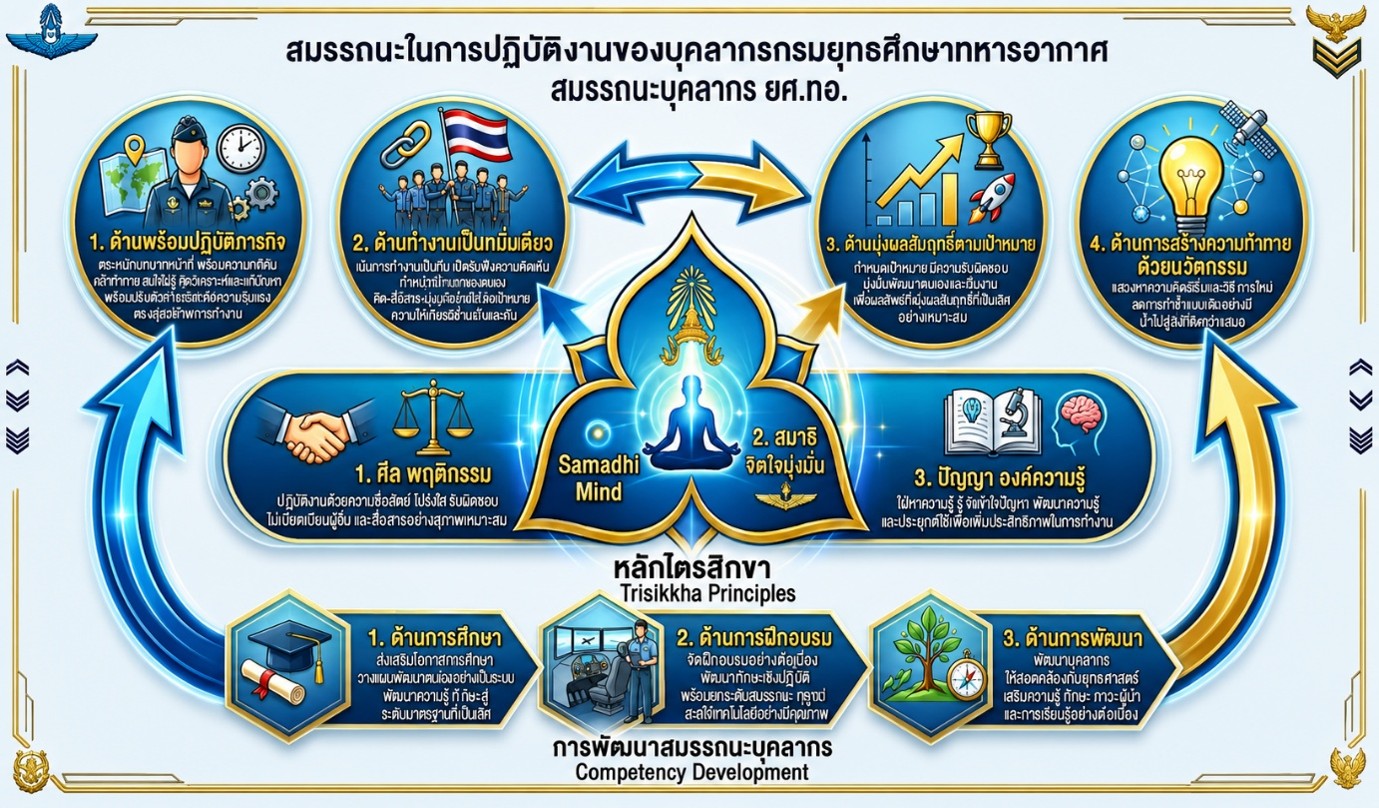
The research results found that 1. the overall performance competence of personnel of the Air Force Education Department was at a high level. When considered by aspect, three aspects were found to be at a high level, in order of mean value: readiness to perform duties, working as a unit, and focusing on achieving goals. and at a moderate level in 1 aspect, namely creating challenges with innovation 2. Factors affecting the performance of personnel of the Air Force Education Department found that the development of personnel competence, consisting of education, development and training, has a statistically significant effect on the performance of personnel of the Air Force Education Department at the 0.01 level and the Threefold Training, consisting of morality, behavior, wisdom, knowledge and concentration, mental focus, has a statistically significant effect on the performance of personnel of the Air Force Education Department at the 0.01 and 0.05 levels and 3. Development of the performance competence of personnel of the Air Force Education Department by applying Buddhist principles found that the Threefold Training should be applied to promote the performance competence of personnel of the Air Force Education Department, namely morality, behavior, concentration, mental focus, wisdom and knowledge.
References
คณะกรรมการพัฒนากำลังพล ทอ. (กพ.ทอ.). (2561). ยุทธศาสตร์การพัฒนากำลังพลกองทัพอากาศ พ.ศ. 2561–2580. กรุงเทพฯ: คณะกรรมการพัฒนากำลังพล ทอ (กพ.ทอ.).
ธนกฤต เกษมสันต์. (2568, 5 พฤศจิกายน). รองหัวหน้าแผนกวิจัยและพัฒนา กองวิจัยและ พัฒนา สำนักบริหารการศึกษา กรมยุทธศึกษา ทหารอากาศ [บทสัมภาษณ์].
พระมหาสุพัฒน์ นนฺทปญฺโญ (ศรียอด). (2563). การพัฒนาศักยภาพพระสอนศีลธรรมในคณะสงฆ์ภาค 1 (ดุษฎีนิพนธ์ปริญญาปรัชญาดุษฎีบัณฑิต สาขาวิชารัฐประศาสนศาสตร์). พระนครศรีอยุธยา: มหาวิทยาลัยมหาจุฬาลงกรณราชวิทยาลัย.
พระสมนึก ธีรปญฺโญ (กลับน้อม). (2564). โมเดลความสัมพันธ์เชิงสาเหตุการพัฒนาสมรรถนะต้นแบบข้าราชการองค์กรปกครองส่วนท้องถิ่นในจังหวัดนนทบุรี (ดุษฎีนิพนธ์ปริญญาปรัชญาดุษฎีบัณฑิต สาขาวิชารัฐประศาสนศาสตร์). พระนครศรีอยุธยา: มหาวิทยาลัยมหาจุฬาลงกรณราชวิทยาลัย.
ภวัต นิตย์โชติ. (2560). การพัฒนาสมรรถนะตามหลักพละ 4 ของบุคลากรปกครองส่วนท้องถิ่นใน จังหวัดสงขลา (ดุษฎีนิพนธ์ปริญญาปรัชญาดุษฎีบัณฑิต สาขาวิชารัฐประศาสนศาสตร์). พระนครศรีอยุธยา: มหาวิทยาลัยมหาจุฬาลงกรณราชวิทยาลัย.
มหาจุฬาลงกรณราชวิทยาลัย. (2539). พระไตรปิฎกฉบับภาษาไทย ฉบับมหาจุฬาลงกรณราชวิทยาลัย. กรุงเทพฯ: โรงพิมพ์มหาจุฬาลงกรณราชวิทยาลัย.
อนุวัต กระสังข์. (2557). การพัฒนาทรัพยากรมนุษย์ในองค์กรตามแนวพุทธภายใต้กระแสบริโภคนิยม (ดุษฎีนิพนธ์ปริญญาปรัชญาดุษฎีบัณฑิต สาขาวิชารัฐประศาสนศาสตร์). พระนครศรีอยุธยา: มหาวิทยาลัยมหาจุฬาลงกรณราชวิทยาลัย.
แอร์บูล สุทธิวรรณ. (2562). กองทัพอากาศกับความมั่นคงของชาติ และสิทธิเสรีภาพของกำลังพลตามระบอบประชาธิปไตย. กรุงเทพฯ: วิทยาลัยศาลรัฐธรรมนูญ สำนักงานศาลรัฐธรรมนูญ.
Yamane, T. (1973). Statistic: An Introductory Analysis (3rd ed.). New York: Harper and Row.
Downloads
Published
How to Cite
Issue
Section
License
Copyright (c) 2026 Journal of Interdisciplinary Innovation Review

This work is licensed under a Creative Commons Attribution-NonCommercial-NoDerivatives 4.0 International License.
In order to conform the copyright law, all article authors must sign the consignment agreement to transfer the copyright to the Journal including the finally revised original articles. Besides, the article authors must declare that the articles will be printed in only the Journal of interdisciplinary Innovation Review. If there are pictures, tables or contents that were printed before, the article authors must receive permission from the authors in writing and show the evidence to the editor before the article is printed. If it does not conform to the set criteria, the editor will remove the article from the Journal without any exceptions.