INTELLIGENCE IN RECRUITMENT AND SELECTION PROCESS: A GUIDELINE FOR DEVELOPING HUMAN RESOURCE MANAGEMENT IN THE DIGITAL AGE
Keywords:
Artificial Intelligence, Recruitment, Human Resource Management, Digital TechnologyAbstract
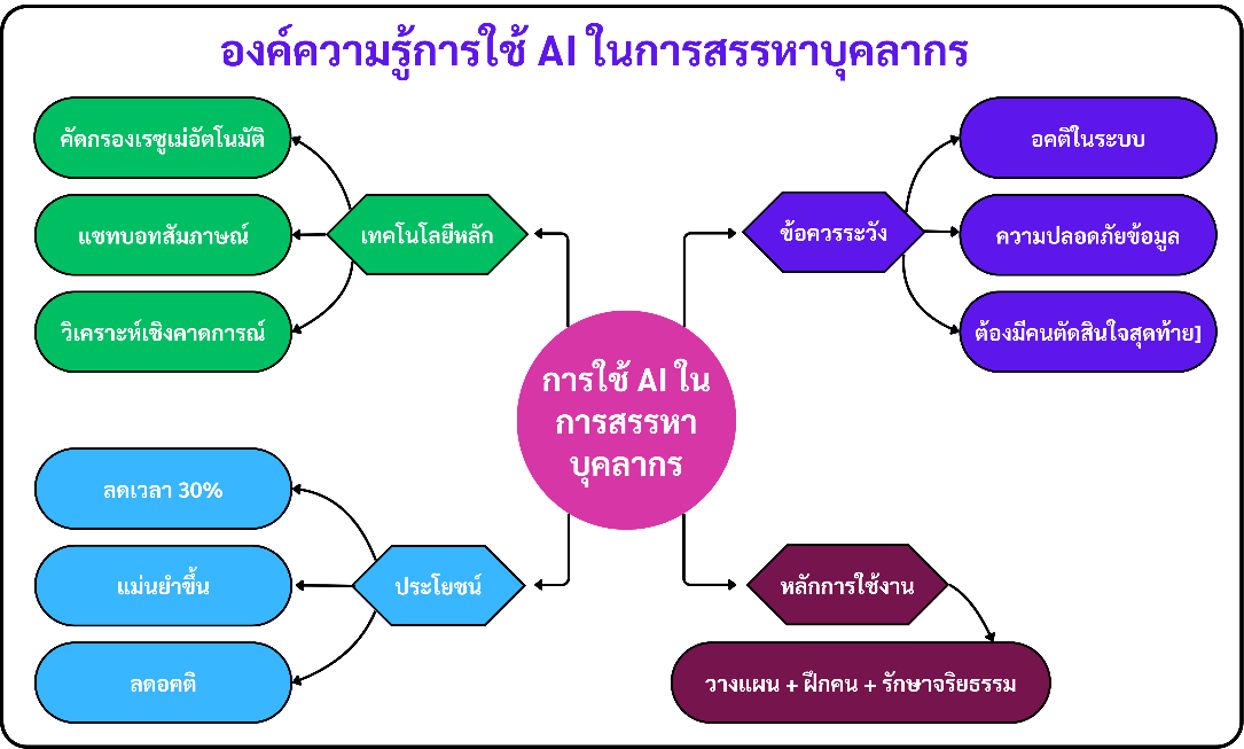
This study aims to analyze the application of artificial intelligence in recruitment and selection processes and examine approaches for developing human resource management in the digital era. Using document analysis and synthesis of relevant research concepts, the study found that artificial intelligence can significantly improve recruitment efficiency by reducing screening time by up to 30%, increasing accuracy in matching candidates with positions, and reducing bias in decision-making. Key benefits include automated resume screening, chatbot communication, in-depth data analysis, and supporting workplace diversity. However, applications still have limitations including algorithmic bias risks, data privacy concerns, and the necessity of maintaining human roles in final decision-making. Effective implementation requires careful planning, personnel training, and adherence to ethical principles.
References
กรุงเทพธุรกิจ. (2568). พนักงาน 58% ยังไม่ปรับตัวใช้ AI ทำงาน แต่องค์กร 74% จะยิ่งใช้ AI พุ่ง. สืบค้นเมื่อ 11 เมษายน 2569 จาก https://www.bangkokbiznews.com/lifestyle/1201928.
นันทยา รื่นกลิ่น. (2568). จริยธรรมในการใช้ปัญญาประดิษฐ์อย่างรับผิดชอบ ในการตัดสินใจด้านทรัพยากรมนุษย์. วารสารวิชาการรัฐศาสตร์และรัฐประศาสนศาสตร์, 7(2), 77–88.
พนิดา อมราวิกรม. (2568). การปรับตัวของทรัพยากรมนุษย์ในยุคปัญญาประดิษฐ์ (AI). วารสารวิชาการรัฐศาสตร์และรัฐประศาสนศาสตร์, 7(1), 72–82.
ลงทุนแมน. (2568). AI ในการสรรหาบุคลากร ยกระดับการเลือกผู้สมัครด้วยข้อมูลที่แม่นยำ. สืบค้นเมื่อ 11 มีนาคม 2569 จาก https://www.longtunman.com/60202.
A.R.E.E. Technology Solutions. (ม.ป.ป.). การใช้ AI และ Machine Learning ในการสรรหาและคัดเลือกบุคลากร. สืบค้นเมื่อ 10 เมษายน 2568 จาก https://areetechnology.com/newblog/the-use-of-ai-and-machine-learning-in-recruitment-and-selection-of-personnel/.
Deloitte. (2020). Human Capital Trends archive Explore past editions of our annual Human Capital Trends reports. Retrieved March 20, 2026, from https://www.deloitte.com/us/en/insights/topics/talent/human-capital-trends/human-capital-trends-archive.html.
Duan, Y. et al. (2019). Artificial intelligence for decision making in the era of Big Data: Evolution, challenges and research agenda. International Journal of Information Management, 48, 63–71.
Eubanks, B. (2022). Artificial Intelligence for HR: Use AI to Support and Develop a Successful Workforce (2nd ed.). London, UK: Kogan Page.
Russell, S. J. & Norvig, P. (2020). Artificial Intelligence: A Modern Approach (4th ed.). Hoboken, NJ: Pearson.
Sharma, A. (2026). AI Recruiting in 2026: How to Hire Faster Without Losing the Human Edge. Retrieved March 20, 2026, from https://recruiterflow.com/blog/ai-recruiting/.
Thakkar, N. (2025). AI in Recruitment: A 2025 Guide to All You Need to Know About the Future of Hiring. Retrieved March 20, 2026, from https://www.oleeo.com/blog/how-is-ai-changing-recruitment/.
Upadhyay, A. K. & Khandelwal, K. (2018). Applying artificial intelligence: Implications for recruitment. Strategic HR Review, 17(5), 255–258.
Downloads
Published
How to Cite
Issue
Section
License
Copyright (c) 2026 Journal of Interdisciplinary Innovation Review

This work is licensed under a Creative Commons Attribution-NonCommercial-NoDerivatives 4.0 International License.
In order to conform the copyright law, all article authors must sign the consignment agreement to transfer the copyright to the Journal including the finally revised original articles. Besides, the article authors must declare that the articles will be printed in only the Journal of interdisciplinary Innovation Review. If there are pictures, tables or contents that were printed before, the article authors must receive permission from the authors in writing and show the evidence to the editor before the article is printed. If it does not conform to the set criteria, the editor will remove the article from the Journal without any exceptions.