LOCAL ADMINISTRATION AND THE DEVELOPMENT OF PEOPLE'S QUALITY OF LIFE
Keywords:
Artificial Intelligence, Personnel Recruitment, Human Resource Management, Digital TechnologyAbstract
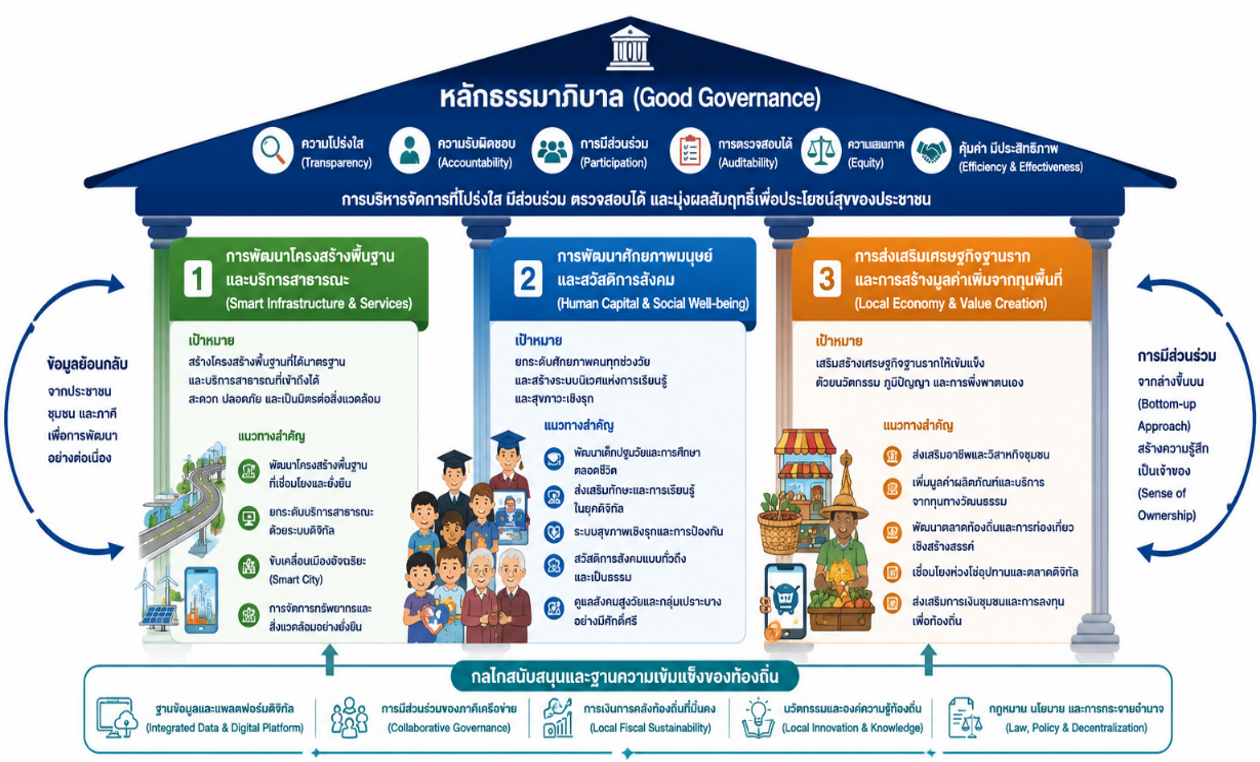
The objective of this academic article was to present guidelines for the management of Local Administrative Organizations (LAOs) in the new era amid a rapidly changing and uncertain environment. It emphasizes that decentralization should not merely involve the delegation of responsibilities under bureaucratic regulations but should serve as a transition toward area-based development that genuinely responds to geographical and cultural diversity. This study employed a documentary research approach by reviewing relevant literature, concepts, theories, and research studies, followed by analysis and synthesis to develop appropriate management guidelines. The findings revealed that the sustainable improvement of citizens’ quality of life is founded on three key pillars: 1. infrastructure and public service development, including digital systems and smart city initiatives; 2. human capital development and social welfare through a lifelong learning ecosystem; and 3. the promotion of the grassroots economy by transforming cultural assets into value-added resources that enhance community self-reliance. However, the success of these pillars depends on adherence to the principles of good governance and the transformation of the role of local administrative organizations from regulators to public service providers that emphasize bottom-up participation. Such an approach fosters citizens’ sense of ownership, which serves as a crucial foundation for reducing inequality and strengthening grassroots democracy in a sustainable manner.
References
คำนาย อภิปรัชญาสกุล (2567). เศรษฐกิจพอเพียง. กรุงเทพฯ: โฟกัสมีเดีย แอนด์ พับลิชชิ่ง.
ชิษณุพงศ์ ทองพวง. (2569). การบริหารจัดการเพื่อการเปลี่ยนผ่านทางดิจิทัล. กรุงเทพฯ: บริษัท สยามจุลละมณฑล จำกัด.
ประเวศน์ มหารัตน์สกุล. (2566) .กลยุทธ์การวางแผนและการจัดการ. กรุงเทพฯ: Greatidea.
พิชาภพ พันธุ์แพ. (2568). ทฤษฎีผู้นำและการปฏิบัติ. กรุงเทพฯ: บริษัท สยามจุลละมณฑล จำกัด.
วัชรมน จันรอง และคณะ. (2564). การมีส่วนร่วมทางการเมืองระดับท้องถิ่นของประชาชนในองค์การบริหารส่วนตำบลบ้านเล่า อำเภอเมืองชัยภูมิ จังหวัดชัยภูมิ. Journal of Modern Learning Development, 6(5), 142–154.
สมคิด บางโม. (2568). องค์การและการจัดการ. กรุงเทพฯ: ซีเอ็ดยูเคชั่น.
สุริยะ มาธรรม (2568). รัฐประศาสนศาสตร์ร่วมสมัย. พระนครศรีอยุธยา: มหาวิทยาลัยมหาจุฬาลงกรณราชวิทยาลัย.
Daft, R. L. (2015). Organization Theory and Design (12th ed.). Boston. MA: Cengage Learning.
Kotter, J. P. (1996) Leading Change. Harvard Business School Press, Boston: Harvard Business School Press.
Mintzberg, H. (1979). The Structuring of Organizations: A Synthesis of the Research. Englewood Cliffs NJ: Prentice Hall.
Downloads
Published
How to Cite
Issue
Section
License
Copyright (c) 2026 Journal of Interdisciplinary Innovation Review

This work is licensed under a Creative Commons Attribution-NonCommercial-NoDerivatives 4.0 International License.
In order to conform the copyright law, all article authors must sign the consignment agreement to transfer the copyright to the Journal including the finally revised original articles. Besides, the article authors must declare that the articles will be printed in only the Journal of interdisciplinary Innovation Review. If there are pictures, tables or contents that were printed before, the article authors must receive permission from the authors in writing and show the evidence to the editor before the article is printed. If it does not conform to the set criteria, the editor will remove the article from the Journal without any exceptions.