SANGAHAVATTHU 4: A BUDDHIST INTEGRATED APPROACH TO SERVICE EXCELLENCE
Keywords:
Sangahavatthu 4, Service Mind, Service Quality, Service ExcellenceAbstract
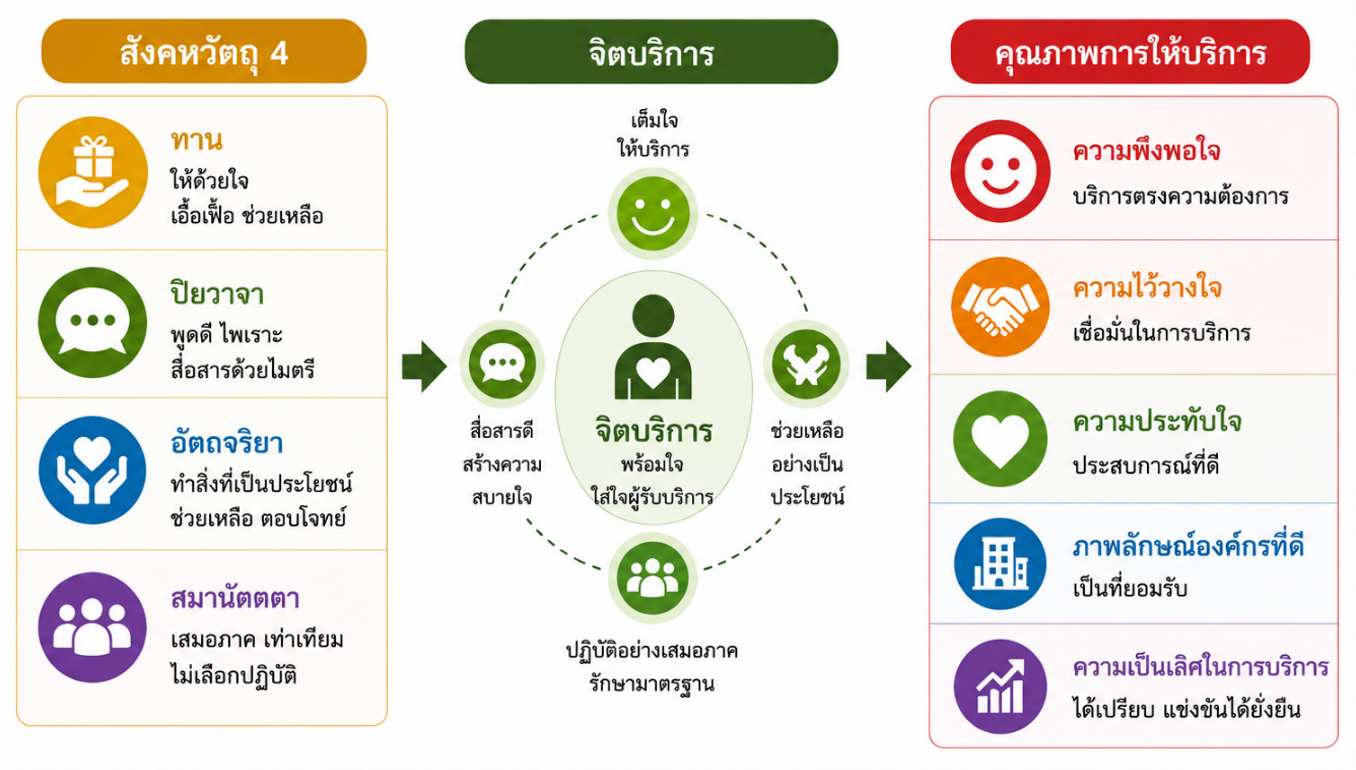
This academic article aims to review and synthesize the concepts of service mind, service quality, and Sangahavatthu 4 in order to propose a Buddhist-integrated framework for service excellence. The article is based on documentary study and synthesis of relevant academic literature, focusing on the relationship between service behavior, customers’ perceived service quality, and Buddhist principles. The synthesis indicates that service mind is an essential attribute of service providers, expressed through willingness, politeness, attentiveness, emotional control, and appropriate responses to service recipients’ needs. Service quality, meanwhile, is determined by the recipients’ perception of service outcomes, service processes, and service behaviors. When integrated with Sangahavatthu 4, dana represents generosity and willingness to help; piyavaca represents polite and appropriate communication; atthacariya represents beneficial action toward service recipients; and samanattata represents equitable and consistent conduct. The new knowledge proposed in this article is that Sangahavatthu 4 can be interpreted as a behavioral mechanism for developing a Buddhist-integrated service mind, which contributes to service quality, satisfaction, trust, and a positive organizational image.
References
กระทรวงพาณิชย์. (2567). แนวโน้มธุรกิจบริการกับผู้บริโภคยุคใหม่. สืบค้นเมื่อ 26 เมษายน 2569 จาก https://www.moc.go.th/th/gallery/article/detail/id/5/iid/387.
คำนาย อภิปรัชญาสกุล. (2557). การบริการลูกค้า. กรุงเทพฯ: โฟกัสมีเดียแอนด์พับลิชชิ่ง.
จินตนา เตชะมนตรีกุล และคณะ. (2567). หลักสังคหวัตถุ 4 กับการให้บริการในหน่วยบริการปฐมภูมิ. วารสารสหเวชศาสตร์, 9(2), 86-99.
ชมพู เนินหาด และคณะ. (2563). จิตบริการสู่งานเป็นเลิศ: บทบาทบุคลากรสายสนับสนุน. วารสารวิทยาลัยพยาบาลพระจอมเกล้า จังหวัดเพชรบุรี, 3(2), 33–45.
ตรีเพ็ชร์ อ่ำเมือง. (ม.ป.ป.). คู่มือ-เทคนิคการให้บริการด้วยใจ. นครปฐม: งานเลขานุการกิจและสภาคณาจารย์ กองบริหารงานทั่วไป สำนักงานอธิการบดี มหาวิทยาลัยมหิดล.
บุญสิริ ชวลิตธำรง. (2529). ธรรมโอสถ. กรุงเทพฯ: อมรินทร์การพิมพ์.
พระครูธรรมธร เดโช ฐิตเตโช (สำเร็จ). (2564). ความสำคัญและความเป็นมาของสังคหวัตถุ 4. วารสารธรรมเพื่อชีวิต, 27(1), 1–10.
พระพรหมคุณาภรณ์ (ป.อ. ปยุตโต). (2551). พจนานุกรมพุทธศาสน์ ฉบับประมวลศัพท์ (พิมพ์ครั้งที่ 11). กรุงเทพฯ: เอส.อาร์. พริ้นติ้ง แมส โปรดักส์.
มนต์จรัส วัชรสิงห์ และคณะ. (2558). จิตบริการและแรงจูงใจในการทำงานที่พยากรณ์ประสิทธิภาพการให้บริการของพยาบาล. วารสารวิชาการศิลปศาสตร์ประยุกต์, 8(2), 115-131.
มหาจุฬาลงกรณราชวิทยาลัย. (2539). พระไตรปิฎกฉบับภาษาไทย ฉบับมหาจุฬาลงกรณราชวิทยาลัย. กรุงเทพฯ: โรงพิมพ์มหาจุฬาลงกรณราชวิทยาลัย.
รมย์ฤดี เวสน์. (2554). การพัฒนารูปแบบการฝึกอบรมตามแนวคิดการเรียนรู้สู่การเปลี่ยนแปลงและทฤษฎีการเห็นคุณค่าในตนเองเพื่อเสริมสร้างจิตบริการสำหรับพนักงานสายการบิน (วิทยานิพนธ์ปริญญาครุศาสตรดุษฎีบัณฑิต สาขาวิชาการศึกษานอกระบบโรงเรียน). กรุงเทพฯ: จุฬาลงกรณ์มหาวิทยาลัย.
ศมนภร เชื้อชาติ. (2567). จิตบริการที่ส่งผลต่อประสิทธิภาพในการบริการของพนักงานเทศบาลตำบลดอนหัวฬ่อ อำเภอเมืองชลบุรี จังหวัดชลบุรี (งานนิพนธ์ปริญญาบริหารธุรกิจมหาบัณฑิต สาขาวิชาบริหารธุรกิจ). ชลบุรี: มหาวิทยาลัยบูรพา.
ศิริพร วิษณุมหิมาชัย. (2548). การสร้างความประทับใจแก่ลูกค้าด้วยคุณภาพและคุณค่าในงานบริการ. สืบค้นเมื่อ 26 เมษายน 2569 จาก https://shorturl.asia/FP9ry.
สมิต สัชฌุกร. (2542). การต้อนรับและบริการที่เป็นเลิศ (พิมพ์ครั้งที่ 4). กรุงเทพฯ: สายธาร.
______. (2550). ศิลปะการให้บริการ. กรุงเทพฯ: สายธาร.
สุกัญญา จันใด. (2561). การพัฒนาโมเดลการวัดจิตบริการของนักศึกษาวิทยาลัยการสาธารณสุขสิรินธร (วิทยานิพนธ์ปริญญาวิทยาศาสตรมหาบัณฑิต สาขาวิชาวิจัย วัดผล และสถิติการศึกษา). ชลบุรี: มหาวิทยาลัยบูรพา.
อาภรณ์ ภู่วิทยพันธุ์.(2549). มัดใจลูกค้าด้วยสุดยอดการบริการ. กรุงเทพฯ: เนชั่นบุ๊คส์ อินเตอร์.
Gronroos, C. (1990). Service Management and Marketing: Managing the Moments of Truth in Service Competition. Singapore: Lexington Books, Lexington.
Hennig-Thurau, T. (2004). Customer orientation of service employees. International Journal of Service Industry Management, 15, 460-478.
Kalia, P. & Paul, J. (2021). E-service quality and e-retailers: Attribute-based multi-dimensional scaling. Computers in Human Behavior, 115, 106608.
Parasuraman, A. et al. (1985). A Conceptual Model of Service Quality and Its Implications for Future Research. Journal of Marketing, 49, 41-50.
Rust, R. T. & Oliver, R. L. (1994). Service quality: Insights and managerial implications from the frontier. In R. T. Rust & R. L. Oliver (Eds.), Service quality: New directions in theory and practice (pp. 1–19). Thousand Oaks, CA: Sage Publications.
Wisher, J. D. & Corney, W. J. (2001). Comparing practices for capturing bank customer feedback – Internet versus traditional banking. Benchmarking: An International Journal, 8(3), 240-250.
Downloads
Published
How to Cite
Issue
Section
License
Copyright (c) 2026 Journal of Interdisciplinary Innovation Review

This work is licensed under a Creative Commons Attribution-NonCommercial-NoDerivatives 4.0 International License.
In order to conform the copyright law, all article authors must sign the consignment agreement to transfer the copyright to the Journal including the finally revised original articles. Besides, the article authors must declare that the articles will be printed in only the Journal of interdisciplinary Innovation Review. If there are pictures, tables or contents that were printed before, the article authors must receive permission from the authors in writing and show the evidence to the editor before the article is printed. If it does not conform to the set criteria, the editor will remove the article from the Journal without any exceptions.