STRUCTURAL LOOPHOLES OF AGE CRITERIA IN THAI CRIMINAL LAW AND MEDICAL FITNESS ASSESSMENT IN JUVENILE SERIOUS OFFENSE CASES
Keywords:
Juvenile Criminal Responsibility, Age Limit, Forensic Psychiatry, Criminal Responsibility CapacityAbstract
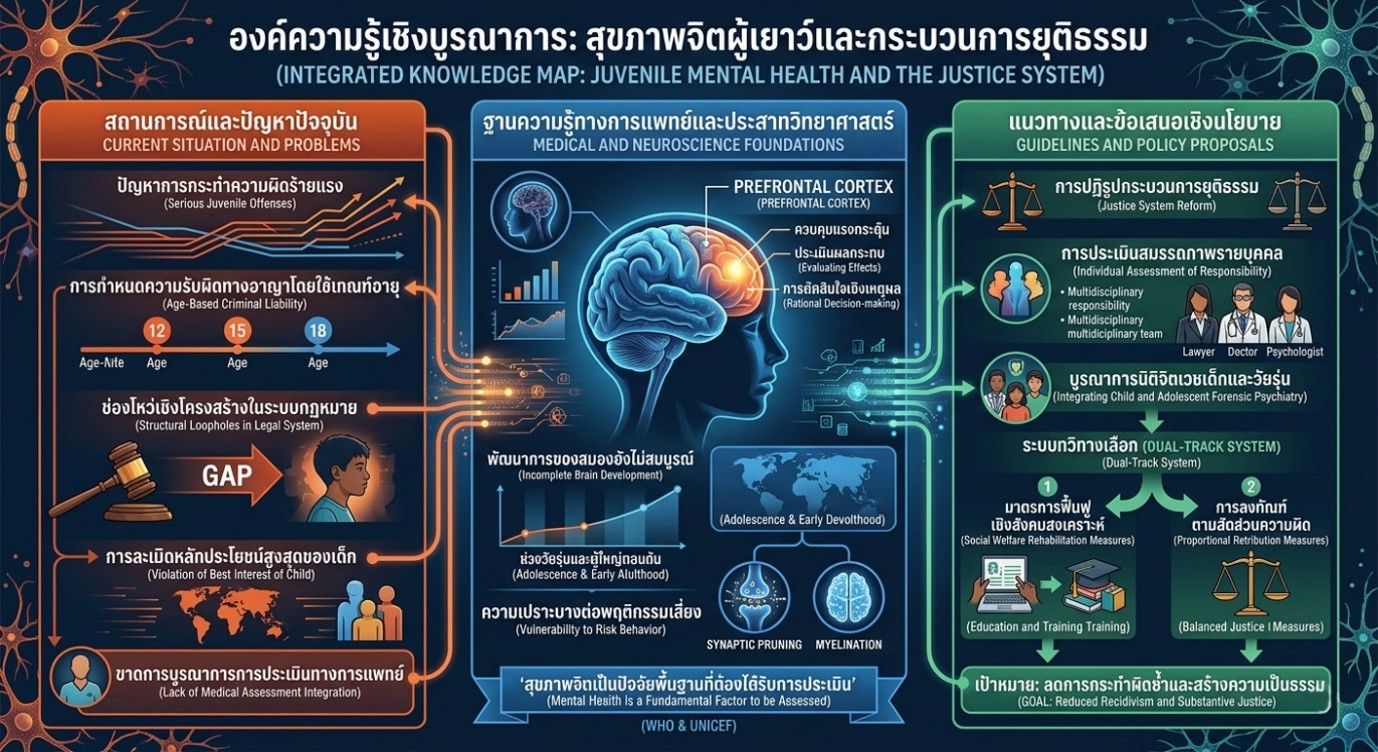
analyzes the relationship between medical fitness concepts and loopholes in age-based criminal responsibility for juvenile offenders in serious crimes in Thailand. Following the enactment of the Criminal Code Amendment Act (No. 29) B.E. 2565 (2022), which raised the minimum age of criminal responsibility from 10 to 12 years to align with international human rights standards, relying solely on chronological age has created structural loopholes. This is particularly evident in heinous crimes and instances where minors are exploited by criminal networks as tools to evade law enforcement. The study reveals that neuroscientific evidence clearly demonstrates that the prefrontal cortex responsible for impulse control and long-term decision-making remains immature until early adulthood (approximately 23–25 years old) through the processes of synaptic pruning and myelination. Consequently, cognitive development and emotional maturity vary significantly among individual minors. Furthermore, the steady increase in juvenile recidivism rates in Thailand from 2019 to 2022 highlights the limitations of current rehabilitation measures, which fail to balance child protection with victim remedy and public safety. Therefore, this article proposes a reform of the Thai juvenile justice system, shifting from rigid age limits to a forensic psychiatry framework that evaluates individual criminal responsibility capacity. This approach requires a multidisciplinary mechanism involving legal, medical, and psychological professionals. Additionally, adopting the Dual-Track System recommended by the UNODC would integrate proportional retributive justice with social welfare rehabilitation. This system would allow serious juvenile offenses to be prosecuted under the adult criminal justice system under specific conditions, ultimately enhancing substantive justice and restoring public confidence.
References
ยุทธชัย ด้วงสวัสดิ์ . (2566). ปัญหาการก่ออาชญากรรมของเด็กและเยาวชนกับมาตรการลงโทษ. วารสารวิชาการนิติศาสตร์ มหาวิทยาลัยทักษิณ, 11(1), 123–136.
ประภาพร สมพร และพิชญา เหลืองรัตนเจริญ. (2568). การกระทำความผิดของเด็ก: ศึกษากรณีตามประมวลกฎหมายอาญา มาตรา 74. วารสารสังคมศาสตร์ นิติรัฐศาสตร์, 9(1), 54–76.
ปัทมาภรณ์ วันแก้ว และคณะ. (2568). การเพิ่มประสิทธิภาพการดำเนินงานด้านนิติจิตเวชเพื่อป้องกันการกระทำผิดซ้ำของผู้ป่วยจิตเวช. วารสารพยาบาลตำรวจและวิทยาศาสตร์สุขภาพ, 17(1), 152–163.
พิมพ์สุรางค์ ชนินทรลีลา. (2565). การยกเว้นความรับผิดในทางอาญาตามประมวลกฎหมายอาญา มาตรา 74 (เอกัตศึกษาปริญญานิติศาสตรมหาบัณฑิต สาขาวิชานิติศาสตร์). กรุงเทพฯ: จุฬาลงกรณ์ราชวิทยาลัย.
สถาบันเพื่อการยุติธรรมแห่งประเทศไทย (องค์การมหาชน). (2566). เมื่อเด็กคนหนึ่งกระทำความผิด .. เส้นทางสู่กระบวนการยุติธรรมและการให้ความยุติธรรมให้กับผู้เสียหาย. สืบค้นเมื่อ 18 กุมภาพันธ์ 2569, จาก https://www.tijthailand.org/article/detail/juvenile-justice.
สำนักงานกิจการยุติธรรม. (2565). พระราชบัญญัติแก้ไขเพิ่มเติมประมวลกฎหมายอาญา (ฉบับที่ 29) พ.ศ. 2565 เกี่ยวกับเกณฑ์อายุเด็กในกระบวนการยุติธรรม. สืบค้นเมื่อ 18 กุมภาพันธ์ 2569 จาก https://www.oja.go.th/wp-content/uploads/2022/05/1-250565_law-child.pdf.
เอกอนันต์ จำปา. (2553). กระบวนการยุติธรรมเชิงสมานฉันท์ในชั้นพนักงานสอบสวน: ศึกษาเฉพาะกรณีความผิดอาญาเกี่ยวกับเด็กและเยาวชน (การศึกษาค้นคว้าอิสระปริญญานิติศาสตรมหาบัณฑิต สาขาวิชานิติศาสตร์). นนทบุรี: มหาวิทยาลัยสุโขทัยธรรมาธิราช.
Casey, B. J. (2008). The adolescent brain. Annals of the New York Academy of Sciences, 1124(1), 111–126.
European Parliament Policy Department for Citizens’ Rights and Constitutional Affairs. (2025). Recruitment of minors into organised crime. Retrieved 18 February 2026, from https://www.europarl.europa.eu/thinktank/en/document/EPRS_BRI(2025)772903.
Getzen et al. (2021). Rehabilitation Prioritized via Juvenile Court for California Youth under Age 16. Journal of the American Academy of Psychiatry and the Law, 49(4), 623-625.
Guy-Evans, O. (2025). Guy-Evans, O. (2025). When does the prefrontal cortex fully develop?. Retrieved 18 February 2026, from https://shorturl.asia/NOxpg.
Inter-American Commission on Human Rights. (2011). Juvenile Justice and Human Rights. Washington, D.C.: Organization of American States. Retrieved 18 February 2026, from https://shorturl.asia/7p53a.
Marshall, H. (2024). Child Criminal Exploitation and the Interactional Emergence of Victim Status. The British Journal of Criminology, 64(5), 1011–1027.
Mulvey, E. P. & Schubert, C. A. (2012). Transfer of juveniles to adult court: Effects of a broad policy in one court. Washington, DC: Office of Juvenile Justice and Delinquency Prevention.
Steinberg, L. (2013). Age of Opportunity: Lessons from the New Science of Adolescence. New York: Houghton Mifflin Harcourt.
UNICEF. (2021). The State of the World's Children 2021: On My Mind – Promoting, Protecting and Caring for Children's Mental Health. New York: UNICEF.
United Nations Office on Drugs and Crime. (n.d.). Treatment and Care for People with Drug Use Disorders in Contact with the Criminal Justice System. Retrieved 18 February 2026, from https://shorturl.asia/VmhpN.
World Health Organization. (2021). Guidelines on Mental Health Promotive and Preventive Interventions for Adolescents. Geneva: World Health Organization.
Downloads
Published
How to Cite
Issue
Section
License
Copyright (c) 2026 Journal of Interdisciplinary Innovation Review

This work is licensed under a Creative Commons Attribution-NonCommercial-NoDerivatives 4.0 International License.
In order to conform the copyright law, all article authors must sign the consignment agreement to transfer the copyright to the Journal including the finally revised original articles. Besides, the article authors must declare that the articles will be printed in only the Journal of interdisciplinary Innovation Review. If there are pictures, tables or contents that were printed before, the article authors must receive permission from the authors in writing and show the evidence to the editor before the article is printed. If it does not conform to the set criteria, the editor will remove the article from the Journal without any exceptions.