DEVELOPMENT OF THE LAW ON PROPERTY OF MONKS IN THAILAND
Keywords:
Development of Laws, Property, Buddhist MonksAbstract
This research aimed to study the conditions, problems, and obstacles in developing laws concerning monks' property in Thailand; compare legal measures between Thailand and foreign countries; and propose legal development guidelines suitable for the Thai monastic context. The methodology integrated documentary research, in-depth interviews with 17 informants, and a focus group with 10 experts. Data were analyzed using descriptive content analysis and summarized in an essay format.
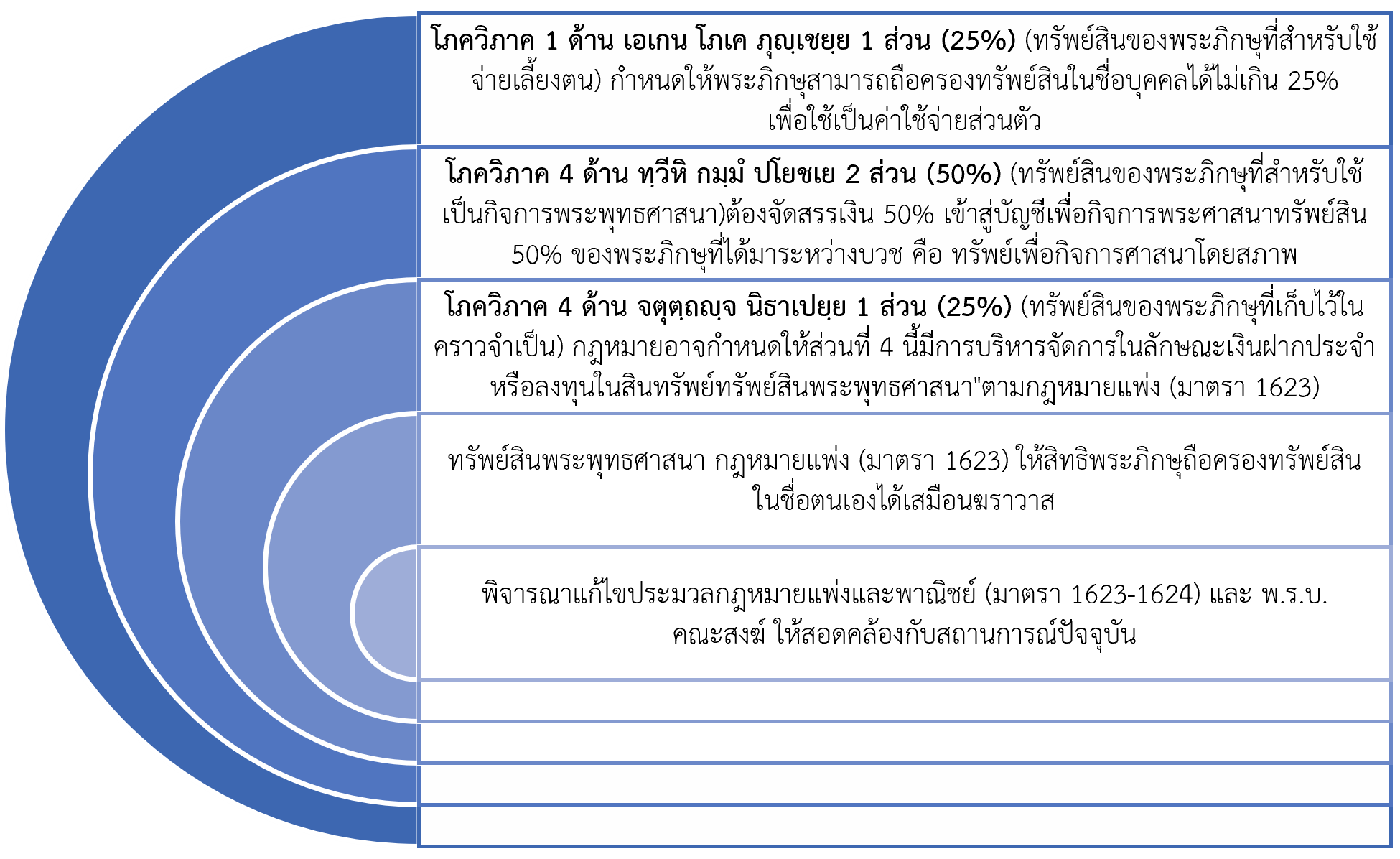
The research findings were as follows: 1. Conditions, Problems, and Obstacles The study found that according to Sections 1622, 1623, and 1624 of the Thai Civil and Commercial Code, ordained monks were exempted from the burden of managing inherited estates. However, a major obstacle regarding the heirs' rights to a deceased monk's estate was the difficulty in distinguishing whether the property acquired during monkhood was personal or belonged to the temple. 2. Legal Comparison When comparing legal measures between Thailand and foreign countries, it was found that Myanmar had extremely strict laws that were highly consistent with Buddhist monastic discipline (Vinaya). Meanwhile, Sri Lanka managed monastic property under the Buddhist Temporalities Ordinance, which contained notable features suitable for adaptation in Thailand. 3. Legal Development Guidelines To make the property laws suitable for the Thai monastic context, the study proposed applying the Buddhist principle of Bhoga-vibhaga (the fourfold division of wealth). Under this concept, monks could hold personal property up to 25% of their income, allocate 50% for religious affairs, and manage the remaining portion as fixed deposits. Consequently, two main conclusions were drawn. First, regarding pre-ordination property, monks were required to clearly declare their existing assets, as management guidelines were already provided by the Sangha Act B.E. 2505 (1962) and Sections 1622–1624 of the Civil and Commercial Code. Second, for property acquired during monkhood, any money or assets obtained from merit-making ceremonies immediately belonged to the temple or the central Sangha fund.
References
ฉัตตมาศ วิเศษสินธุ์ และสุชาดา ศรีใหม่. (2561). พระภิกษุยักยอกทรัพย์ : ศึกษาความรับผิดทางอาญาและอาบัติตามพระวินัย. วารสารนิติศาสตร์และสังคมท้องถิ่น, 1(1), 107–133.
นรา ถิ่นนัยธร. (2564). สิทธิทางทรัพย์สินของพระภิกษุในพระพุทธศาสนา (ดุษฎีนิพนธ์ปริญญานิติศาสตรดุษฎีบัณฑิต สาขาวิชานิติศาสตร์). ปทุมธานี: มหาวิทยาลัยธรรมศาสตร์.
พระครูอาทรกิจจาภิรักษ์ (ฉัตรชมภู). (2557). การศึกษาวิเคราะห์โภควิภาค 4 ในคัมภีร์พระพุทธศาสนา. (วิทยานิพนธ์ปริญญาพุทธศาสตรดุษฎีบัณฑิต สาขาวิชาพระพุทธศาสนา). พระนครศรีอยุธยา: มหาวิทยาลัยมหาจุฬาลงกรณราชวิทยาลัย.
พระนิทัศน์ ธีรปญฺโญ (วงศ์วังเพิ่ม). (2560). กฎหมายที่เกี่ยวกับทรัพย์สินของพระสงฆ์. วารสารมณีเชษฐาราม, 1(2), 41-47.
เพิ่มศักดิ์ เพิ่มพูน. (2534). กฎหมายที่พระสงฆ์ควรทราบ. กรุงเทพฯ: โรงพิมพ์มหาจุฬาลงกรณราชวิทยาลัย.
ไพโรจน์ กัมพูสิริ. (2564). หลักกฎหมายมรดก (พิมพ์ครั้งที่ 8). ปทุมธานี: มหาวิทยาลัยธรรมศาสตร์.
วิชิตร เปาะสี. (2562). ปัญหากฎหมายเกี่ยวกับทรัพย์สินและมรดกของพระภิกษุสงฆ์. สืบค้นเมื่อ 26 พฤษภาคม 2569 จาก http://www.lawgrad.ru.ac.th/Abstracts/569.
สมเกียรติ วรปัญญาอนันต์. (2564). ข้อความคิดว่าด้วยการครอบครองตามกฎหมายลักษณะทรัพย์สิน. วารสารนิติศาสตร์ มหาวิทยาลัยธรรมศาสตร์, 5(1), 1-38.
Downloads
Published
How to Cite
Issue
Section
License
Copyright (c) 2026 Journal of Interdisciplinary Innovation Review

This work is licensed under a Creative Commons Attribution-NonCommercial-NoDerivatives 4.0 International License.
In order to conform the copyright law, all article authors must sign the consignment agreement to transfer the copyright to the Journal including the finally revised original articles. Besides, the article authors must declare that the articles will be printed in only the Journal of interdisciplinary Innovation Review. If there are pictures, tables or contents that were printed before, the article authors must receive permission from the authors in writing and show the evidence to the editor before the article is printed. If it does not conform to the set criteria, the editor will remove the article from the Journal without any exceptions.