LEGAL PROTECTION OF MONKS' RIGHTS IN THAILAND
Keywords:
Protection of Rights, Law, Buddhist MonksAbstract
This research aimed to study the conditions, problems, and obstacles concerning the legal rights protection of monks in Thailand; compare relevant laws; and propose guidelines for legal development. The methodology integrated documentary research, in-depth interviews with 17 informants, and a focus group with 10 experts. Data were analyzed using descriptive content analysis and summarized in an essay format.
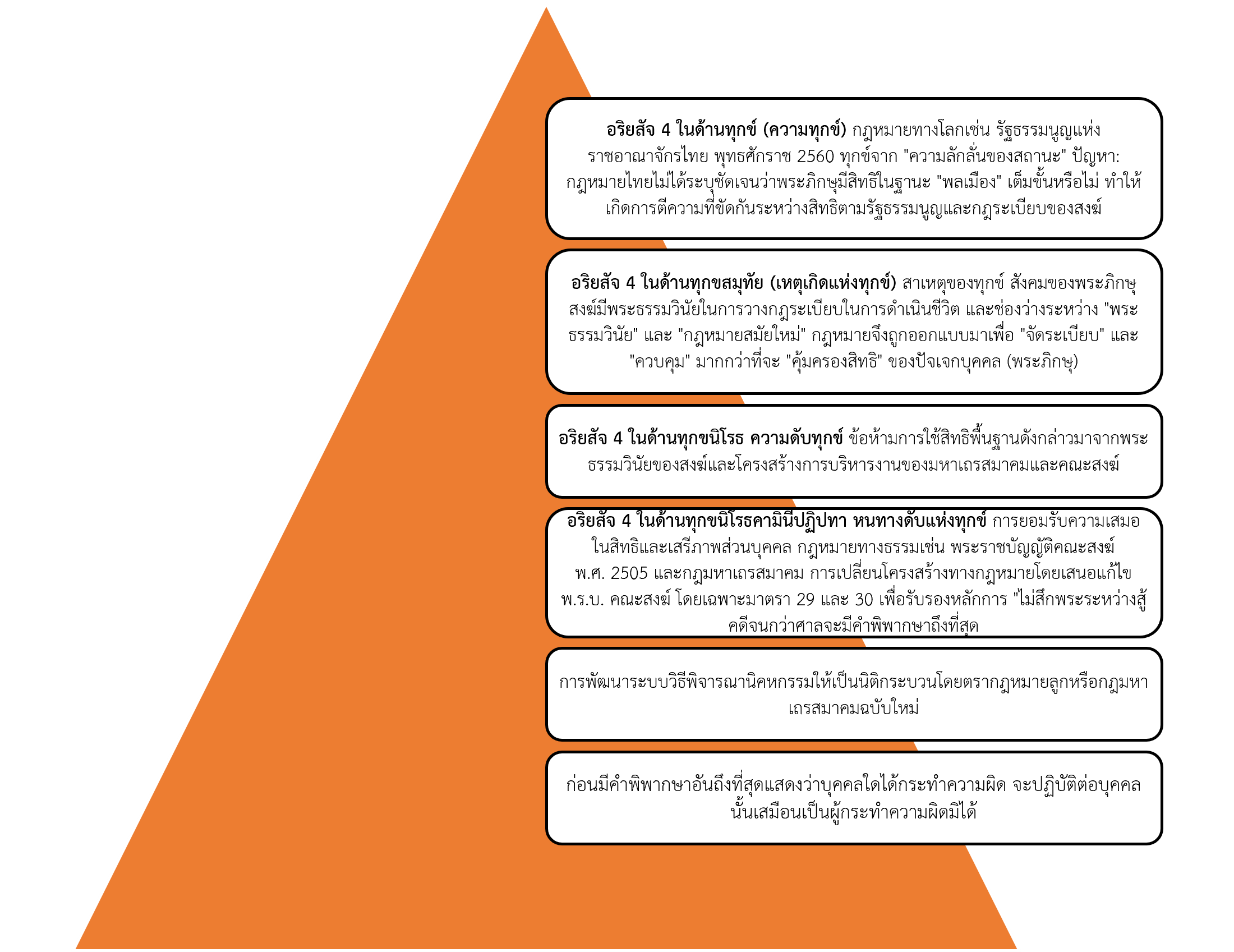
The research findings were as follows: 1. Conditions, Problems, and Obstacles The study found that monks' basic rights were safeguarded by the Sangha Act B.E. 2505 (1962), which governed the monastic structure, and Section 26 of the 2017 Constitution, which guaranteed human dignity and equal rights for all Thai citizens regardless of status, gender, age, profession, or religion. However, a major problem existed in Sections 29 and 30 of the Sangha Act, which empowered state officials to immediately force a monk to disrobe while a criminal case was still pending. 2. Legal Comparison When comparing legal protections, it was found that Article 12 in Sri Lanka guaranteed that all persons were equal before the law and entitled to equal legal protection. In Laos, Section 3 of the 1998 Sangha Act mandated strict adherence to precepts (227 for monks, 10 for novices, and 8 for lay devotees) while granting legal rights similar to those in Thailand and 3. Legal Development Guidelines To improve legal protection, the study proposed applying the Four Noble Truths Suffering (Dukkha), its Cause (Samudaya), its Cessation (Nirodha), and the Path (Magga) to foster the recognition of equality in personal rights and freedoms. Furthermore, religious laws, specifically the Sangha Act B.E. 2505 and the regulations of the Sangha Supreme Council, should be amended to align with contemporary society without contradicting monastic discipline (Vinaya).
References
จัง จ๊าคส์รุสโซ. (2517). สัญญาประชาคม. กรุงเทพฯ: ชมรมแสงธรรม.
นรา ถิ่นนัยธร. (2564). สิทธิทางทรัพย์สินของพระภิกษุในพระพุทธศาสนา (ดุษฎีนิพนธ์ปริญญานิติศาสตรดุษฎีบัณฑิต สาขาวิชานิติศาสตร์). ปทุมธานี: มหาวิทยาลัยธรรมศาสตร์.
บรรเจิด สิงคะเนติ. (2552). หลักพื้นฐานเกี่ยวกับสิทธิเสรีภาพ และศักดิ์ศรีความเป็นมนุษย์. กรุงเทพฯ: วิญญูชน.
บุญศรี มีวงศ์อุโฆษ. (2535). คำอธิบายวิชากฎหมายรัฐธรรมนูญเปรียบเทียบ : รัฐธรรมนูญ เยอรมัน. กรุงเทพฯ: โครงการตำราและเอกสารประกอบการสอน คณะนิติศาสตร์ มหาวิทยาลัยธรรมศาสตร์.
พระมหาโพธิวงศาจารย์ (ทองดี). (2561). พระวินัยบัญญัติ (พิมพ์ครั้งที่ 2). กรุงเทพฯ: ม.ป.ท.
พระมหารมย์ แตงทรัพย์ และศิริศักดิ์ ศุภมนตรี. (2557). สิทธิของพระภิกษุทางกฎหมายอาญา. วารสารพุทธศาสน์ศึกษา จุฬาลงกรณ์มหาวิทยาลัย, 21(1), 69–80.
วัดมหาธาตุยุวราชรังสฤษฎิ์. (2537). ผจญมาร. กรุงเทพฯ: เทพนิมิตการพิมพ์.
สมชาย เจริญกิจ. (2565). สิทธิในคดีอาญาของพระสงฆ์ไทย. วารสารนิติศาสตร์และสังคมท้องถิ่น, 6(2), 97-118.
สมยศ เชื้อไทย. (2535). คำบรรยายหลักรัฐธรรมนูญทั่วไป. กรุงเทพฯ: เรือนแก้วการพิมพ์.
Downloads
Published
How to Cite
Issue
Section
License
Copyright (c) 2026 Journal of Interdisciplinary Innovation Review

This work is licensed under a Creative Commons Attribution-NonCommercial-NoDerivatives 4.0 International License.
In order to conform the copyright law, all article authors must sign the consignment agreement to transfer the copyright to the Journal including the finally revised original articles. Besides, the article authors must declare that the articles will be printed in only the Journal of interdisciplinary Innovation Review. If there are pictures, tables or contents that were printed before, the article authors must receive permission from the authors in writing and show the evidence to the editor before the article is printed. If it does not conform to the set criteria, the editor will remove the article from the Journal without any exceptions.