THE FOUR PRINCIPLES OF SOCIAL HARMONY: A COMPASS FOR EFFECTIVE WORK PERFORMANCE
Keywords:
The Four Principles of Social Harmony, Work Practices, Personnel, Human Resource ManagementAbstract
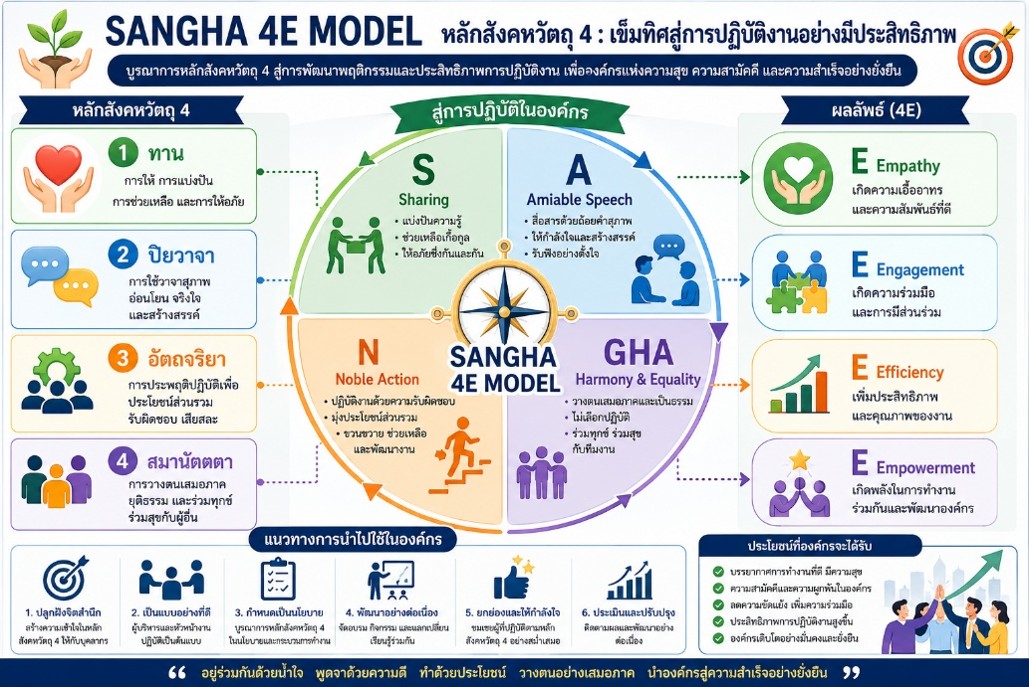
This academic article aims to synthesize the concept of the Four Principles of Social Harmony (Sanghahavatthu 4) and their application to effective work performance. It studies relevant documents, texts, and Buddhist principles to highlight the importance of improving work performance, self-sacrifice, and adherence to moral values, leading to increased efficiency. The Four Principles of Social Harmony are considered crucial guidelines for life and work and consist of: 1. Dana (Giving): Sharing, sacrificing, being generous, and helping others, reducing selfishness through giving and fostering a sense of public service; 2. Piyavaca (Pleasant Speech): Using polite and courteous language, speaking kindly and constructively to promote unity and understanding, which can be practiced through mindfulness and compassion; 3. Atthacariya (Beneficial Conduct): Acting in a way that benefits others, helping and supporting each other, and working for the common good; and 4. Samanattata (Equality): Maintaining impartiality and fairness, avoiding exploitation of others. And treating everyone equally, the Four Principles of Social Harmony (Sanghahavatthu 4) serve as a guiding compass in work practices, promoting ethical and moral collaboration, fostering cooperation and unity, and leading to sustainable success for the work and the organization. Furthermore, the Four Principles of Social Harmony can be appropriately applied to management and operations in all sectors, both public and private, as they are principles that promote human resource management, building good relationships within the organization, and improving work efficiency, leading to the development of strong and sustainable organizations in the long term.
References
ธงชัย สันติวงษ์. (2546). การบริหารทรัพยากรมนุษย์ (พิมพ์ครั้งที่ 11 ฉบับปรับปรุงใหม่). กรุงเทพฯ: บริษัทประชุมช่าง จำกัด.
พระธรรมโกศาจารย์ (ประยูร ธมฺมจิตฺโต). (2549). พุทธวิธีการบริหาร. กรุงเทพฯ: มหาวิทยาลัยมหาจุฬาลงกรณราชวิทยาลัย.
พระพรหมคุณาภรณ์ (ป.อ. ปยุตฺโต). (2561). สันติภาพเกิดจากอิสรภาพและความสุข. กรุงเทพฯ: บริษัท พิมพ์สวย จำกัด.
พระสมโชค คุตฺตธมฺโม (เกื้อกลิ่น) และคณะ. (2565). การประยุกต์ใช้หลักสังคหวัตถุ 4 ในการเสริมสร้างการปฏิบัติงานของบุคลากรองค์การบริหารส่วนตำบลเขาตอก อำเภอเคียนซา จังหวัดสุราษฎร์ธานี. วารสาร มจร อุบลปริทรรศน์, 7(2), 927-936.
มหาจุฬาลงกรณราชวิทยาลัย. (2539). พระไตรปิฎกฉบับภาษาไทย ฉบับมหาจุฬาลงกรณราชวิทยาลัย. กรุงเทพฯ: โรงพิมพ์มหาจุฬาลงกรณราชวิทยาลัย.
สมยศ นาวีการ. (2549). การบริหารและพฤติกรรมองค์การ (พิมพ์ครั้งที่ 4 แก้ไขปรับปรุง). กรุงเทพฯ: บรรณกิจ.
สำนักงานสถิติแห่งชาติ. (2567). การสำรวจประชากรสูงอายุในประเทศไทย พ.ศ. 2567 ระดับจังหวัด. สืบค้นเมื่อ 2 มกราคม 2569 จาก https://shorturl.asia/I5WFb.
สุทธิพงศ์ ปานเพ็ชร์. (2550). การประยุกต์หลักพุทธธรรมกับวิถีชีวิตชุมชน (รายงานผลการวิจัย). กรุงเทพฯ: มหาวิทยาลัยธุรกิจบัณฑิตย์.
Downloads
Published
How to Cite
Issue
Section
License
Copyright (c) 2026 Journal of Interdisciplinary Innovation Review

This work is licensed under a Creative Commons Attribution-NonCommercial-NoDerivatives 4.0 International License.
In order to conform the copyright law, all article authors must sign the consignment agreement to transfer the copyright to the Journal including the finally revised original articles. Besides, the article authors must declare that the articles will be printed in only the Journal of interdisciplinary Innovation Review. If there are pictures, tables or contents that were printed before, the article authors must receive permission from the authors in writing and show the evidence to the editor before the article is printed. If it does not conform to the set criteria, the editor will remove the article from the Journal without any exceptions.