INNOVATIVE COMMUNICATION APPROACHES OF CONTEMPORARY BUDDHIST LECTURERS
Keywords:
Creative Communication, Contemporary Buddhist Monk Trainers, Buddhist Propagation, Participatory CommunicationAbstract
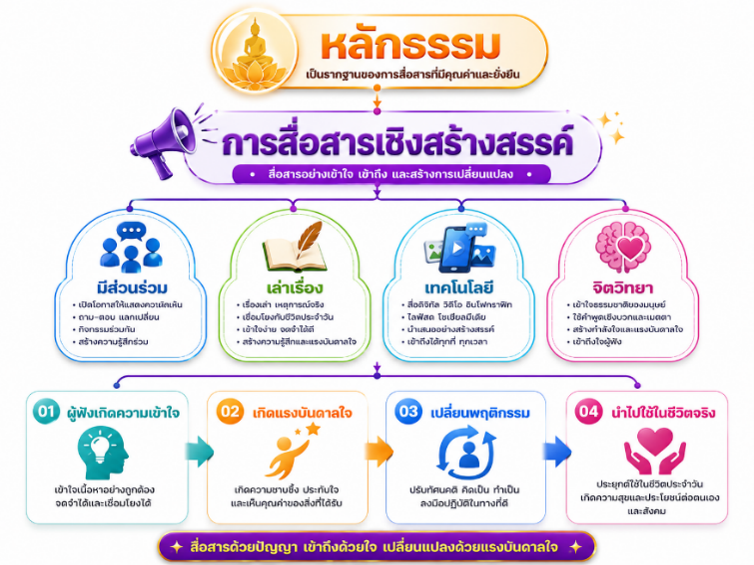
This article investigates the creative communication model of contemporary Buddhist monk trainers (Phra Witthayakorn). The study explores the perspectives of Buddhist monk trainers and lay facilitators on creative communication and synthesizes knowledge to develop communication approaches appropriate for contemporary society. Data were collected through in-depth interviews with 11 key informants, comprising experienced Buddhist monk trainers and lay facilitators engaged in Buddhist propagation. The data were analyzed using content analysis and inductive synthesis. The findings reveal that the creative communication of contemporary Buddhist monk trainers is an integration of Buddhist principles with communication theories and modern learning management. This approach emphasizes learner-centered communication and active participation. The role of Buddhist monk trainers has shifted from being knowledge transmitters to learning process designers who create meaningful experiences and inspire learners. The effective communication model consists of five key components: 1. storytelling, 2. participatory communication through activities, games, questioning, and reflective learning, 3. the use of creative language appropriate to the audience, 4. the application of digital media and technology to enhance learning effectiveness, and 5. psychological communication to inspire positive attitudes and behavioral change. The new body of knowledge generated from this study is the Creative Communication Model for Contemporary Buddhist Monk Trainers, which integrates Buddhist teachings, participatory communication, storytelling, digital media, and psychological communication to promote learners' knowledge, attitudes, and behaviors. This model provides a significant framework for enhancing the competencies of Buddhist monk trainers and improving Buddhist propagation in ways that are effective, sustainable, and responsive to the needs of the digital era.
References
กาญจนา แก้วเทพ และคณะ. (2543). สื่อเพื่อชุมชน: การประมวลองค์ความรู้. กรุงเทพฯ: สำนักงานกองทุนสนับสนุนการวิจัย.
กาญจนา แก้วเทพ. (2546). อีกครั้งกับเรื่องการสื่อสารแบบมีส่วนร่วม. วารสารวิจัยสังคม, 26(2), 101-135.
กุลิสรา จิตรชญาวณิช. (2561). การศึกษาและความเป็นครูไทย. กรุงเทพฯ: สำนักพิมพ์แห่งจุฬาลงกรณ์มหาวิทยาลัย.
เกรียงศักดิ์ เจดีย์แปง. (2551). การพัฒนาประสิทธิภาพการสื่อสารภายในองค์กร สำนักประชาสัมพันธ์เขต 3 (การศึกษาอิสระปริญญาบริหารธุรกิจมหาบัณฑิต สาขาวิชาการจัดการทั่วไป). เชียงราย: มหาวิทยาลัยเชียงราย.
ขวัญวรา วงค์คำ และคณะ. (2565). การจัดการเรียนรู้เชิงรุกโดยใช้เกมคุณธรรมเพื่อส่งเสริมความเป็นพลเมืองดีของนักเรียนชั้นประถมศึกษา. วารสารสันติศึกษาปริทรรศน์ มจร, 10(2), 747–761.
ชเนตตี ทินนาม. (2569). เจาะลึก “สื่อ” ยุคดิจิทัล บทบาทและหลักจริยธรรมนักสื่อสาร ร่วมสร้างความจริงในสังคม. สืบค้นเมื่อ 23 พฤษภาคม 2569 จาก https://www.chula.ac.th/highlight/303952/.
ชื่นณัสฐา เสนาะโสตร์. (2565). เกร็ดความรู้ กับเทคนิคการนำเสนออย่างมีประสิทธิภาพ. สืบค้นเมื่อ 23 พฤษภาคม 2569 จาก https://shorturl.asia/LPVqx.
ไชยยศ ปั้นสกุลไชย. (2565). แค่เล่าเรื่องเป็น เห็นโอกาสมากกว่าคนอื่น. กรุงเทพฯ: ต้นคิด.
ธวัชชัย บุตรงาม. (2568). แนวทางการประยุกต์ใช้โปรแกรม Kahoot! ของวิทยากรในยุคดิจิทัล. วารสารพุทธนวัตกรรมการศึกษา, 1(3), 85–96.
นาวิน เพิ่มประยูร. (2562). การสื่อสารเชิงสร้างสรรค์เพื่อสร้างอัตลักษณ์ส่วนบุคคลผ่านเฟซบุ๊กแฟนเพจ (วิทยานิพนธ์ปริญญานิเทศศาสตรมหาบัณฑิต สาขาวิชาการสื่อสารเชิงกลยุทธ์). ปทุมธานี: มหาวิทยาลัยกรุงเทพ.
พระครูปลัดบุญยัง ทุลฺลโภ (สุนทรวิภาต) และพระมหาสมบัติ ธนปญฺโญ. (2558). บทบาทพระสงฆ์กับการเผยแผ่ยุคปัจจุบัน. วารสารครุศาสตร์ปริทรรศน์ฯ, 2(3), 132–138.
พระธัชฑล รกฺขิโต (อัตรัง) และคณะ. (2569). การวิเคราะห์เชิงจิตวิทยาภาษาศาสตร์ของคำพูดให้กำลังใจเพื่อส่งเสริมประสิทธิภาพการทำงานของบุคลากรทางการศึกษา. วารสารภาษาและวัฒนธรรมศึกษา, 5(2), 85-95.
พระปราโมทย์ วาทโกวิโท และพระมหาหรรษา ธมฺมหาโส. (2563). รูปแบบการพัฒนาวิทยากรต้นแบบสันติภาพโดยพุทธสันติวิธี. วารสารสันติศึกษาปริทรรศน์ มจร, 8(ฉบับเพิ่มเติม), 253-265.
พระมหาศิริพงศ์ จนฺทปาโมชฺโช. (2569, 17 พฤษภาคม). เจ้าอาวาสวัดหนองคูวนาราม อำเภอลำปลายมาศ จังหวัดบุรีรัมย์ [สัมภาษณ์].
พระวชิระ สุปภาโส. (2569, 17 พฤษภาคม). วัดเทวีวรญาติ แขวงวัดเทพศิรินทร์ เขตป้อมปราบศัตรูพ่าย กรุงเทพมหานคร [สัมภาษณ์].
พระสมุห์พัชรพล ปญฺญาธโร. (2569, 17 พฤษภาคม). วัดแสลงโทน อำเภอแสลงโทน จังหวัดบุรีรัมย์ [สัมภาษณ์].
พระอุทิศ อาสภจิตฺโต และคณะ. (2569). การพัฒนาวิทยากรสอนธรรมเพื่อสร้างแรงบันดาลใจแก่ผู้ต้องขังในเรือนจำ จังหวัดนครปฐม. วารสารชัยภูมิปริทรรศน์, 9(1), 39-52.
ภัทรภณ คบทองหลาง. (2569, 17 พฤษภาคม). ครู โรงเรียนลำดวนพิทยาคม อำเภอกระสัง จังหวัดบุรีรัมย์ [สัมภาษณ์].
มนัสพล ยังทะเล และคณะ. (2568). การประยุกต์ธรรมะให้เข้ากับยุคสมัยในการเผยแผ่ธรรมของพระสงฆ์สำหรับเยาวชน. วารสารศรีสุวรรณภูมิปริทรรศน์, 3(3), 294-303.
วศิน อินทสระ. (2558). เทคนิคการเผยแผ่พระศาสนา. สมุทรปราการ: Canna graphic.
วิชชุพงศ์ วรศาสตร์กุล. (2566). ปัญหาการใช้คำสะกดผิดของร้านค้ารอบมหาวิทยาลัยราชภัฏเลย. วารสารบัณฑิตแสงโคมคำ, 8(3), 640-656.
Morin, A. (2003). Self-awareness review Part 2: Changing or escaping the self. Science & Consciousness Review. Science and Consciousness Review, 1, 1-8.
Downloads
Published
How to Cite
Issue
Section
License
Copyright (c) 2026 Journal of Interdisciplinary Innovation Review

This work is licensed under a Creative Commons Attribution-NonCommercial-NoDerivatives 4.0 International License.
In order to conform the copyright law, all article authors must sign the consignment agreement to transfer the copyright to the Journal including the finally revised original articles. Besides, the article authors must declare that the articles will be printed in only the Journal of interdisciplinary Innovation Review. If there are pictures, tables or contents that were printed before, the article authors must receive permission from the authors in writing and show the evidence to the editor before the article is printed. If it does not conform to the set criteria, the editor will remove the article from the Journal without any exceptions.