MANAGING THE THAI ALUMINUM INDUSTRY TO SUPPORT THE CARBON BORDER ADJUSTMENT MECHANISM
Keywords:
Thailand’s Aluminium Industry, Carbon Border Adjustment Mechanism (CBAM), Low-Carbon Economy, Circular Economy, Industrial ManagementAbstract
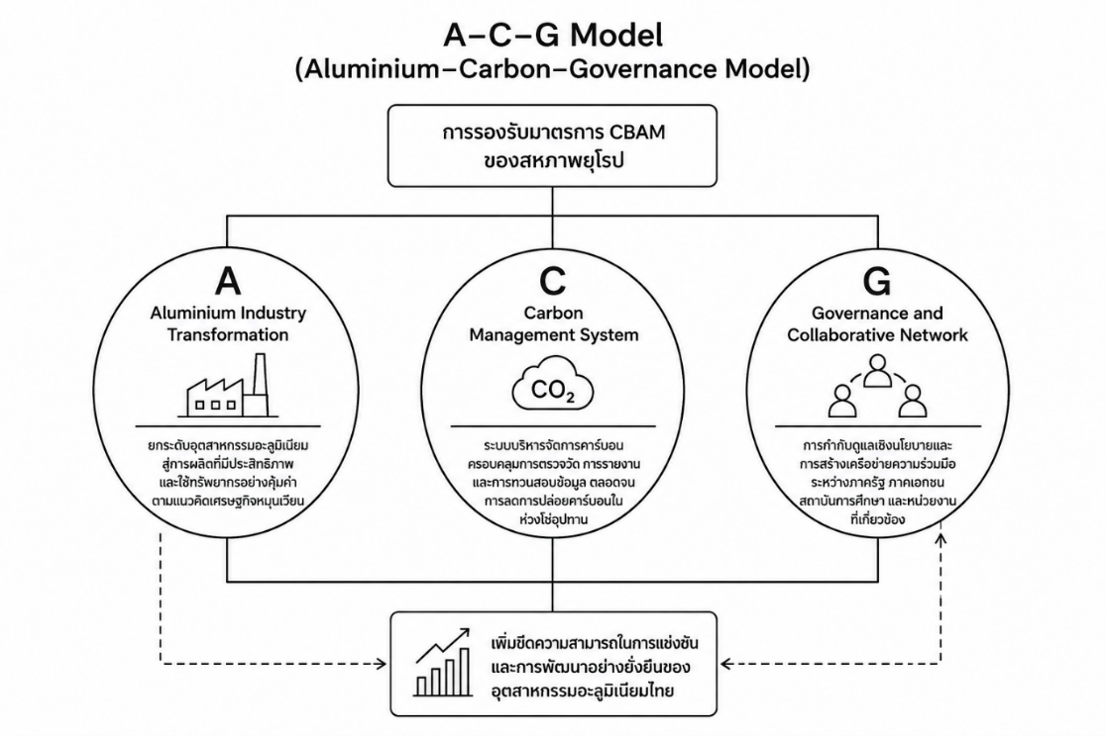
This academic article aims to analyze the European Union’s Carbon Border Adjustment Mechanism (CBAM), its impacts on Thailand’s aluminium industry, and management approaches to support adaptation to emerging global trade regulations within the context of a low-carbon economy. The article is based on the synthesis and analysis of academic documents, policy reports, research studies, and related sources. The findings indicate that CBAM is a trade-related mechanism designed to prevent carbon leakage and promote fair competition by requiring imported products to account for greenhouse gas emissions generated throughout their production processes. As a highly energy-intensive sector with significant greenhouse gas emissions, Thailand’s aluminium industry faces several challenges, including carbon measurement, reporting and verification requirements, environmentally friendly production adjustments, energy efficiency improvements, and the management of additional carbon-related costs. Nevertheless, CBAM should not be viewed solely as a trade barrier; it also presents an opportunity for Thailand’s aluminium industry to enhance its competitiveness and align with sustainable development principles through the adoption of clean technologies, efficient resource utilization, and circular economy practices. The article further emphasizes that effective adaptation to CBAM requires strong governmental support in policy formulation, investment promotion, carbon data infrastructure development, and collaborative partnerships among government agencies, private enterprises, academic institutions, and other relevant stakeholders. In response, the article proposes the A-C-G Model, consisting of Aluminium Industry Transformation, Carbon Management System, and Governance and Collaborative Network, as a strategic framework for enhancing competitiveness, mitigating the impacts of environmental trade measures, and supporting the sustainable development of Thailand’s aluminium industry under the transition toward a low-carbon economy.
References
ถลัชนันท์ ตันติเวชวุฒิกุล และคณะ. (2567). มาตรการ CBAM กระทบการส่งออกไทยแค่ไหน อย่างไร. สืบค้นเมื่อ 12 มิถุนายน 2569 จาก https://www.pier.or.th/abridged/2024/13/.
ปิยะบุตร วานิชพงษ์พันธุ์. (2568). ยุทธศาสตร์ความมั่นคงองค์รวมของประเทศไทยมุ่งสู่อุตสาหกรรมที่เป็นกลางทางคาร์บอนอย่างยั่งยืน. วารสารสถาบันวิชาการป้องกันประเทศ, 16(1), 76–96.
เพชรรัตน์ ผานิตกุลรัตน์. (2567). แนวทางการลดก๊าซเรือนกระจกในประเทศไทยผ่านกลไกการกำหนดราคาคาร์บอน. วารสารรัฏฐาภิรักษ์ วิทยาลัยป้องกันราชอาณาจักร, 66(1), 81-92.
สมเกียรติ ตั้งกิจวานิชย์. (2567). การปรับประเทศไทยให้ยืดหยุ่นต่อสภาพภูมิอากาศ. สืบค้นเมื่อ 9 มิถุนายน 2569 จาก https://tdri.or.th/2024/12/tdri-ac-2024-session1/.
สำนักงานสภาพัฒนาการเศรษฐกิจและสังคมแห่งชาติ. (2566). เอกสารประกอบ แผนพัฒนาเศรษฐกิจและสังคมแห่งชาติฉบับที่ 13 (พ.ศ. 2566 – 2570). สืบค้นเมื่อ 15 มิถุนายน 2569 จาก https://shorturl.asia/R8Q0Y.
องค์การบริหารจัดการก๊าซเรือนกระจก (องค์การมหาชน). (2568). ไทยตั้งรับมาตรการ CBAM ของสหภาพยุโรป ด้วยมาตรการ Thai CBAM. สืบค้นเมื่อ 12 มิถุนายน 2569 จาก https://shorturl.asia/pfFDx.
อนิวัตร ชูไว. (2568). มาตรการ CBAM กับผลกระทบต่อภาคอุตสาหกรรมไทย. สืบค้นเมื่อ 10 มิถุนายน 2569 จาก https://web.parliament.go.th/assets/portals/82/news/1660/1_1660.pdf.
อสิ ม้ามณี. (2566). มาตรการปรับคาร์บอนก่อนเข้าพรมแดนของสหภาพยุโรป : การเปลี่ยนข้อบังคับด้านสิ่งแวดล้อมจากต่างชาติให้เป็นโอกาสทางการค้า. วารสารรัฏฐาภิรักษ์, 65(1), 40–51.
Chaivanich, K. & Singyoocharoen, W. (2024). Regulation and impact from enforcement of the EU's Carbon Border Adjustment Mechanism (CBAM) to prepare for the implementation of Thailand industry in the future. Science and Technology Nakhon Sawan Rajabhat University Journal, 16(23), 115–131.
European Commission. (2021). Proposal for a Regulation of the European Parliament and of the Council Establishing a Carbon Border Adjustment Mechanism. Retrieved May 17, 2026, from https://shorturl.asia/ubLod.
_____. (2026). Carbon Border Adjustment Mechanism. Retrieved May 20, 2026, from https://shorturl.asia/1EOWy.
International Energy Agency (IEA). (2023). Aluminium. Retrieved May 28, 2026, from https://www.iea.org/energy-system/industry/aluminium.
National Metal and Materials Technology Center (MTEC). (2023). Promoting circular economy design for sustainable resources use. Retrieved May 25, 2026, from https://www.mtec.or.th/annual-report2023/en/promoting-circular-economy-design-for-sustainable-resources-use/.
Office of Natural Resources and Environmental Policy and Planning (ONEP). (2022). Thailand's long-term low greenhouse gas emission development strategy (revised version). Retrieved May 25, 2026, from https://shorturl.asia/BWXtJ.
Downloads
Published
How to Cite
Issue
Section
License
Copyright (c) 2026 Journal of Interdisciplinary Innovation Review

This work is licensed under a Creative Commons Attribution-NonCommercial-NoDerivatives 4.0 International License.
In order to conform the copyright law, all article authors must sign the consignment agreement to transfer the copyright to the Journal including the finally revised original articles. Besides, the article authors must declare that the articles will be printed in only the Journal of interdisciplinary Innovation Review. If there are pictures, tables or contents that were printed before, the article authors must receive permission from the authors in writing and show the evidence to the editor before the article is printed. If it does not conform to the set criteria, the editor will remove the article from the Journal without any exceptions.