THE DYNAMICS OF POLITICAL PARTIES AND THE VOTING BEHAVIOR OF THE NEW GENERATION IN THAI SOCIETY
Keywords:
Political Party Dynamics, Election Behavior, Young Voters, Digital Political CommunicationAbstract
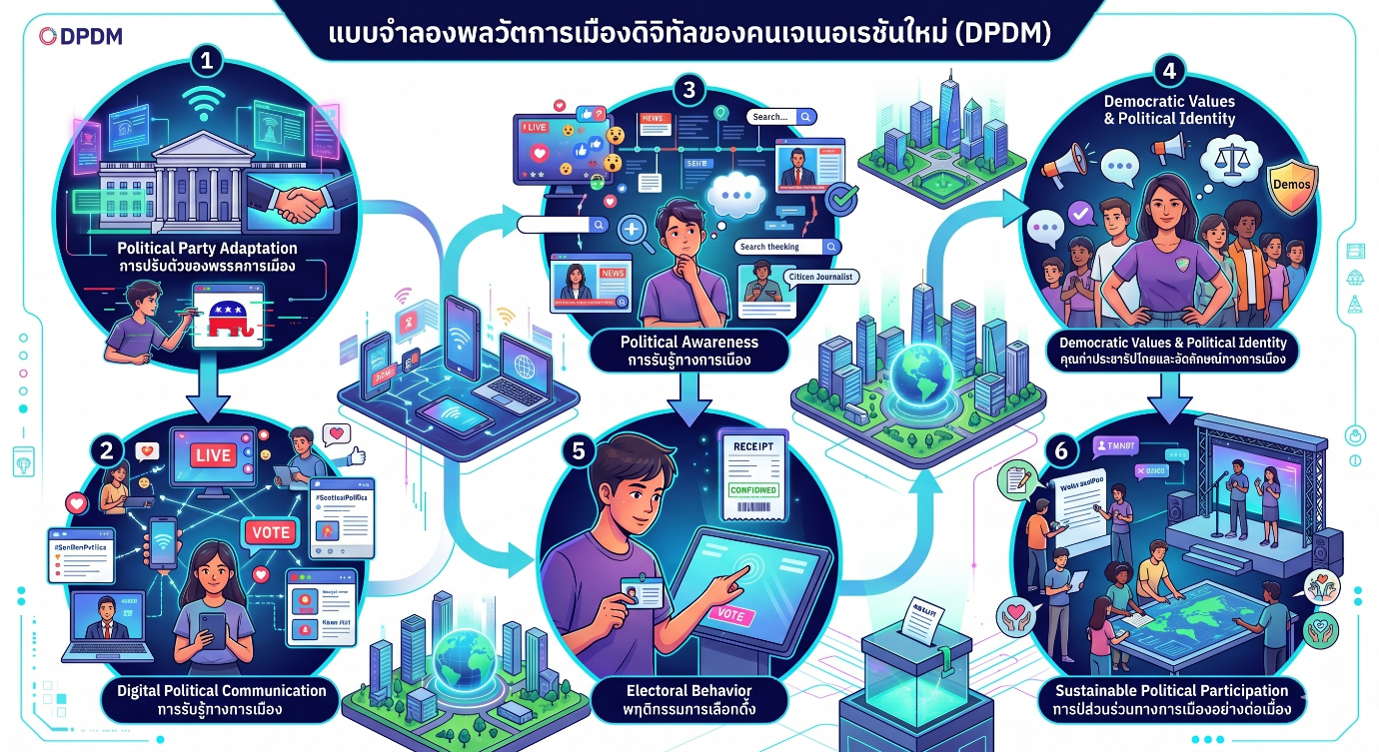
This academic article aims to study the dynamics of political parties and analyze the voting behavior of the new generation in Thai society within the context of digital political communication. It finds that changes in digital technology and the expansion of social media have led Thai political parties to shift from patronage-based politics relying on social networks and personal interests to policy-based politics and political communication through digital platforms. Political parties that can present public policies aligned with public needs, communicate effectively, and build an image reflecting transparency and public participation tend to receive high levels of support from new voters. Simultaneously, the new generation, comprising Generation Y and Generation Z, makes political decisions differently from previous generations, prioritizing information, public policies, democratic values, and political participation through digital media over traditional patronage relationships or loyalty to political parties. Furthermore, social media plays a significant role in shaping political awareness, setting the public agenda, and mobilizing political participation. As a result, digital-era elections are increasingly characterized by data-driven decision-making based on information and policy issues. A synthesis of knowledge and a model of the digital political dynamics of the new generation, encompassing the adaptation of political parties, digital political communication, political awareness, democratic values, and voting behavior, systematically explains the dynamic relationships between these factors. This provides new knowledge that can be applied to studying voting behavior and developing political strategies. And strengthening Thai democracy in the digital age appropriately.
References
ชนัญสรา อรนพ ณ อยุธยา. (2562). ข่าวลวงบนสื่อสังคมออนไลน์: ความตระหนักรู้และรู้เท่าทันสื่อของดิจิทัลเนทีฟไทย. วารสารนิเทศศาสตร์ปริทัศน์, 23(1), 72-85.
นนทรัตน์ สุวรรณพงศ์. (2563). กลยุทธ์การสื่อสารทางสื่อสังคมออนไลน์ของพรรคการเมืองในการเลือกตั้งทั่วไป พ.ศ. 2562 (การค้นคว้าอิสระปริญญารัฐศาสตรมหาบัณฑิต สาขาวิชาการเมืองการปกครอง). ปทุมธานี: มหาวิทยาลัยธรรมศาสตร์.
ประจักษ์ ก้องกีรติ. (2563). การเมืองแห่งความหวังและความกลัว: วิเคราะห์การเลือกตั้ง 24 มีนาคม 2562. รัฐศาสตร์สาร, 41(1), 1-28.
พิจิตรา สึคาโมโต้ และวิไลวรรณ จงวิไลเกษม. (2564). นิเวศสื่อและข้อมูลข่าวสารทางการเมืองของไทยในยุคดิจิทัลดิสรัปชัน. วารสารนิเทศศาสตร์ จุฬาลงกรณ์มหาวิทยาลัย, 39(3), 1-22.
พิรงรอง รามสูต. (2564). สื่อสังคมกับการเมืองไทยในยุคดิจิทัล. กรุงเทพฯ: สำนักพิมพ์แห่งจุฬาลงกรณ์มหาวิทยาลัย.
ภัสสร คงเอียด. (2569). กลยุทธ์การหาเสียงผ่านสื่อดิจิทัลของพรรคการเมืองไทยในการเลือกตั้ง พ.ศ. 2566. วารสารสหวิทยาการ มหาวิทยาลัยชินวัตร, 3(1), 38-52.
ลิขิต ธีรเวคิน. (2554). การเมืองการปกครองไทย. กรุงเทพฯ: สำนักพิมพ์มหาวิทยาลัยธรรมศาสตร์.
วริศรา ศิริชานนท์. (2562). ความคาดหวังและแนวโน้มพฤติกรรมการเลือกตั้งของคนรุ่นใหม่ต่อการใช้สิทธิเลือกตั้งสมาชิกสภาผู้แทนราษฎร พ.ศ.2562: กรณีศึกษานักศึกษาระดับชั้นปริญญาตรี มหาวิทยาลัยธรรมศาสตร์ ศูนย์รังสิต. วารสารธรรมศาสตร์, 38(3), 69-87.
ศุภกร เชิดชูธีรกุล และสมบูรณ์ สุขสำราญ. (2567). การสื่อสารทางการเมืองผ่านสื่อสังคมออนไลน์ของพรรคก้าวไกลในปัจจุบัน. วารสาร มจร อุบลปริทรรศน์, 9(2), 1-15.
สติธร ธนานิธิโชติ. (2562). พฤติกรรมการเลือกตั้งของคนรุ่นใหม่ในการเลือกตั้งทั่วไป พ.ศ. 2562. วารสารสถาบันพระปกเกล้า, 17(3), 5-26.
สิริพรรณ นกสวน สวัสดี. (2562). พลวัตของการเลือกตั้งและพฤติกรรมผู้ลงคะแนนเสียงในการเมืองไทยร่วมสมัย. รัฐศาสตร์สาร, 40(2), 1-35.
เอกพล เธียรจารุวัฒน์. (2563). พื้นที่สาธารณะ ปรากฏการณ์ห้องสะท้อนเสียง และการแบ่งขั้วทางการเมืองบนทวิตเตอร์ในช่วงก่อนการเลือกตั้งทั่วไป พ.ศ. 2562. วารสารนิเทศศาสตร์ จุฬาลงกรณ์มหาวิทยาลัย, 38(3), 41-68.
โอฬาร ถิ่นบางเตียว. (2562). เครือข่ายหัวคะแนนกับการเมืองแบบอุปถัมภ์ในการเลือกตั้งของไทย. วารสารการเมืองการปกครอง, 9(1), 58-75.
Campbell, A. et al. (1960). The American Voter. New York: John Wiley & Sons.
Castells, M. (2012). Networks of Outrage and Hope: Social Movements in the Internet Age. Cambridge, UK: Polity Press.
Dahl, R. A. (1989). Democracy and Its Critics. New Haven, CT: Yale University Press.
Downs, A. (1957). An Economic Theory of Democracy. New York: Harper & Row.
Inglehart, R. (2018). Cultural Evolution: People's Motivations are Changing, and Reshaping the World. Cambridge, UK: Cambridge University Press.
Laothamatas, A. (1996). A Tale of Two Democracies: Conflicting Perceptions of Elections and Democracy in Thailand. Singapore: Institute of Southeast Asian Studies.
McCombs, M. & Shaw, D. L. (1972). The agenda-setting function of mass media. Public Opinion Quarterly, 36(2), 176–187.
Norris, P. (2000). A Virtuous Circle: Political Communications in Postindustrial Societies. Cambridge, UK: Cambridge University Press.
Downloads
Published
How to Cite
Issue
Section
License
Copyright (c) 2026 Journal of Interdisciplinary Innovation Review

This work is licensed under a Creative Commons Attribution-NonCommercial-NoDerivatives 4.0 International License.
In order to conform the copyright law, all article authors must sign the consignment agreement to transfer the copyright to the Journal including the finally revised original articles. Besides, the article authors must declare that the articles will be printed in only the Journal of interdisciplinary Innovation Review. If there are pictures, tables or contents that were printed before, the article authors must receive permission from the authors in writing and show the evidence to the editor before the article is printed. If it does not conform to the set criteria, the editor will remove the article from the Journal without any exceptions.