CAUSAL RELATIONSHIP MODEL FOR THE DEVELOPMENT OF EXECUTIVE COMPETENCIES OF MAHACHULALONGKORNRAJAVIDYALAYA UNIVERSITY
Keywords:
Causal Relationship Model, Prototype Competencies of Administrators, Human Resource Development, Threefold TrainingAbstract
This research article aimed to present a causal relationship model for developing exemplary competencies of administrators at Mahachulalongkornrajavidyalaya University. The study employed a mixed-methods research design, integrating quantitative and qualitative approaches concurrently with equal emphasis. The quantitative population consisted of 719 personnel at the central campus of Mahachulalongkornrajavidyalaya University, from which a sample of 310 participants was determined based on the number of model parameters and selected through multistage sampling. In addition, nine experts participated in a focus group discussion. The research instruments included a questionnaire and a structured in-depth interview form. Quantitative data were analyzed using frequency, percentage, mean, standard deviation, factor analysis, and structural equation modeling, while qualitative data were analyzed using descriptive content analysis.
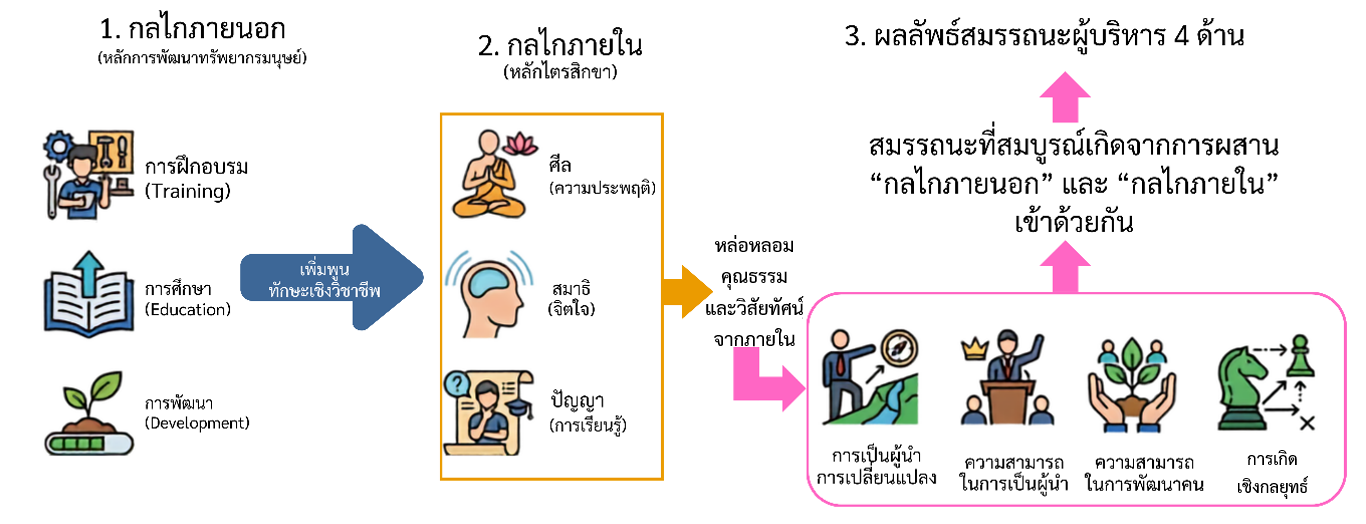
The findings revealed that the hypothesized model consisted of three latent variables: human resource development, the Threefold Training (Tisikkha), and exemplary administrator competencies. The model estimates indicated that human resource development had a direct effect on the Threefold Training at .433, while the Threefold Training had a direct effect on exemplary administrator competencies at .358. Human resource development had a total effect of .237 on exemplary administrator competencies, with statistical significance at the .01 level. However, the correlation between the observed variables of leadership competency and human development competency was as high as .971. The VIF values were 19.063 and 21.239, while the Tolerance values were .052 and .047, respectively, indicating substantial redundancy among the indicators. The structural equation explained 16.10 percent of the variance in exemplary administrator competencies. Moreover, the model fit indices did not meet the acceptable criteria χ² = 879.971, df = 32, p < .001, χ²/df = 27.499, GFI = .736, AGFI = .629, RMR = .147, and RMSEA = .293. Therefore, the hypothesized model could not yet be considered empirically supported. The path coefficients should be interpreted only as preliminary trends within the sample, and the indicators should be refined before the model is tested with a new sample.
References
กระทรวงศึกษาธิการ. (2542). พระราชบัญญัติการศึกษาแห่งชาติ พ.ศ. 2542. กรุงเทพฯ: โรงพิมพ์คุรุสภา.
กองแผนงาน สำนักงานอธิการบดี. (ม.ป.ป.). แผนพัฒนามหาวิทยาลัยมหาจุฬาลงกรณราชวิทยาลัย ในช่วงแผนพัฒนาการศึกษาระดับอุดมศึกษา ระยะที่ 13 (พ.ศ. 2566–2570). พระนครศรีอยุธยา: มหาวิทยาลัยมหาจุฬาลงกรณราชวิทยาลัย.
บุญชิรา ภู่ชนะจิต. (2564). โมเดลความสัมพันธ์เชิงสาเหตุของการบูรณาการหลักพุทธธรรมเพื่อการพัฒนาทรัพยากรมนุษย์ของตำรวจภูธรจังหวัดชลบุรี (ดุษฎีนิพนธ์ปริญญาปรัชญาดุษฎีบัณฑิต สาขาวิชารัฐประศาสนศาสตร์). พระนครศรีอยุธยา: มหาวิทยาลัยมหาจุฬาลงกรณราชวิทยาลัย.
ปุณณภา ปริเมธาชัย และคณะ. (2566). การบูรณาการหลักพุทธธรรมเพื่อการพัฒนาทรัพยากรมนุษย์ของสำนักงานศิลปวัฒนธรรมร่วมสมัย กระทรวงวัฒนธรรม. วารสารพุทธนวัตกรรมและการจัดการ, 6(1), 56–71.
พระสมนึก ธีรปญฺโญ (กลับน้อม). (2564). โมเดลความสัมพันธ์เชิงสาเหตุการพัฒนาสมรรถนะต้นแบบข้าราชการองค์กรปกครองส่วนท้องถิ่นในจังหวัดนนทบุรี (ดุษฎีนิพนธ์ปริญญาปรัชญาดุษฎีบัณฑิต สาขาวิชารัฐประศาสนศาสตร์). พระนครศรีอยุธยา: มหาวิทยาลัยมหาจุฬาลงกรณราชวิทยาลัย.
มหาวิทยาลัยมหาจุฬาลงกรณราชวิทยาลัย. (2567). รายงานประจำปี ประจำปี 2566. สืบค้นเมื่อ 22 ธันวาคม 2567 จาก https://plandiv.mcu.ac.th/?page_id=105.
สุภมาส อังศุโชติ และคณะ. (2554). สถิติวิเคราะห์สำหรับการวิจัยทางสังคมศาสตร์และพฤติกรรมศาสตร์: เทคนิคการใช้โปรแกรม LISREL. กรุงเทพฯ: เจริญมั่นคงดีการพิมพ์.
องค์การบริหารส่วนตำบลด่านชุมพล. (2564). คู่มือการกำหนดสมรรถนะข้าราชการส่วนท้องถิ่น “คู่มือสมรรถนะประจำผู้บริหาร”. สืบค้นเมื่อ 22 ธันวาคม 2567 จาก https://shorturl.asia/tKoba.
Diamantopoulos, A. & Siguaw, A. D. (2000). Introducing LISREL: A guide for the uninitiated. London: Sage Publications.
Likert, R. A. (1961). New patterns of management. New York: McGraw-Hill Book Company.
Lindeman, R. H. et al. (1980). Introduction to bivariate and multivariate analysis. Glenview, IL: Scott, Foresman.
Nadler, L. (1980). Corporate human resource development: Management tool. Illinois: McGraw-Hill Book.
Weiss, R. (1972). The provision of social relationship. In Z. Rubin (Ed.), Doing unto others. (pp. 17–26). Englewood Cliffs, NJ: Prentice-Hall.
Downloads
Published
How to Cite
Issue
Section
License
Copyright (c) 2026 Journal of Interdisciplinary Innovation Review

This work is licensed under a Creative Commons Attribution-NonCommercial-NoDerivatives 4.0 International License.
In order to conform the copyright law, all article authors must sign the consignment agreement to transfer the copyright to the Journal including the finally revised original articles. Besides, the article authors must declare that the articles will be printed in only the Journal of interdisciplinary Innovation Review. If there are pictures, tables or contents that were printed before, the article authors must receive permission from the authors in writing and show the evidence to the editor before the article is printed. If it does not conform to the set criteria, the editor will remove the article from the Journal without any exceptions.