PRASIDH SILAPABANLENG'S SIAMESE SUITE: TRANSCRIPTION FROM SYMPHONIC WORK TO PIANO CONCERTO
Keywords:
Siamese Suite, Prasidh Silapabanleng, Klaus Pringsheim, Arrangement of Thai Music, Piano ConcertoAbstract
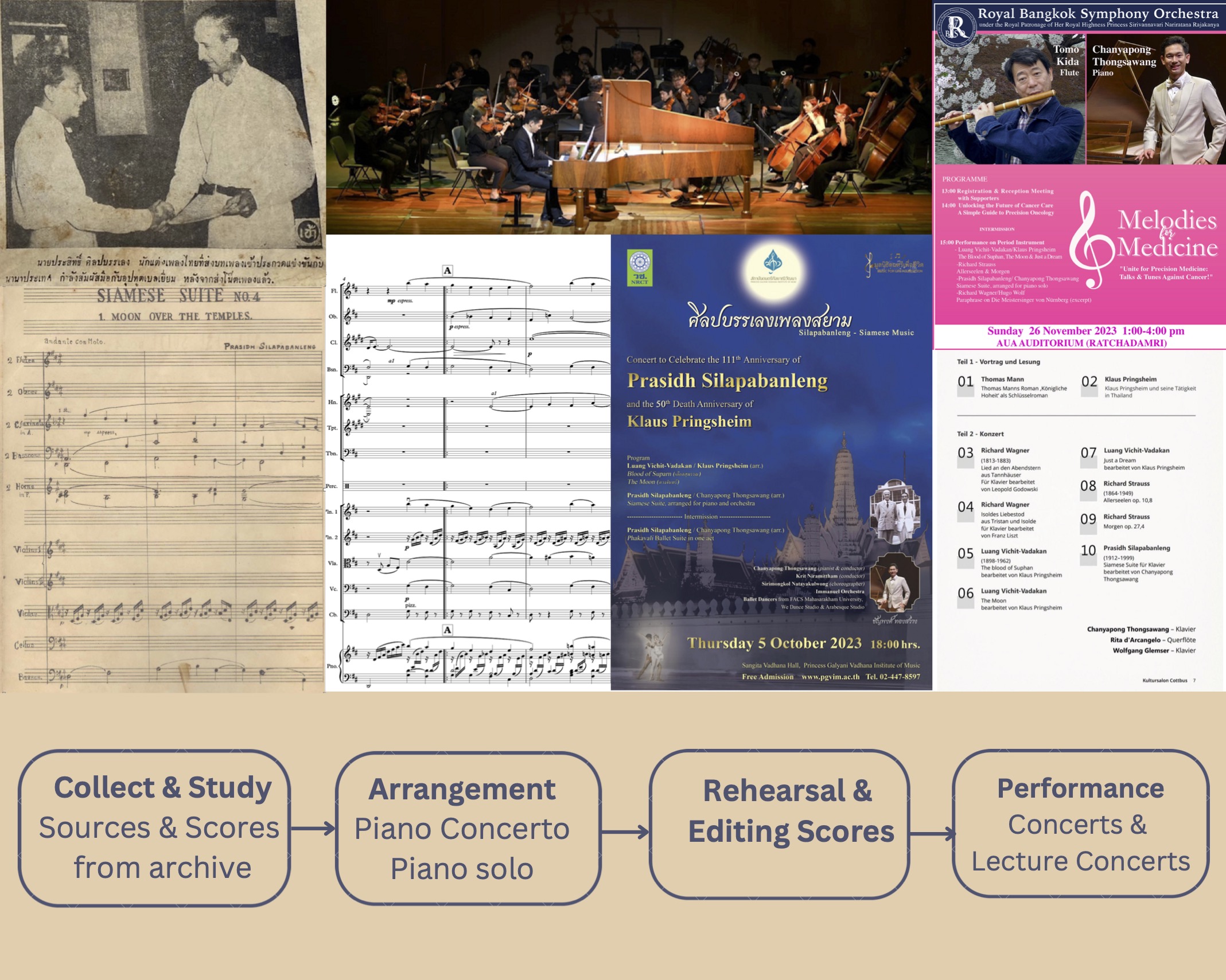
Background and Objectives: Siamese Suite, a masterpiece of Prasidh Silapabanleng, was composed in May 1953 for the Queen Elisabeth Competition (international composition category) in Belgium. It was finally premiered at the UNESCO Music Conference in Manila, the Philippines, in 1954. Siamese Suite is the first Thai composition with a symphonic structure, consisting of four movements that showcase the essence of Thai cultural identity and music through the use of Western classical composition techniques. The first movement, “Moon over the Temple” in Andante con moto tempo, is based on an earlier piece called Intermezzo, composed for a graduation exam with Professor Klaus Pringsheim in Japan. The second movement, “In the Grand Palace” in Moderato tempo, reflects the Thai monarchy and the grandeur of the royal palace. The third movement, “Siamese Lament” in a slow tempo Lento cantabile, features a sorrowful melody, imitating the mournful sound of the Thai pi (an oboe-like instrument). The final movement, entitled “In Bangkok’s Chinatown,” is the longest, consisting of four parts: “Introduction” (Adagio), “Love Scene” (Lento), “Heartbreak” (Andante cantabile), and “At the Wedding” (Allegro). It derived from the original song “Chuen-Jai” (Rejoice) with a merry dance scene from the play “Ka-Buan-Se-Ri-Jean”, which reflects the Chinese Freedom Movement in 1937 by young Chinese students against Japanese occupation during the early stage of the second Sino-Japanese war. On the occasion of the 111th anniversary of Prasidh Silapabanleng, the 125th anniversary of Luang Vichit-Vadakan, and the 50th anniversary of the passing of Klaus Pringsheim, a renowned composer and supervisor of Prasidh Silapabanleng at the Tokyo Academy of Music between 1935-37, the author conducted an artistic research project entitled “Silapabanleng’s Siamese Music, performed by Immanuel Orchestra in the community of Klongtoey” in 2023. The research aimed to arrange and perform Thai classical music in new transcriptions, while providing music education and performance opportunities for youth in the Klongtoey community through the Music for Life Foundation.
Methods: The researcher collected and studied the biography and works of Prasidh Silapabanleng from various sources such as books, music scores, letters, documents, stage play manuscripts, recordings, and photographs. The Siamese Suite was analyzed in detail from the original manuscript by the composer’s student, Mr. Kasem Suwongse, and from the later printed score by the Royal Thai Navy Music Division. The composition was arranged by the author for piano and orchestra as a piano concerto, maintaining the original harmonies while adapting it for piano performance. Additionally, the piece was arranged for solo piano performance, with efforts to preserve the orchestral sound’s essence by incorporating pianistic techniques such as arpeggios, tremolos, and traditional Thai musical elements to make it suitable for frequent performance. During rehearsals with the orchestra, the researcher adjusted both the piano part and orchestral arrangement to ensure effective mutual support and harmony.
Results: Performing the piano alongside the orchestra helped young musicians play more accurately in pitch, as the piano provided clear pitch references. Moreover, the piano added expressiveness, enriching the overall sound with techniques exploring the instrument’s tonal range, including smooth arpeggios, tremolo, imitation of the “Kro” technique from traditional Thai music, and the use of octave intervals played with alternating hands as an alternative to the marimba. This arrangement preserved the original composition’s uniqueness while expanding its accessibility to new audiences and contemporary contexts.
Conclusions: Today, Thai classical music is often arranged in various styles to suit modern social and cultural contexts. This artistic research project aims to promote valuable Thai musical works in forms that attract contemporary audiences, especially youth, enabling them to experience the aesthetics of Thai classical music while preserving historical narratives that may have been overlooked or forgotten. Through community-engaged arrangement and performance, this project serves as a bridge connecting the past and present, fostering understanding and appreciation for Thai cultural heritage.
References
Atthakor, Ploenpote. “Hailing the Hero: Concert Celebrates the Centennial of Prasidh Silapabanleng Who Crucially Forged the Link between Thai and Western Music.” Bangkok Post, August 14, 2012. https://www.bangkokpost.com/life/arts-and-entertainment/307514/hailing-the-hero.
Boonyamanop, Arun. “Phakavali [Manuscript].” Prasidh Silapabanleng Archives. Accessed December 21, 2024. https://archives-prasidh.silapabanleng.org/index.php/zw4g-2dph-h8tm.
Eisinger, Ralf. Klaus Pringsheim aus Tokyo. Zur Geschichte eines musikalischen Kulturtransfers. Munich: Ludicium, 2020.
Memorial Book for the Cremation Ceremony of Prasidh Silapabanleng. Bangkok: Vachirintsarn, 1999. (in Thai)
Natayakul, Sirimongkol. Phakavali: Legend of Thai Stage Theatre. Bangkok: Inthaninpress, 2012. (in Thai)
PGVIM Channel. “Silapabanleng - Siamese Music (part 1).” YouTube Video, 33:43. December 7, 2023. https://www.youtube.com/watch?v=8U2-DOg7GM0&t=513s.
Sakulsurarat, Pasinee, and Weerachat Premananda. “Doctoral Music Composition: The Portraits of Prasidh Silapabanleng.” Rangsit Music Journal 14, no. 2 (July-December 2019): 88-102. (in Thai)
Silapabanleng, Prasidh. Sai Sumphan. The Latvian National Symphony Orchestra, Terje Mikkelsen, conductor. Riga Recording Studio, June 2005. CD.
Silapabanleng, Prasidh. “Siamese Suite [Manuscript, 1953].” Prasidh Silapabanleng Archives. Accessed December 21, 2024. https://archives-prasidh.silapabanleng.org/uploads/r/silapabanleng-archives/4/e/d/4edb1a97daf9e74869803677a3c1f8f57546a77e79b90022890fbca921409dc3/TH-SLPBL-MUS-03-01-041A.pdf.
Silapabanleng, Prasidh. “Siamese Suite, Royal Thai Navy School of Music [Score].” Prasidh Silapabanleng Archives. Accessed December 21, 2024. https://archives-prasidh.silapabanleng.org/uploads/r/silapabanleng-archives/b/2/d/b2d660ae5dc2308a4694abf8f6115e817d89b6d7c73f505132a2a0cc034f5ee4/TH_SLPBL_MUS-03-01-43D.pdf.
Sorrell, Neil. “A Study of a Unique Artist and His Music: Prasidh Silapabanleng (1912-1999).” SPAFA Journal 10, no. 1 (January-April 2000): 5-24.
Thongsawang, Chanyapong. Silapabanleng’s Siamese Music. Bangkok: Tanapress, 2023. https://archives-prasidh.silapabanleng.org/uploads/r/silapabanleng-archives/1/1/1/111e01edd4b118e98246329233f7d2b93d117f1812a41436bfc018da484d028b/TH_SLPBL_BKP.01.05.pdf. (in Thai)
Downloads
Published
How to Cite
Issue
Section
License
Copyright (c) 2025 College of Music

This work is licensed under a Creative Commons Attribution-NonCommercial-NoDerivatives 4.0 International License.
The copyright of the article belongs to the author. Published articles represent the views of the authors. The editorial team neither necessarily agree with nor take any responsibility for the article.