A SINGLE-CASE STUDY OF USING MUSIC THERAPY TO IMPROVE EXPRESSIVE LANGUAGE IN A STROKE PATIENT WITH BROCA'S APHASIA
Keywords:
Stroke, Aphasia, Broca's Aphasia, Music Therapy, Neurologic Music Therapy, Melodic Intonation Therapy, Therapeutic SingingAbstract
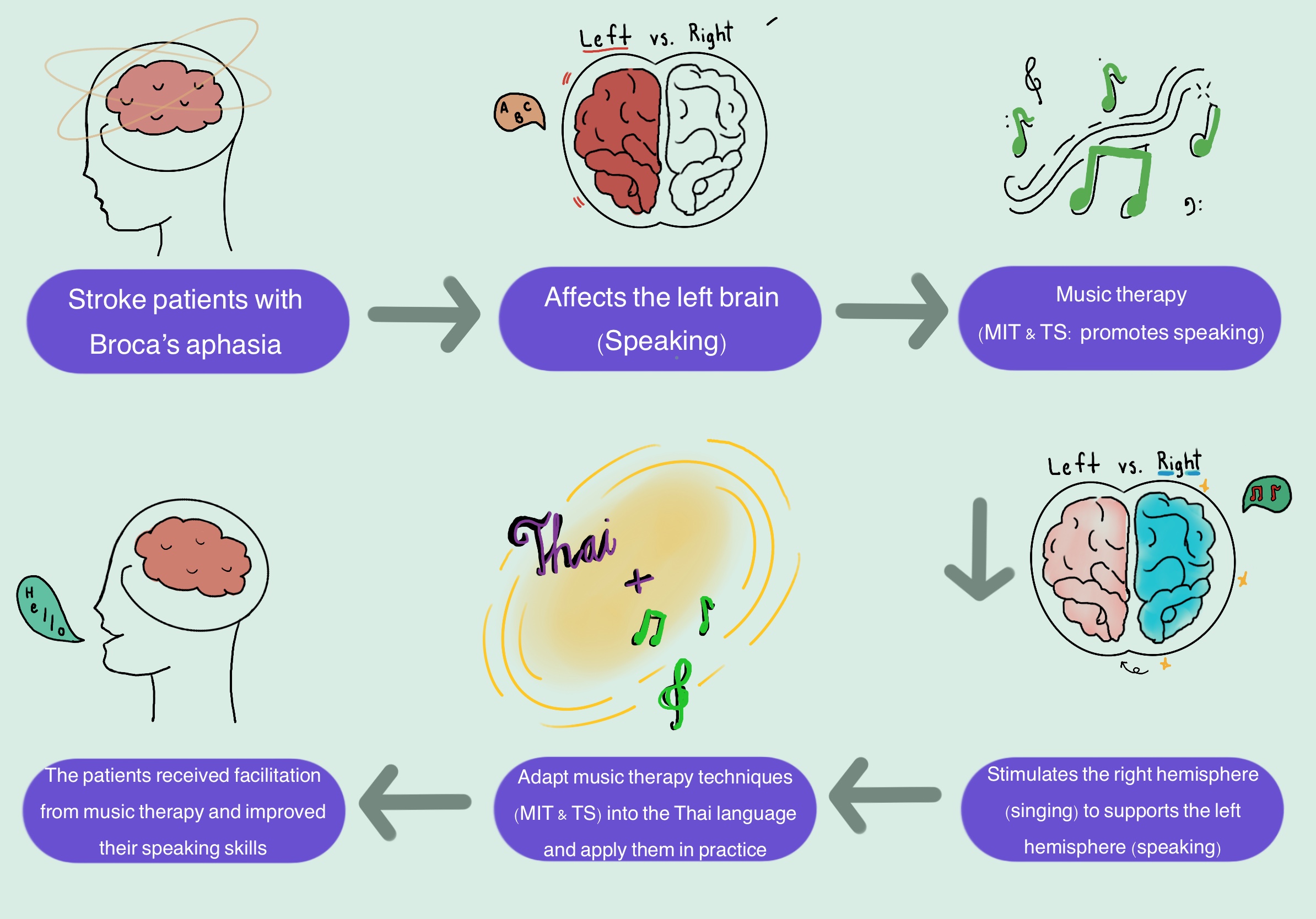
Background and Objectives: This research examines the effect of music therapy on improving expressive language in stroke patients with Broca’s aphasia. Broca’s aphasia is a form of language impairment characterized by a significant difficulty in speaking and constructing grammatically correct sentences, particularly affecting conjunctions and prepositions such as ‘and,’ ‘or,’ and ‘but.’ Broca’s aphasia patients may also struggle with using prepositions. Although they retain an understanding of language and are aware of their communicative intentions, damage to the brain regions involved in speech production hinders their ability to articulate thoughts accurately, resulting in limited vocabulary. For example, a patient who wishes to say, ‘Take the dog for a walk,’ might express it as simply, ‘Dog walk.’ The rehabilitation of these skills often focuses primarily on speech therapy. Speech therapists provide various assessments and exercises to help patients practice and regain their speech abilities, aiming to restore them as closely as possible to their original state. Besides speech therapy, music therapy is another professional field commonly used abroad, either on its own or alongside speech therapy. Numerous studies have highlighted the positive impact of music therapy on the recovery from Broca’s aphasia. Music therapy is defined as the use of musical activities to support individualized therapeutic goals, emphasizing the dynamic interaction between the music therapist, music, and the client. These activities must be grounded in research, and music therapists are required to have completed accredited music therapy training. Through the researcher’s investigation, it was found that, in Thailand, a considerable number of stroke patients experience significant challenges in communication. However, music therapy has not yet been incorporated into the rehabilitation process for improving communication skills in stroke patients. Furthermore, the adaptation of music therapy to align with Thailand’s unique linguistic context remains underdeveloped. Internationally, numerous studies have explored the benefits of music therapy in stroke patients with Broca’s aphasia. These studies highlight that musical tones and rhythms can stimulate the right hemisphere of the brain, compensating for damage to the left hemisphere, enabling patients to use singing as an alternative means of communication. International research has investigated the use of music—particularly pitch, melody, and rhythm—to engage undamaged brain regions and facilitate recovery. Neurologic Music Therapy commonly employs techniques such as Melodic Intonation Therapy (MIT) and Therapeutic Singing (TS). While most studies focus on English-speaking populations, research on music therapy for stroke patients with Broca’s aphasia in Thailand remains lacking, despite the significant number of individuals affected and their unique linguistic needs. This study aims to examine the impact of music therapy on the rehabilitation of language skills in stroke patients with Broca’s aphasia. It seeks to provide guidelines for patients and families on utilizing music therapy for speech recovery and to offer insights for music therapists on effective rehabilitation methods. Additionally, this research will contribute valuable knowledge for further studies in this area.
Methods: This research employs a mixed-method incorporating both A-B single-case and a case-study design. Using Melodic Intonation Therapy and Therapeutic Singing, this study focuses on four key areas of speaking skills: intelligible verbalizations, verbalizing single words, verbalizing phrases, and verbalizing sentences. The music therapy intervention consisted of eight sessions in total. The Individualized Music Therapy Assessment Profile (IMTAP) and Thai Adaptation Aphasia Battery (T-WAB) were used to measure the outcome. The researcher employed the Thai Adaptation of the Western Aphasia Battery (T-WAB) to evaluate and classify the type and severity of aphasia. This assessment includes four key areas: 1) Spontaneous Speech, 2) Auditory Verbal Comprehension, 3) Repetition, and 4) Naming. Testing occurred both before and after the music therapy interventions, with assessments conducted by a speech therapist. Furthermore, the researcher used the Individualized Music Therapy Assessment Profile (IMTAP), a tool that music therapists utilize to evaluate various abilities in both children and adults. This study focuses on the language skills section (Expressive Communication), particularly subcategory E: Verbalizations, which encompasses assessments of comprehension, single-word responses, phrase construction, and sentence formation.
Results: The results showed that intelligible verbalizations during the baseline phase had an average of 40%, which steadily increased to 80% and even 100% during the music therapy phase. Verbalization of single words averaged 50% at the baseline, but scores gradually increased throughout the music therapy sessions, reaching a peak at 100%. For phrase-length verbalizations, the baseline average was 33.3%, which improved to 80% and eventually to 100% during the music therapy phase. Verbalization of sentences showed a baseline average of 0%, but increased to 40%, 80%, and 100% over the course of the therapy sessions.
Conclusions: This research provides guidelines for using music therapy to enhance the speaking skills of stroke patients with Broca’s aphasia. From this study, music therapists can gain valuable methods and procedures for applying music therapy techniques to improve expressive language in such patients, while those interested in further studying this population can also receive useful insights and guidelines for using music therapy in future research and development.
References
Al-Shdifat, Khalid G., Jawdat Sarsak, and Fatoon A. Ghareeb. “Exploring the Efficacy of Melodic Intonation Therapy with Broca’s Aphasia in Arabic.” South African Journal of Communication Disorders 65, no. 1 (2018): a567. https://doi.org/10.4102/sajcd.v65i1.567.
American Music Therapy Association. “What Is Music Therapy?” Accessed August 14, 2022. https://www.musictherapy.org/about/musictherapy.
American Stroke Association. “About Stroke.” Accessed October 8, 2022. https://www.stroke.org/en/about-stroke.
Boucher, V., L. J. Garcia, J. Fleurant, and J. Paradis. “Variable Efficacy of Rhythm and Tone in Melody-Based Interventions: Implications for the Assumption of a Right-Hemisphere Facilitation in Non-Fluent Aphasia.” Aphasiology 15, no. 2 (2001): 131-149. https://doi.org/10.1080/02687040042000098.
Conklyn, Dwyer, Eric Novak, Adrienne Boissy, Francois Bethoux, and Kamal Chemali. “The Effects of Modified Melodic Intonation Therapy on Nonfluent Aphasia: A Pilot Study.” Journal of Speech, Language, and Hearing Research 55, no. 5 (October 2012): 1463-1471. https://doi.org/10.1044/1092-4388(2012/11-0105).
Creswell, John W. Research Design: Qualitative, Quantitative, and Mixed Methods Approaches. 3rd ed. Thousand Oaks, CA: Sage Publications, 2009.
Farooq, Idrees, Muhammad Ahmed, Muhammad Azzam Khan, Saba Yaqoob, Bareera Saeed, Mishal Butt, Fahad Masood, and Tallat Anwar Faridi. “Efficacy of Melodic Intonation Therapy in Patients with Chronic Broca’s Aphasia: Speech Language Pathology Perspective: Melodic Intonation Therapy in Chronic Broca’s Aphasia.” Pakistan BioMedical Journal 5, no. 4 (April 2022): 206-209. https://doi.org/10.54393/pbmj.v5i4.410.
Haddad, Mora. “The Effects of Melodic Intonation Therapy (MIT) on People with Communication Impairments: A Primary Focus on People with Broca’s Aphasia.” Research papers, Southern Illinois University Carbondale, 2013.
Leonardi, Simona, Alberto Cacciola, Rosaria De Luca, Bianca Aragona, Veronica Andronaco, Demetrio Milardi, Placido Bramanti, and Rocco Salvatore Calabrò. “The Role of Music Therapy in Rehabilitation: Improving Aphasia and Beyond.” International Journal of Neuroscience 128, no. 1 (2018): 90-99. https://doi.org/10.1080/00207454.2017.1353981.
Lim, Kil-Byung, Yong-Kyun Kim, Hong-Jae Lee, Jeehyun Yoo, Ji Youn Hwang, Jeong-Ah Kim, and Sung-Kyun Kim. “The Therapeutic Effect of Neurologic Music Therapy and Speech Language Therapy in Post-Stroke Aphasic Patients.” Annals of Rehabilitation Medicine 37, no. 4 (August 2013): 556-562. https://doi.org/10.5535/arm.2013.37.4.556.
National Aphasia Association. “Aphasia Therapy Guide.” Accessed October 8, 2022. https://www.aphasia.org/aphasia-resources/aphasia-therapy-guide/.
National Institute on Deafness and other Communication Disorders. “Aphasia.” Accessed October 8, 2022. https://www.nidcd.nih.gov/health/aphasia.
Piccolo, Adriana, Francesco Corallo, Davide Cardile, Michele Torrisi, Chiara Smorto, Simona Cammaroto, and Viviana Lo Buono. “Music Therapy in Global Aphasia: A Case Report.” Medicines 10, no. 2 (February 2023): 16. https://doi.org/10.3390/medicines10020016.
Racette, Amélie, Céline Bard, and Isabelle Peretz. “Making Non-Fluent Aphasics Speak: Sing Along!” Brain 129, no. 10 (October 2006): 2571-2584. https://doi.org/10.1093/brain/awl250.
Thaut, Michael H., and Volker Hoemberg, eds. Handbook of Neurologic Music Therapy. New York: Oxford University Press, 2014.
Tomaino, Concetta M. “Effective Music Therapy Techniques in the Treatment of Nonfluent Aphasia.” Annals of the New York Academy of Sciences 1252, no. 1 (April 2012): 312-317. https://doi.org/10.1111/j.1749-6632.2012.06451.x.
Wan, Catherine Y., Theodor Rüber, Anja Hohmann, and Gottfried Schlaug. “The Therapeutic Effects of Singing in Neurological Disorders.” Music Perception: An Interdisciplinary Journal 27, no. 4 (April 2010): 287-295. https://doi.org/10.1525/mp.2010.27.4.287.
Yamadori, A., Y. Osumi, S. Masuhara, and M. Okubo. “Preservation of Singing in Broca’s Aphasia.” Journal of Neurology, Neurosurgery & Psychiatry 40, no. 3 (March 1977): 221-224. https://doi.org/10.1136/jnnp.40.3.221.
Downloads
Published
How to Cite
Issue
Section
License
Copyright (c) 2025 College of Music

This work is licensed under a Creative Commons Attribution-NonCommercial-NoDerivatives 4.0 International License.
The copyright of the article belongs to the author. Published articles represent the views of the authors. The editorial team neither necessarily agree with nor take any responsibility for the article.