CULTURAL ARTS KNOWLEDGE TRAINING COURSE FOR THE SURVIVAL OF ETHNIC GROUPS IN PHUTAKIAN COMMUNITY THA SAO SUBDISTRICT, SAI YOK DISTRICT, KANCHANABURI PROVINCE
Keywords:
Ethnic Arts and Culture, Training Courses, ExistenceAbstract
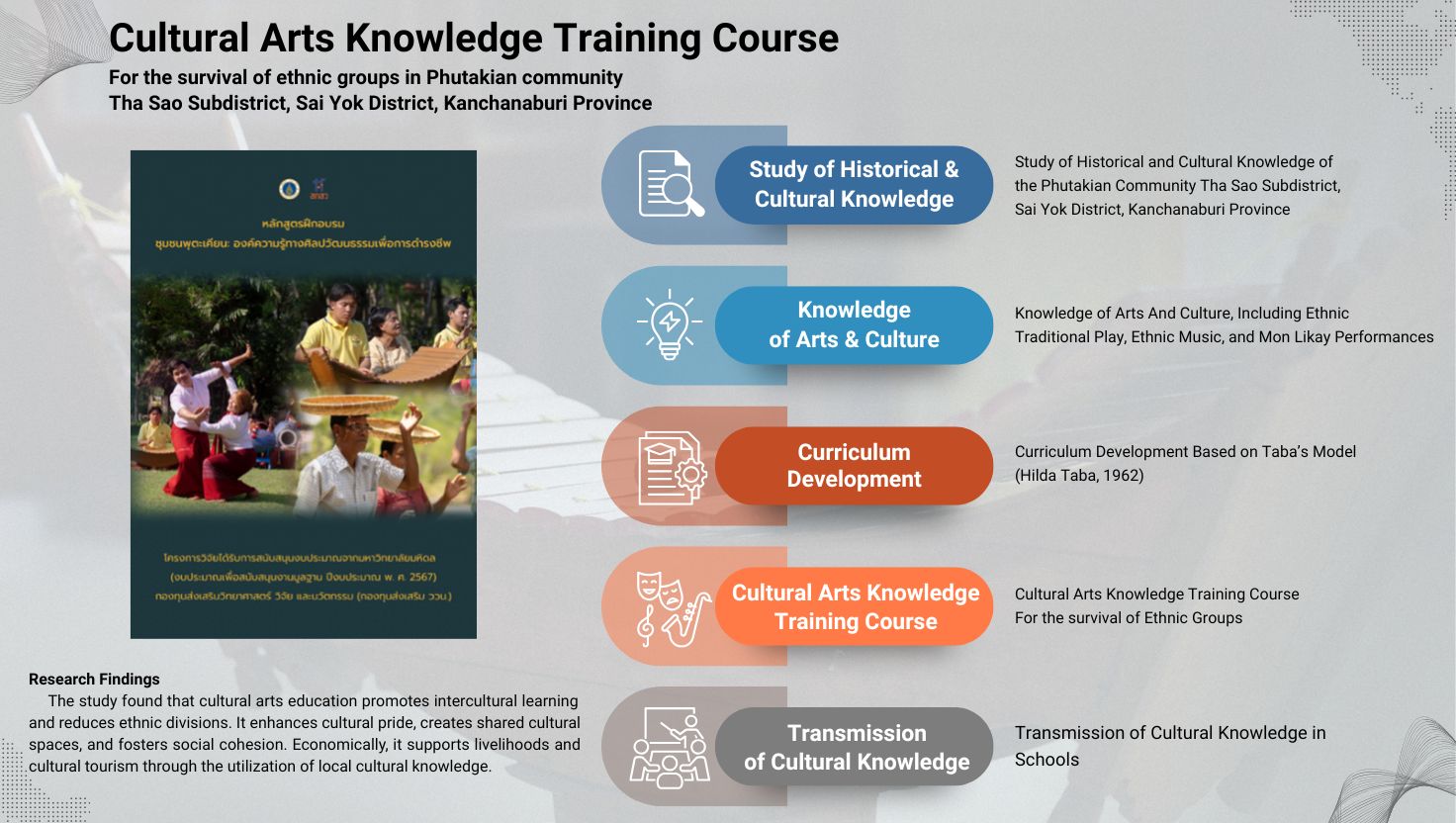
Background and Objectives: The Ban Phutakian Community, Tha Sao Subdistrict, Sai Yok District, Kanchanaburi Province, is a community with a history that dates back to before World War II. It is also a community where various ethnic groups have settled, including the Mon ethnic group, the Karen ethnic group, the Thai Yuan ethnic group, and other ethnic groups. As a result, the arts and culture within this community are diverse and unique. It has also provided arts and culture occupations that support people in the community. However, due to the changing social and cultural situation, the knowledge of arts and culture that has a role and function in traditions and culture has been reduced in importance, which also affects these arts and culture occupations. The number of people employed in arts and culture has decreased. As a result, music teachers, musicians, and actors have moved and changed their occupations, which is an important reason why the arts and culture that are the foundation of the Phutakian community are disappearing. Therefore, this research aims to study the history and knowledge of arts and culture for the livelihood of ethnic groups and to develop a training curriculum for knowledge of arts and culture for the livelihood of ethnic groups, in order to be a tool for preserving and restoring cultural heritage to remain in a tangible form and to be an important foundation for the development of training curricula which will help promote the transfer of knowledge from generation to generation systematically, resulting in participatory learning within the community. This can also create opportunities to adapt traditional wisdom to suit modern lifestyles, which will lead to awareness of cultural values in ethnic groups, especially among youth who are the inheritors of knowledge in the future.
Methods: We conducted the research using Participatory Action Research (PAR) as the primary methodological framework. Field data were collected through semi-structured interviews, focus group discussions, and participant observation. The key informants included: (1) community leaders and local wisdom holders, (2) musicians and performing artists, and (3) school directors and teachers. Additionally, a quantitative research component was conducted using a questionnaire survey, with the population and sample group consisting of students at Phutthawimut Wittaya School.
Results: The research results found that history and knowledge of arts and culture are cultural heritages of ethnic groups, reflecting the identity of the community through knowledge of arts and culture, including ethnic traditional play, ethnic music, and Mon Likay performances. However, due to social and cultural changes, some of this knowledge has been lost. The community has therefore begun to restore it by using the educational process. This process can be integrated with Participatory Action Research (PAR) community participation to conduct training courses to create a learning process in arts and culture. The evaluation results of the training course on knowledge of arts and culture for livelihood showed that the level of awareness of the training course on arts and culture for livelihood in terms of curriculum and content, lecturers, teaching media and equipment, study locations, and environment was at a high level. In terms of training activities, knowledge and understanding gained from training, as well as application of this knowledge, were at the highest level.
Conclusions: This research aimed to study the history and knowledge of arts and culture for the livelihood of ethnic groups within the Phutakian community. This knowledge of arts and culture has been passed down from generation to generation, becoming a model that can be learned, especially ethnic traditional play, music, and Mon Likay performances. It plays an important role in traditions and rituals and enhances entertainment, love, and unity within the community. However, with the current social and cultural dynamics, the arts and culture of ethnic groups within the community have begun to disappear. Therefore, this study designed the process of developing a training course on knowledge of arts and culture for the livelihood of ethnic groups using the concept of curriculum development, starting from problem analysis, setting goals, selecting and organizing content, and designing learning experiences to evaluation, emphasizing the participation of knowledgeable people in ethnic communities together with educational institutions to create a learning process that is consistent with the context of the community. The results of this research indicate that the development of such a training course is a concrete approach that can effectively conserve, restore, and promote the continuation of cultural knowledge and plays an important role in sustainably maintaining cultural identity in the community.
References
Assawarangseekul, Napaporn. “Problems of Ethnic Groups in Thailand: Cultural Identity Changes.” In RSU National Research Conference 2019, Rangsit University, April 26, 2019, 947-957. https://rsucon.rsu.ac.th/files/proceedings/nation2019/NA19-089.pdf. (in Thai)
Athikhomnantha, Phachongchit. Changes in Thai Society and Culture. Bangkok: Ramkhamhaeng University, 2000. (in Thai)
Boonanon, Amnat. “Development of Lanna Traditional Music Curriculum for Mattayomsuksa Two in the Nan Cultural Zone.” Rajabhat Chiang Mai Research Journal 12, no. 2 (April-September 2011): 67-78. https://so05.tci-thaijo.org/index.php/cmruresearch/article/view/95988/74967. (in Thai)
Boonserm, Pawinee. “Developing Local Dance to Promote Ethnic Group Identity in Kanchanaburi for the Thai Tourism Industry.” Journal of Communication Arts 40, no. 2 (May-August 2022): 24-40. https://so02.tci-thaijo.org/index.php/jcomm/article/view/251146/172666. (in Thai)
Burkey, Richard M. Ethnic and Racial Groups: The Dynamics of Dominance. Menlo Park, CA: Cummings, 1978.
Kaewsawang, Papar-orn. “The Development of Local Curriculum: Music and Ancient Remains in Lopburi: A Case of The Sacred Performance for Relics Worship.” Journal of Humanities and Social Sciences Nakhon Phanom University 13, no. 3 (September-December 2023): 246-257. https://so03.tci-thaijo.org/index.php/npuj/article/view/271734/181388. (in Thai)
Kanchanaburi Provincial Cultural Office. Report on the Performance of the Missions Assigned by the Office of Cultural Surveillance and Public Relations Kanchanaburi. Kanchanaburi: Kanchanaburi Provincial Cultural Office, 2013. (in Thai)
Khaopluem, Pinthip, and Nawat Laothong. “The Development of Thai Musical Instrument (Woodwind) Craftsman Curriculum of Nonthaburi Province.” Mahidol Music Journal 5, no. 2 (September 2022 - February 2023): 56-70. https://so04.tci-thaijo.org/index.php/mmj/article/view/259707/178710. (in Thai)
Kutanan, Wibhu, Dang Liu, Jatupol Kampuansai, Metawee Srikummool, Suparat Srithawong, Rasmi Shoocongdej, Sukrit Sangkhano, et al. “Reconstructing the Human Genetic History of Mainland Southeast Asia: Insights from Genome-Wide Data from Thailand and Laos.” Molecular Biology and Evolution 38, no. 8 (August 2021): 3459-3477. https://doi.org/10.1093/molbev/msab124.
Lipson, Mark, Olivia Cheronet, Swapan Mallick, Nadin Rohland, Marc Oxenham, Michael Pietrusewsky, Thomas Oliver Pryce, et al. “Ancient Genomes Document Multiple Waves of Migration in Southeast Asian Prehistory.” Science 361, no. 6397 (July 2018): 92-95. https://www.science.org/doi/full/10.1126/science.aat3188.
McDonald, E. J., “The Development and Evaluation of a Set of Multimedia Self- Instructional Learning Packages for Use in Remedial English at Urban Community College.” Dissertation Abstracts International 34, no. 09 (1971): 432-599.
Mulmanee, Sompong. “Salina of Thung Kula Rong Hai: Legend, Ecological Space, and Creation of Cultural Identity.” Wiwitwannasan Journal of Language and Culture 2, no. 1 (January-April 2018): 81-95. https://so06.tci-thaijo.org/index.php/wiwitwannasan/article/view/192734. (in Thai)
Nithedsilp, Woravit, and Chawalit Kodsiri. “An Integrated Instruction with Art and Cultural Preservation for Lanna Community.” Dhammathas Academic Journal 17, no. 3 (September-December 2017) Special Issue: 285-295. https://so06.tci-thaijo.org/index.php/dhammathas/article/view/111358. (in Thai)
Opap, Worasit, Sirirat Kaewnet, Benjamas Topinjai, and Pollavat Praphattong. “The Cultural Spaces Establishment in Community with Diversity of Ethnic Groups in Baan Huay Nam Khun Chiangrai Province.” Research Report, Office of the National Culture Commission, 2006. (in Thai)
Piriyakarnnon, Methee, and Nopadon Thungsakul. “Article Review: Public Space, Cultural Space and Public Cultural Space.” NAJUA: History of Architecture and Thai Architecture 18, no. 1 (January-June 2021): 134-158. https://so04.tci-thaijo.org/index.php/NAJUA/article/view/252584. (in Thai)
Pongsapich, Amara. Cultural Transmission and Receipt in Society and Culture. Bangkok: Image Printing, 1997. (in Thai)
Purcarea, Irina. “Cultural Entrepreneurship. The Importance of Developing Cultural Competences within the Framework of Resource Mobilization.” Holistic Marketing Management Journal 5, no. 4 (December 2015): 15-21.
Santasombat, Yos. Human and Culture. Bangkok: Thammasat University Press, 1997. (in Thai)
Smith, Gregory A. “Place-Based Education: Learning to Be Where We Are.” Phi Delta Kappan 83, no. 8 (April 2002): 584-594. https://doi.org/10.1177/003172170208300806.
Taba, Hilda. Curriculum Development: Theory and Practice. New York: Harcourt, Brace & World, 1962.
Taptiani, Nisa, Anjar Mahadi, Ibn Fajar Romadhon, Arvi Muhammad Pratama, Rafli Muhammad, Eko Purwanto, Dian Nurvita Sari, et al. “The Impact of Globalization on Local Culture.” International Journal of Progressive Sciences and Technologies 45, no. 1 (June 2024): 92-102. https://ijpsat.org/index.php/ijpsat/article/view/6233.
Tipduangta, Chonthicha, Nongluck Kienngam, Somkiart Intasingh, and Chetthapoom Wannapaisan. “State, Problems, and The Needs of Development Local Curriculum Using Community Participation-Based Learning to Enhance Creative Thinking and Respectful Mind for Elementary Students, Chiang Mai Province.” Journal of Social Science and Buddhistic Anthropology 7, no. 1 (January 2022): 130-149. (in Thai)
Travers, Paul D., and Ronald W. Rebore. Foundation of Education: Becoming a Teacher. 2nd ed. Englewood Cliffs, NJ: Prentice-Hall, 1990.
Wankaew, Surichai. Social and Cultural Changes. 12th ed. Bangkok: Chulalongkorn University, 2010. (in Thai)
Wannasiri, Niyaphan. Social and Cultural Anthropology. Bangkok: Kasetsart University Press, 1997. (in Thai)
Wasi, Prawase. Knowledge Management: The Process of Unleashing Human Potential, Freedom, and Happiness. Bangkok: The Knowledge Management Institute, 2005. (in Thai)
Wisadsing, Waewmayura. “Music for Mon Dance Mon Village in Saiyok Kanjanaburi.” Master’s thesis, Chulalongkorn University, 2006. https://cuir.car.chula.ac.th/xmlui/handle/123456789/41425?show=full. (in Thai)
Downloads
Published
How to Cite
Issue
Section
License
Copyright (c) 2025 College of Music

This work is licensed under a Creative Commons Attribution-NonCommercial-NoDerivatives 4.0 International License.
The copyright of the article belongs to the author. Published articles represent the views of the authors. The editorial team neither necessarily agree with nor take any responsibility for the article.