THE DEVELOPMENT OF AN INTEGRATED EMBODIED COGNITION AND MUSIC THERAPY PROGRAM TO ENHANCE EXECUTIVE FUNCTIONS OF PRIMARY STUDENTS WITH A TENDENCY TOWARD LEARNING DISABILITIES
DOI:
https://doi.org/10.65824/mmj.v9.280937Keywords:
Embodied Cognition, Music Therapy, Executive Functions, Students with Learning Disabilities, Primary Students, Integrated Intervention ProgramAbstract
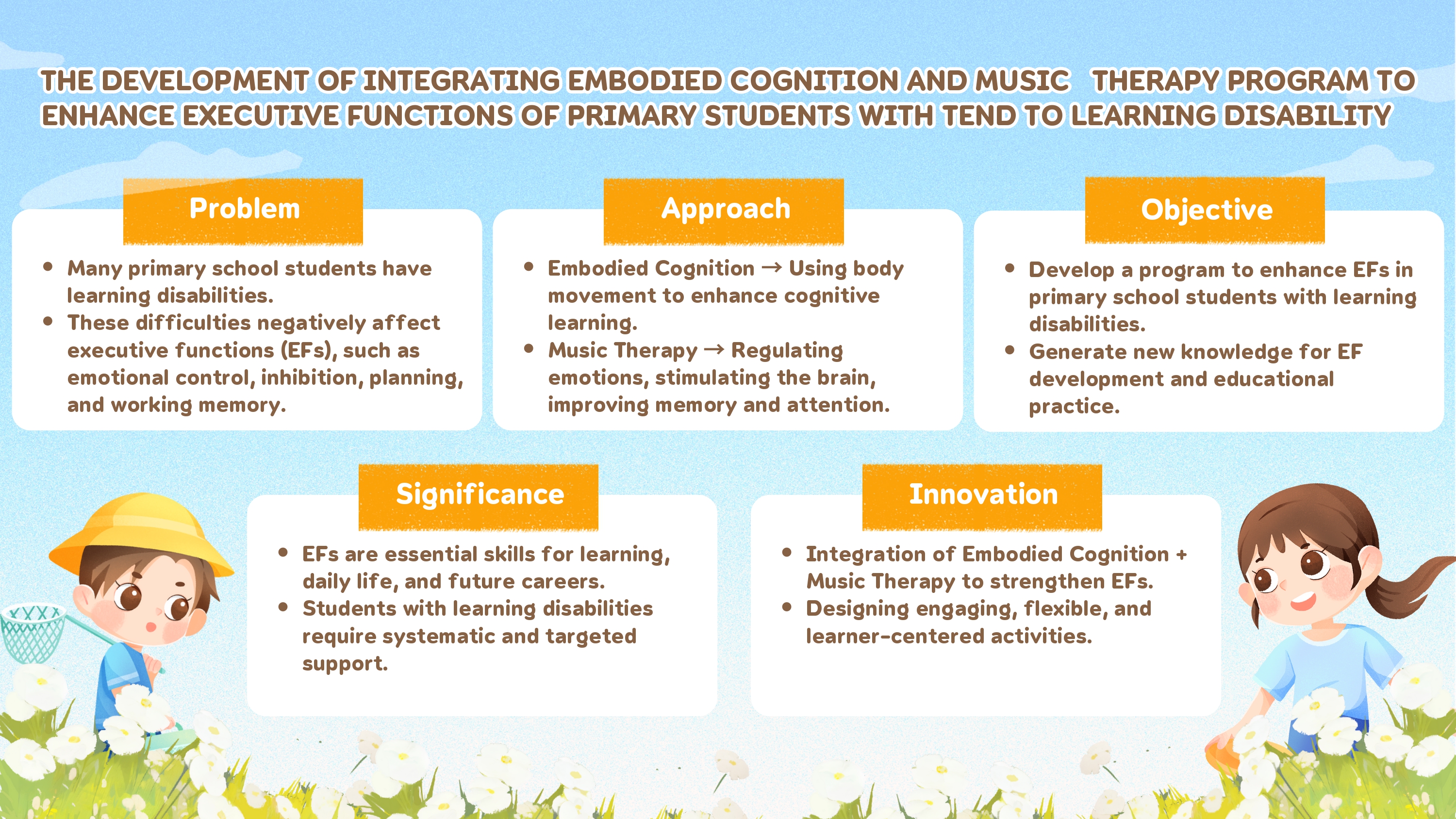
Background and Objectives: In recent years, a growing number of primary school students have been identified as having a tendency toward learning disabilities, which significantly impacts their academic development, classroom adaptation, and social functioning. Of particular concern are deficits in executive functions—a set of cognitive skills involving self-regulation, planning, working memory, and cognitive flexibility. Students with weaknesses in these areas often struggle with behavior regulation, following multi-step instructions, and maintaining attention, all of which hinder learning. Embodied cognition is a concept that emphasizes the integration of bodily experiences into the learning process. When combined with music therapy—a well-documented method for stimulating brain regions related to executive function—this integrated approach offers an innovative strategy to support cognitive development in children with learning difficulties. The use of music and movement in learning may lead to improved attention, emotional regulation, and self-discipline, especially when designed in developmentally appropriate, engaging formats. This study, therefore, aimed to: (1) explore the executive function skills of primary school students with a tendency toward learning disabilities; (2) develop an integrated embodied cognition and music therapy program to enhance their executive functions; and (3) examine the effectiveness of the developed program in improving executive function skills among the target group.
Methods: This mixed-methods study was conducted in two phases. Phase 1 involved a survey of executive function skills among 230 primary school students suspected of having learning disabilities. Participants were selected from schools under the Office of the Basic Education Commission in Bangkok. The assessment tool used was the KU-THEF (Teacher Version), which evaluates nine domains of executive function: inhibition, emotional control, flexibility, initiation, planning and organization, working memory, task monitoring, self-monitoring, and materials organization. Phase 2 involved an experimental intervention using a quasi-experimental design. Sixty students were purposively selected and divided equally into an experimental group (n = 30) and a control group (n = 30). The experimental group participated in a 10-session intervention program (45 minutes per session), incorporating embodied cognition and music therapy-based activities, such as “I Create the Rhythm,” “Remember and Jump,” “Move as I Plan,” “Clean it up,” and “I Am the Inspector.” All participants were assessed before the intervention (pre-test), immediately after (post-test), and four weeks later (follow-up test). Data were analyzed using descriptive statistics and ANCOVA to compare performance across the three time points between the two groups.
Results: The findings from phase one revealed that the majority of students exhibited below-standard levels of EF, particularly in the domains of task monitoring, material organization, planning and organization, working memory, and initiation. In phase two, the experimental group demonstrated statistically significant improvements in their overall executive function scores compared to the control group (p < .05), both in the post-test and the follow-up test. Notable gains were observed in planning and organization, working memory, and self-regulation—core components of executive functioning necessary for learning and everyday functioning. Additionally, behavioral observations and teacher reports indicated that students in the experimental group showed increased focus, improved task persistence, and greater classroom engagement. Students became more confident, expressed creativity, and participated actively in group activities. Many also demonstrated enhanced responsibility and organization when managing classroom materials.
Conclusions: The integrated embodied cognition and music therapy program developed in this study was found to be effective in enhancing executive functions in primary school students with learning difficulties. Its strength lies in the holistic integration of cognitive, physical, and emotional engagement through structured and playful learning experiences. The activities were developmentally appropriate, stimulating, and motivating for the target group, promoting both skill acquisition and behavioral growth. These findings align with global research trends emphasizing the importance of movement, emotion, and multisensory learning in cognitive development. The success of this intervention suggests strong potential for application in regular school settings, as well as adaptation for other vulnerable student populations. Future studies should consider long-term implementation and cross-contextual validation of the program to further assess its sustainability and impact on academic and social outcomes.
References
Ahokas, J. Riikka. “Brain and Body Percussion: The Relationship between Motor and Cognitive Functions.” Master’s thesis, University of Jyväskylä, 2015.
Alloway, Tracy Packiam, Susan Elizabeth Gathercole, Hannah Kirkwood, and Julian Elliott. “The Cognitive and Behavioral Characteristics of Children with Low Working Memory.” Child Development 80, no. 2 (March-April 2009): 606-621. DOI: https://doi.org/10.1111/j.1467-8624.2009.01282.x
American Music Therapy Association. “What Is Music Therapy?” Accessed August 14, 2022. https://www.musictherapy.org/about/musictherapy.
American Psychiatric Association. Diagnostic and Statistical Manual of Mental Disorders: DSM-5-TR. 5th ed., text revision. Washington, DC: American Psychiatric Association Publishing, 2022. DOI: https://doi.org/10.1176/appi.books.9780890425787
Baddeley, Alan D., and Graham Hitch. “Working Memory.” Psychology of Learning and Motivation 8 (1974): 47-89. DOI: https://doi.org/10.1016/S0079-7421(08)60452-1
Barnett, William Steven. “Preschool Education and Its Lasting Effects: Research and Policy Implications.” Research Report, Great Lakes Center for Education Research and Practice, 2008.
Barsalou, Lawrence W. “Grounded Cognition.” Annual Review of Psychology 59 (2008): 617-645. DOI: https://doi.org/10.1146/annurev.psych.59.103006.093639
Best, John R., and Patricia H. Miller. “A Developmental Perspective on Executive Function.” Child Development 81, no. 6 (November-December 2010): 1641-1660. DOI: https://doi.org/10.1111/j.1467-8624.2010.01499.x
Coull, Jennifer T., Chris D. Frith, Christian Büchel, and Anna C. Nobre. “Orienting Attention in Time: Behavioural and Neuroanatomical Distinction between Exogenous and Endogenous Shifts.” Neuropsychologia 38, no. 6 (June 2000): 808-819. DOI: https://doi.org/10.1016/S0028-3932(99)00132-3
Dackermann, Tanja, Ursula Fischer, Hans-Christoph Nuerk, Ulrike Cress, and Korbinian Moeller. “Applying Embodied Cognition: From Useful Interventions and Their Theoretical Underpinnings to Practical Applications.” ZDM Mathematics Education 49, no. 4 (2017): 545-557. DOI: https://doi.org/10.1007/s11858-017-0850-z
Diamond, Adele. “Executive Functions.” Annual Review of Psychology 64 (2013): 135-168. DOI: https://doi.org/10.1146/annurev-psych-113011-143750
Glenberg, Arthur M. “Embodiment as a Unifying Perspective for Psychology.” WIREs Cognitive Science 1, no. 4 (July-August 2010): 586-596. DOI: https://doi.org/10.1002/wcs.55
Gooding, Lori F. Medical Music Therapy: Building a Comprehensive Program. Silver Spring, MD: American Music Therapy Association, 2014.
Hansomsakkul, Aree, Piyathip Pradujprom, and Peera Wongupparaj. “Enhancing Working Memory in Preschool Children with Dyscalculia Using a Numerical Development and Embodied Cognition Program.” Dhonburi Rajabhat University Journal 15, no. 2 (July-December 2021): 50-65. https://so02.tci-thaijo.org/index.php/journaldru/article/view/253789. (in Thai)
Kruger, Daniel. “An Historical Study of the First Year of the Canadian Association of Music Therapists.” Master’s thesis, Concordia University, 2019.
Moreno, Sylvain, Ellen Bialystok, Raluca Barac, E. Glenn Schellenberg, Nicholas J. Cepeda, and Tom Chau. “Short-Term Music Training Enhances Verbal Intelligence and Executive Function.” Psychological Science 22, no. 11 (November 2011): 1425-1433. https://www.jstor.org/stable/41320049. DOI: https://doi.org/10.1177/0956797611416999
Pahirun, Patcharin, Juthamas Haenjohn, and Sasinan Sirithadakunlaphat. “The Effects of Brain Mind and Learning Training Program on Executive Functions of the Brain of Primary School Students.” Ratchaphruek Journal 16, no. 3 (September-December 2018): 64-71. https://so05.tci-thaijo.org/index.php/Ratchaphruekjournal/article/view/153300/111721. (in Thai)
Saengsawang, Thapanee, Rachada Tubtes, Thitipong Supawatpinyo, Anchan Tondeaw, and Piyaporn Kaewpirom. “Executive Function Skills of Students with Learning Disabilities (LD) in Resource Room.” NEU Academic and Research Journal 13, no. 2 (April-June 2023): 284-296. https://so04.tci-thaijo.org/index.php/neuarj/article/view/265739/180025. (in Thai)
Saksiriphol, Daranee. “Development of Screening Instrument for Preschooler at Risk with Dyscalculia.” Journal of Education Burapha University 31, no. 1 (January-April 2020): 16-28. (in Thai)
Thai Health Promotion Foundation. Kasetsart University and Thai Health of Executive Function Scales (KU-THEF): Teacher Version. Bangkok: Thai Health Promotion Foundation, 2020. (in Thai)
Thanasetkorn, Panadda. “Developing Executive Function (EF) Skills through Positive Discipline.” In Handbook for Developing Executive Functions (EF) Skills for Early Childhood Teachers, edited by Supawadee Harnmethee, Tida Pitaksinsuk, and Pawana Aramrit, 128-159. Bangkok: Matichon, 2018. (in Thai)
Thaut, Michael H., and Volker Hoemberg, eds. Handbook of Neurologic Music Therapy. Oxford: Oxford University Press, 2014.
Wilson, Margaret. “Six Views of Embodied Cognition.” Psychonomic Bulletin & Review 9, no. 4 (December 2002): 625-636. DOI: https://doi.org/10.3758/BF03196322
Zuk, Jennifer, Christopher Benjamin, Arnold Kenyon, and Nadine Gaab. “Behavioral and Neural Correlates of Executive Functioning in Musicians and Non-Musicians.” PLoS One 9, no. 6 (June 2014): e99868. DOI: https://doi.org/10.1371/journal.pone.0099868
Downloads
Published
How to Cite
Issue
Section
License
Copyright (c) 2026 College of Music

This work is licensed under a Creative Commons Attribution-NonCommercial-NoDerivatives 4.0 International License.
The copyright of the article belongs to the author. Published articles represent the views of the authors. The editorial team neither necessarily agree with nor take any responsibility for the article.