THE MUSLIM PROCESSION IN THE SOUTHERN BORDER PROVINCES: A STUDY OF MUSIC CULTURE FOR PRESERVING AND RESTORING CULTURAL HERITAGE
DOI:
https://doi.org/10.65824/mmj.v9.281296Keywords:
Musical Culture, Muslim Procession, Southern Border ProvinceAbstract
Background and Objectives: The culture and way of life of Muslims in the southern border provinces of Thailand are based on the fusion of traditional beliefs influenced by Hinduism, Buddhism, and Islam, which results in local traditions that are unique and different from other regions, especially in terms of religion, language, lifestyle, and various rituals. The organization of the procession is an important element in local traditions that expresses respect, faith, and loyalty to important persons and communicates cultural identity through performing arts, music, costumes, and local arts. The music in the procession plays an important role in creating an atmosphere and enhancing the sacredness of the ritual. It is a representation of the local Muslim music culture that should be preserved, restored, and developed sustainably to promote understanding between people inside and outside the culture and as a case for creating academic knowledge that reflects the identity and wisdom of the southern border communities. The objectives are to study the components of the Muslim procession in the southern border provinces and study the bands in the Muslim procession in the southern border provinces.
Methods: This research on the music culture in the Muslim procession in the southern border provinces is a qualitative research study using an ethnomusicological approach to preserve and restore cultural heritage wisdom. Data were collected through participatory and non-participatory observation, as well as structured and unstructured informal interviews with 8 experts in history, culture, and music and 15 people who are experienced and widely recognized in the community in organizing local parades. The research instruments consisted of cameras, audio recorders, and notebooks. The data collection focused on ethnic history, procession components, musical characteristics, and the roles of local musicians. The data analysis used a descriptive analytical method based on issues related to procession components, musical characteristics, and local cultural identity to present the results in a systematic academic manner.
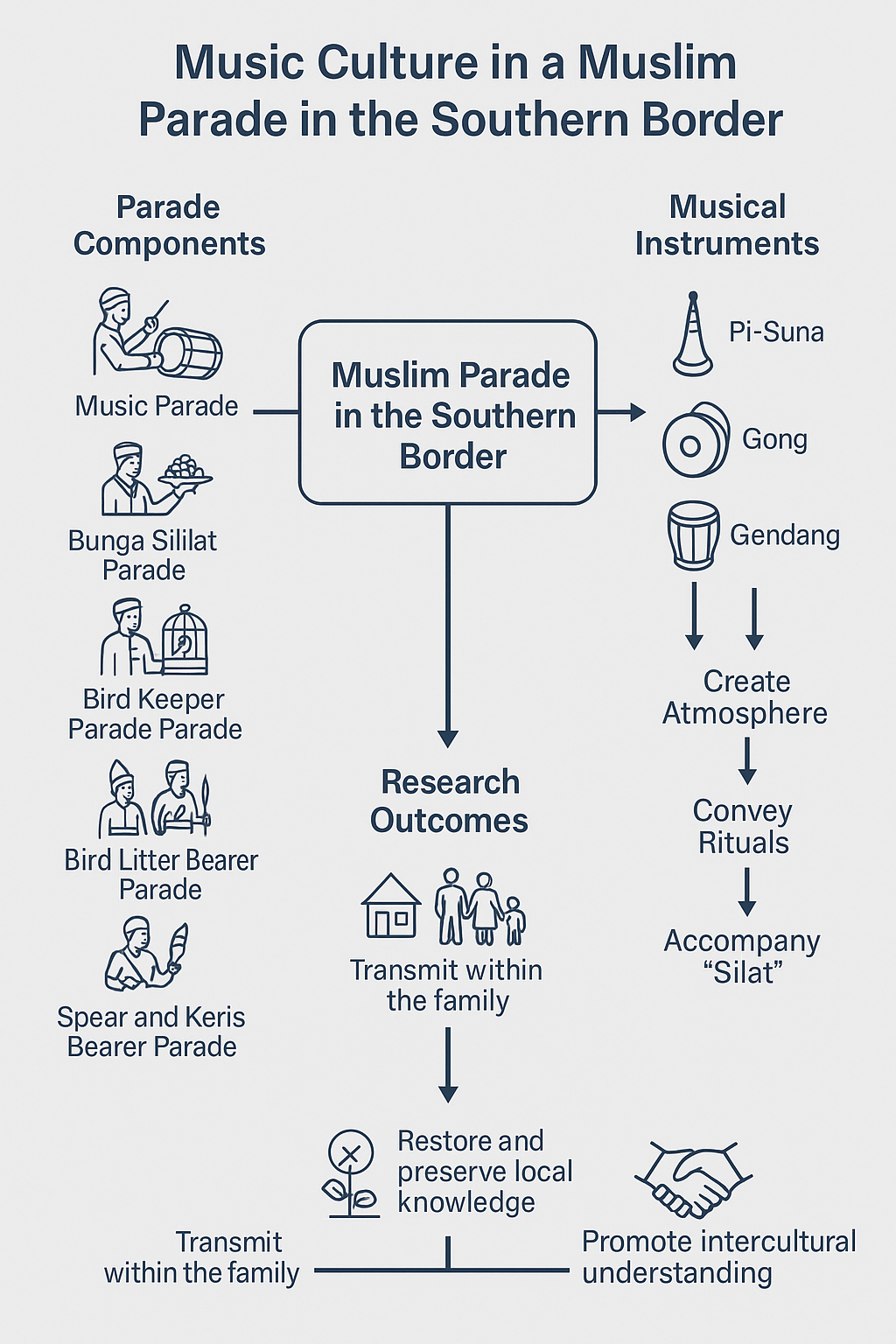
Results: The research results found that the Muslim procession in the southern border provinces is based on beliefs and values from local cultures that combine Brahmanism, Buddhism, and Islam. It consists of 6 processions: a musical procession, a noble procession, a Bunga Sireh procession, a bird caretaker procession, a bird carrying pole procession, and a spear and dagger procession. The participants in the procession are dressed in local southern costumes. The music used in the Muslim procession in the southern border provinces is found to include the Pi-suna, Gong, and Gendang, in the form of a gong and drum ensemble, which plays the sound to make the procession fun, powerful, and sacred, and also performs the Silat (a Malay martial dance). The musical instruments have a loud sound and also feature elegant, fun, powerful melodies, and an aggressive rhythm. Three songs were found to be used in the procession. In Narathiwat Province, a song called “Rayakalae” was used in the procession. In Yala and Pattani Provinces, songs were used in the procession with improvised melodies to the rhythm of gongs and drums, though the names of the songs used in these processions were not known. There was a tradition of paying homage to teachers before the performance, family inheritance, and an annual ceremony to pay homage to teachers.
Conclusions: The Muslim procession in the southern border provinces of Thailand is a tradition that reflects the combination of religious beliefs, namely Brahmanism, Buddhism, and Islam. From research results and study of historical documents, it was found that Muslim processions in the southern border provinces have 6 main components: a musical procession, a noble procession, a Bunga Sireh procession, a bird keeper procession, a bird carrying pole procession, and a spear and dagger procession. Participants in the procession usually dress in southern traditional clothing. In terms of music, the procession uses a gong and drum ensemble consisting of a Pi-suna, Gong, and Gendang, which create a joyful, majestic, and sacred atmosphere. Including the performance of Malay martial arts (Silat), the songs used in the procession have characteristics specific to each region, such as the song “Rayokalae” in Narathiwat province, while in Yala province and Pattani province, improvised melodies are used. In addition, there is a tradition of paying respect to teachers before playing and passing down musical skills through the bloodline within the family.
References
Bird Procession of Yaharing District, Pattani Province. Photograph. National Archives in Honour of H.M. Queen Sirikit, Yala. 1968.
Bunga Sireh Procession (Baisri Tray) in the Important Elephant Procession on March 10, 1968. Photograph. National Archives in Honour of H.M. Queen Sirikit, Yala. 1968.
City Pillar Burial Ceremony, Yala Province. Photograph. National Archives in Honour of H.M. Queen Sirikit, Yala. 1962.
Dosomi, Saman. “Music for Muslim Parade in Yala Province.” Interview by Sakolput Kottunti, September 28, 2024.
Laengaenae, Bueraheng. “Music for Muslim Parade in Narathiwat Province.” Interview by Sakolput Kottunti, October 3, 2024.
Laengaenae, Usman. “Music for Muslim Parade in Narathaiwat Province.” Interview by Sakolput Kottunti, October 3, 2024.
Mamu, Adi. “Music Culture in a Muslim Parade.” Interview by Sakolput Kottunti, September 28, 2024.
Phongpaiboon, Sudhiwong, Somboon Thanasook, and Phichai Kaewkhao. Knocking Rust off the Dagger: A Look at the Way of Life of the People of the Lower South. Bangkok: Office of the Research Fund, 2000. (in Thai)
Procession (Ka Kho Suroh Bird), Mueang Yala District, Yala Province. Photograph. National Archives in Honour of H.M. Queen Sirikit, Yala. 1968.
Royal Coronation Ceremony, Royal Coronation Ceremony of King Rama V, R.E. 126-127. Photograph. National Archives of Thailand, Bangkok. 1907.
Sani, Jede. “Music for Muslim Parade in Pattani Province.” Interview by Sakolput Kottunti, October 4, 2024.
Skeat, Walter William. Skeat Collection. Photograph. Museum of Archaeology and Anthropology, University of Cambridge, Cambridge. 1899.
Thirasattho, Rewat. “Ritual in Muslim Music in Border Thailand Province.” Interview by Sakolput Kottunti, October 4, 2024.
Virunha, Chuleeporn. Bungaraya: History from Malay Oral Traditions. Bangkok: Chulalongkorn University Press. 2001. (in Thai)
Wattananikorn, Anan. History of Langkasuka-Pattani. Bangkok: Mitr Siam Printing, 1988. (in Thai)
Downloads
Published
How to Cite
Issue
Section
License
Copyright (c) 2026 College of Music

This work is licensed under a Creative Commons Attribution-NonCommercial-NoDerivatives 4.0 International License.
The copyright of the article belongs to the author. Published articles represent the views of the authors. The editorial team neither necessarily agree with nor take any responsibility for the article.