THE APPLICATION OF CIRCULAR MOTION IN PIANO PERFORMANCE: REDUCING TENSION AND ENHANCING AGILITY
DOI:
https://doi.org/10.65824/mmj.v9.282020Keywords:
Circular Motion, Piano Technique, Injury, Muscle TensionAbstract
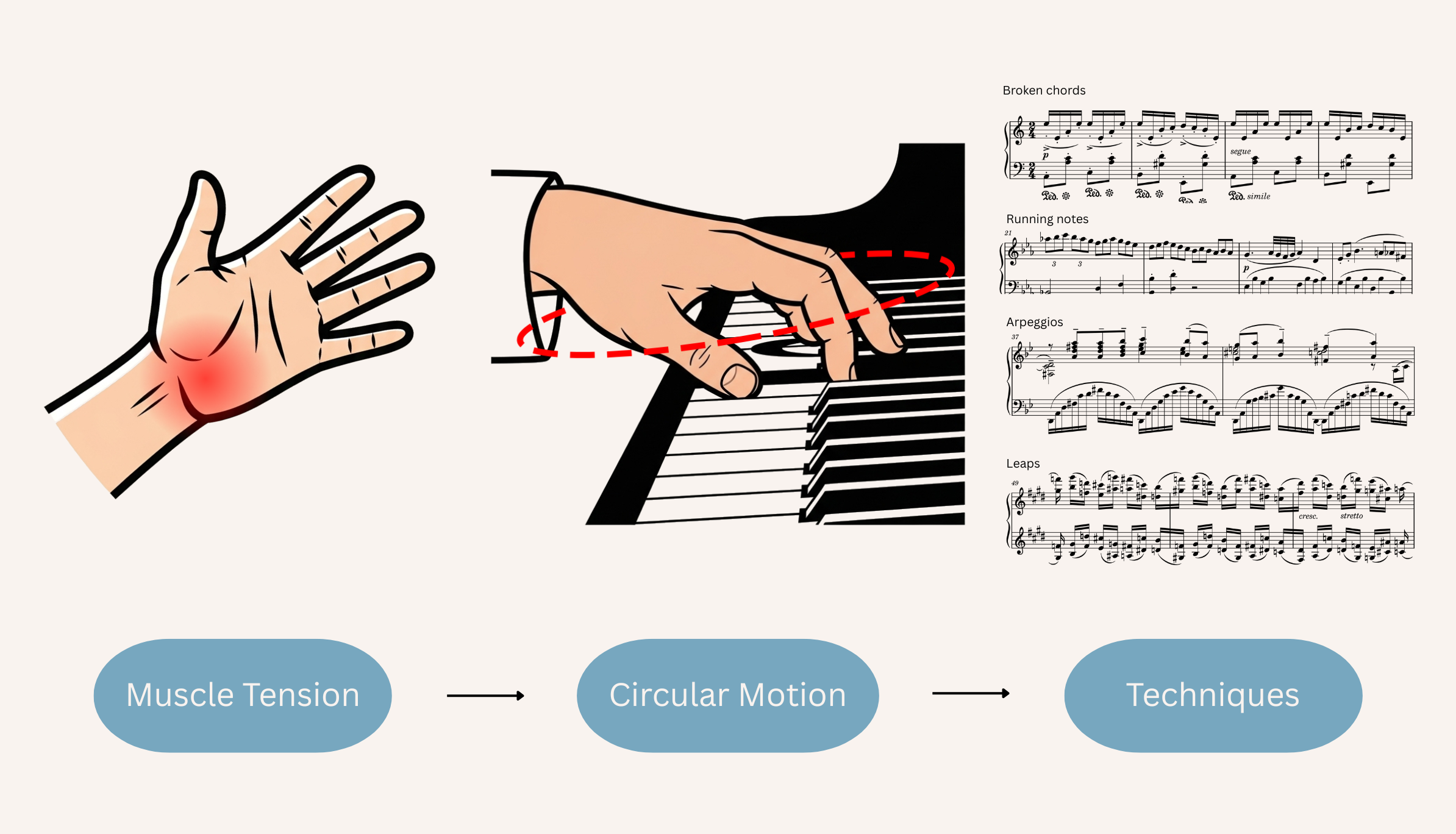
Background and Objectives: Piano study at the undergraduate and graduate levels requires both technical skill and understanding of musicality, yet many students face challenges with muscle tension caused by excessive practice or ineffective technique. This tension can interfere with performance, restrict musicality, and potentially lead to long-term injury. Building on a pedagogical perspective, this study investigates circular motion as a method for reducing tension and improving agility. Although circular motion is widely acknowledged in pedagogical literature, its practical use in specific repertoire is often overlooked. This study addresses that gap by providing applied examples, comparative analysis and performance videos. The following objectives drive the research: 1) To study the injury risks posed by muscle tension in piano performance and to examine its effects on the freedom of movement and the expression of musicality; 2) To study the concept of circular motion described by pedagogues; 3) To apply circular motion in piano performance to reduce tension and improving agility, and to demonstrate the differences after its application.
Methods: This study uses a documentary method to investigate sources from books, theses, journal articles, and online pedagogical sources to support the research objectives, involving a literature review on muscle tension and the pedagogical perspective of circular motion. Furthermore, the study explores the effectiveness of circular motion by practical application on selected piano repertoire which were chosen based on their variety of techniques, including running notes, broken chords, leaps and arpeggios. Moreover, the study visualizes the differences from applying circular motion in demonstration videos and public performance in a lecture-recital. Finally, the findings are be compiled in a research article.
Results: The results of this study can be summarized as follows. 1) Muscle Tension: across a variety of the piano technique literature, pedagogues and piano teachers consistently emphasize the importance of cultivating awareness of muscle tension in piano performance. Tension is widely recognized as a major culprit, as it limits agility, restricts freedom of movement and finger flexibility, inhibits performance, and increases the risk of injury. To prevent this, pedagogues encourage the use of multiple parts of the body and promote relaxation as a healthier approach. 2) Circular motion involves natural, curved movements of the wrist, forearm, hand, and shoulder, allowing tension to be shared among these areas, which is more effective and helps prevent physical strain and stiffness compared to abrupt, linear movement. 3) Circular motion can be applied to various musical passages. It provides better angles to strike the keys when performing running notes, smoother transitions when playing arpeggios and greater accuracy when playing leaps. The application of this technique reduces physical strain and promotes fluid, effortless performance. 4) Lecture-recital: the lecture-recital described in this article clearly illustrated the improvement in musicality when playing with and without the application of the circular motion. Moreover, the performer experienced physical ease throughout the entire performance.
Conclusions: This study highlights the importance of avoiding muscle tension in advanced piano study and proposes circular motion as an effective approach to both injury prevention and technical fluency in performance. Demonstration videos and a lecture-recital help to clearly visualize the improvement achieved through the use of circular motion. Its implementation in pedagogy offers educators and students a practical and adaptable approach for developing healthier and more expressive playing habits.
References
Bar-Niv, Rami. “The Magic of Wrist Circles.” International Journal of Music. Last modified March 2022. https://ijm.education/piano/the-magic-of-wrist-circles/.
Breithaupt, Rudolf Maria. Natural Piano-Technic: Preliminary to Intermediate Grade. Leipzig: D.F. Kahnt, 1909.
Chandee, Natsarut. “Chopin - Etude in E major, Op. 10, No. 3 : Demonstration Video 1.” YouTube Video, 1:09. October 31, 2025. https://www.youtube.com/watch?v=aLtUCRmeog0.
Chandee, Natsarut. “Chopin - Etude in E major, Op. 10, No. 3 : Demonstration Video 2.” YouTube Video, 0:26. October 20, 2025. https://www.youtube.com/watch?v=-OOymw70188.
Chandee, Natsarut. “József Gát's ‘spindle-motion of the arms’ demonstration video.” YouTube Video, 0:13. June 9, 2025. https://www.youtube.com/watch?v=xwJnMyEx0f4.
Chandee, Natsarut. “Mozart's Piano Sonata in C minor, K. 457 : Demonstartion video 1.” YouTube Video, 0:27. October 20, 2025. https://www.youtube.com/watch?v=aT-zJ5F2MMw.
Chandee, Natsarut. “Mozart's Piano Sonata in C minor, K. 457 : Demonstartion video 2.” YouTube Video, 0:27. October 20, 2025. https://www.youtube.com/watch?v=UfBJLmFD2uM.
Chandee, Natsarut. “Mozart's Piano Sonata in C minor, K. 457 : Demonstartion video 3.” YouTube Video, 1:24. October 31, 2025. https://www.youtube.com/watch?v=wF8ImLrLsxI.
Chandee, Natsarut. “Natsarut Chandee First year Lecture Recital - Circular Motion.” YouTube Video, 1:05:20. June 9, 2025. https://www.youtube.com/watch?v=-uhDHS3wBYc.
Chandee, Natsarut. “Rachmaninoff Prelude in G minor, Op. 23, No. 5 : Demonstration Video 1.” YouTube Video, 0:56. October 31, 2025. https://www.youtube.com/watch?v=bh_CwNc8wnY.
Chandee, Natsarut. “Rachmaninoff Prelude in G minor, Op. 23, No. 5 : Demonstration Video 2.” YouTube Video, 0:50. October 20, 2025. https://www.youtube.com/watch?v=Yp3ZuSe7GL4.
Chandee, Natsarut. “Seymour Fink - Pronation circle and Supination circle demonstration.” YouTube Video, 0:43. April 18, 2025. https://www.youtube.com/watch?v=mXiZAORIUQ0.
Chandee, Natsarut. “Sibelius - 13 pieces for piano, Op. 76, No. 2 : Demonstration Video 1.” YouTube Video, 0:53. October 31, 2025. https://www.youtube.com/watch?v=LPFh4SUYt7U.
Chandee, Natsarut. “Sibelius - 13 pieces for piano, Op. 76, No. 2 : Demonstration Video 2.” YouTube Video, 0:40. June 5, 2025. https://www.youtube.com/watch?v=GT7QH2RuIhc.
Cheng, Chih-Tung. “Baroque Pianism: Perspectives on Playing Baroque Keyboard Music on the Piano, with Emphasis on Bach’s Fugues in the Well-Tempered Clavier.” DMA diss., The City University of New York, 2019. https://academicworks.cuny.edu/gc_etds/3449.
Fielden, Thomas. The Science of Pianoforte Technique. London: Macmillan, 1961.
Fink, Seymour. Mastering Piano Technique: A Guide for Students, Teachers, and Performers. Portland, OR: Amadeus Press, 1992.
Gát, József. The Technique of Piano Playing. Budapest: Corvina, 1974.
Mark, Thomas. What Every Pianist Needs to Know about the Body. Chicago: GIA Publications, 2003.
Matthay, Tobias. The Act of Touch in All Its Diversity: An Analysis and Synthesis of Pianoforte Tone-Production. London: Longmans, Green, 1903. DOI: https://doi.org/10.2307/904667
Rosenblum, Sandra P. Performance Practices in Classic Piano Music. Bloomington: Indiana University Press, 1988. DOI: https://doi.org/10.2979/2599.0
Timothy, Johanes. “Personal Account on the Development of Wrist and Arm Techniques in Piano Playing.” Research Project, Royal Conservatoire of Scotland, 2020. https://www.academia.edu/44688214.
Wheatley-Brown, Michele, Gilles Comeau, and Donald Russell. “The Role and Management of Tension in Pedagogical Approaches to Piano Technique.” Arts BioMechanics 2, no. 1 (2014): 1-17. https://piano.uottawa.ca/wp-content/uploads/2016/04/Publications/Physical%20aspects/22.%20Brown_Tension%202013.pdf.
Downloads
Published
How to Cite
Issue
Section
License
Copyright (c) 2026 College of Music

This work is licensed under a Creative Commons Attribution-NonCommercial-NoDerivatives 4.0 International License.
The copyright of the article belongs to the author. Published articles represent the views of the authors. The editorial team neither necessarily agree with nor take any responsibility for the article.