KEY FINGERING POSITIONS IN THE CAGED FINGERING SYSTEM FOR GUITAR
Keywords:
Guitar Fingering, CAGED System, Key Fingering PositionsAbstract
Background and Objectives: On the guitar, a single pitch can be played at multiple positions on the fingerboard, and each position has implications for interpretation and physical efficiency in shifting to other positions. Fingering study is essential for developing systematic and coordinated performance between the left and right hands. Numerous fingering concepts exist, and the determination of fingerings plays a vital role in guiding performance practices, such as accompaniment and improvisation. This article aims to present the fundamental fingering concepts within the CAGED system on the guitar, grounded in the five basic chord shapes—C, A, G, E, and D—while emphasizing key left-hand finger positions. This study deliberately excludes analysis of voice-leading and specific chord voicings.
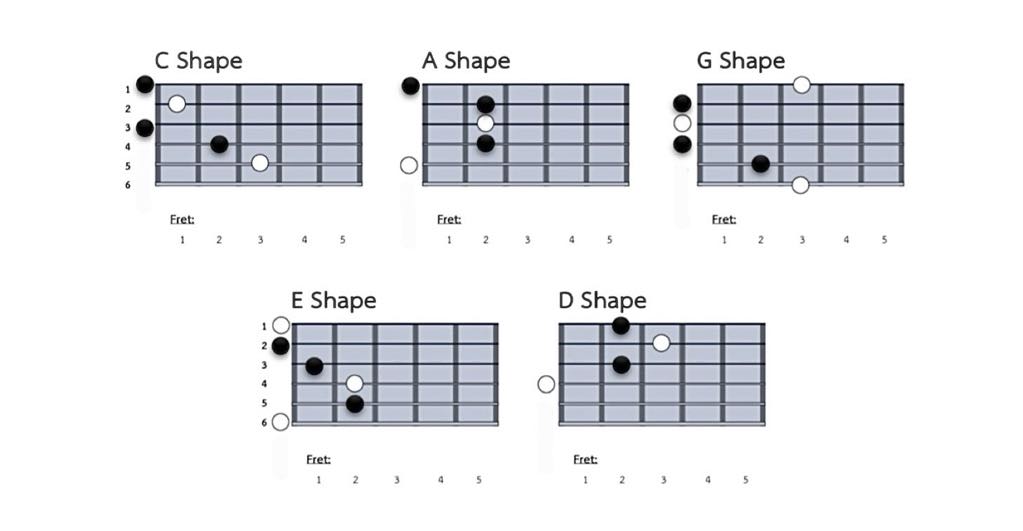
Methods: The study presents observations based on key left-hand finger positions associated with each of the five chord shapes. In the C Shape, two key positions are found on strings 5 and 2; in the A Shape, on strings 5 and 3; in the G Shape, on strings 6, 3, and 1; in the E Shape, on strings 6, 4, and 1; and in the D Shape, on strings 4 and 2. These finger positions are used to construct various arpeggio fingerings (major triads, major seventh chords, minor triads, and minor seventh chords), scale fingerings (major, major pentatonic, minor, and minor pentatonic), and chord fingerings (major, minor, diminished, major seventh, minor seventh, dominant seventh, and half-diminished seventh chords).
Results: The CAGED fingering system is based on five foundational chord shapes—C, A, G, E, and D—each identified through its corresponding Key Fingering positions on the left hand. These positions serve as critical anchors for constructing arpeggios, scale fingerings, and chord voicings. Each fingering shape typically spans four to five frets. The CAGED system does not require every fingering to contain two complete octaves or to start or end on the tonic note. In arpeggio and scale fingerings, the key positions consistently appear, while in chord fingerings, some shapes may omit certain positions for ergonomic reasons. The choice of left-hand fingers used to play these positions is not fixed.
Conclusions: Each CAGED shape includes 2–3 Key Fingering positions, and a clear understanding and memorization of these positions can greatly enhance one’s ability to develop further fingerings aligned with the CAGED framework. The article refers to these as the C Shape, A Shape, G Shape, E Shape, and D Shape, although some texts may use alternate terms such as C Form, A Form, etc. When applying these positions creatively, all Key Fingering positions may sometimes be included or selectively omitted depending on suitability. Though different sources may label or interpret the CAGED system in varying terms, they share similar underlying principles.
References
Clay, Levi, and Joseph Alexander. Guided Guitar Scale Practice Routines: Master Every Essential Guitar Scale in this Comprehensive 10 Week Course. Edited by Tim Pettingale. Ampney Crucis, UK: Fundamental Changes, 2024.
Fischer, Peter. Blues Guitar Rules. Bruhl, Germany: AMA Verlag, 2000.
Hanson, Paul. Shred Guitar. Van Nuys, CA: Alfred Music, 1996.
Neely, Blake, and Jeff Schroedl. Chords & Scales for Guitar. Milwaukee, WI: Hal Leonard Corporation, 1997.
Office of the Royal Society. Dictionary of Music, Royal Society Edition. Bangkok: Office of the Royal Society Press, 2018. (in Thai)
Pass, Joe. Joe Pass on Guitar. Edited by Kenn Chipkin. Van Nuys, CA: Alfred Music/CPP Media, 1996.
Sungwijit, Jetnipith. Basic Concept The CAGED Fingering System for Electric Guitar. Bangkok: Tana Press, 2023. (in Thai)
Sungwijit, Jetnipith. "Electric Guitar Performance Interpretation in 'Like What?'" Mahidol Music Journal 7, no. 1 (March-June 2024): 124-139. (in Thai)
Sungwijit, Jetnipith. "Power Chord Part 1: Basic Concept of Power Chord." Rangsit Music Journal 14, no. 1 (January-June 2019): 1-11. (in Thai)
Tagliarino, Barrett. Chord-Tone Soloing. Milwaukee, WI: Hal Leonard Corporation, 2006.
Wyatt, Keith. Blues Guitar Soloing. Milwaukee, WI: Hal Leonard Corporation, 2014.
Downloads
Published
How to Cite
Issue
Section
License
Copyright (c) 2025 College of Music

This work is licensed under a Creative Commons Attribution-NonCommercial-NoDerivatives 4.0 International License.
The copyright of the article belongs to the author. Published articles represent the views of the authors. The editorial team neither necessarily agree with nor take any responsibility for the article.