THE EVOLUTION OF MUSIC EDUCATION IN INDONESIA: FROM COLONIALISM TO COMMERCIALIZATION
DOI:
https://doi.org/10.65824/mmj.v9.282044Keywords:
Indonesian Music Education, Colonialism, Commercialization, Indonesian MusicAbstract
Background and Objectives: This study examines the evolution of music education in Indonesia from the colonial era to the present, investigating how Western musical traditions have shaped national music education frameworks. The research explores the cultural, political, and economic forces that have transformed musical pedagogy and their implications for traditional Indonesian musical heritage and contemporary practice.
Methods: This research employs a comprehensive historical-critical methodology integrating multiple data sources. Primary sources include systematic analysis of palace manuscripts from the Yogyakarta Palace library (dating from early 1900s), government documents, institutional archives, and educational curricula across historical periods. In-depth interviews were conducted with 23 musicians, educators, and cultural custodians to capture lived experiences of musical adaptation processes. Secondary sources include scholarly literature and music histories. The study uses interdisciplinary analytical frameworks including post-colonial theory, political economy, and Bourdieu's cultural capital theory, examining four historical epochs: Colonial era (pre-1945), Sukarno period (1945-1965), New Order (1965-1998), and Reform era (1998-present).
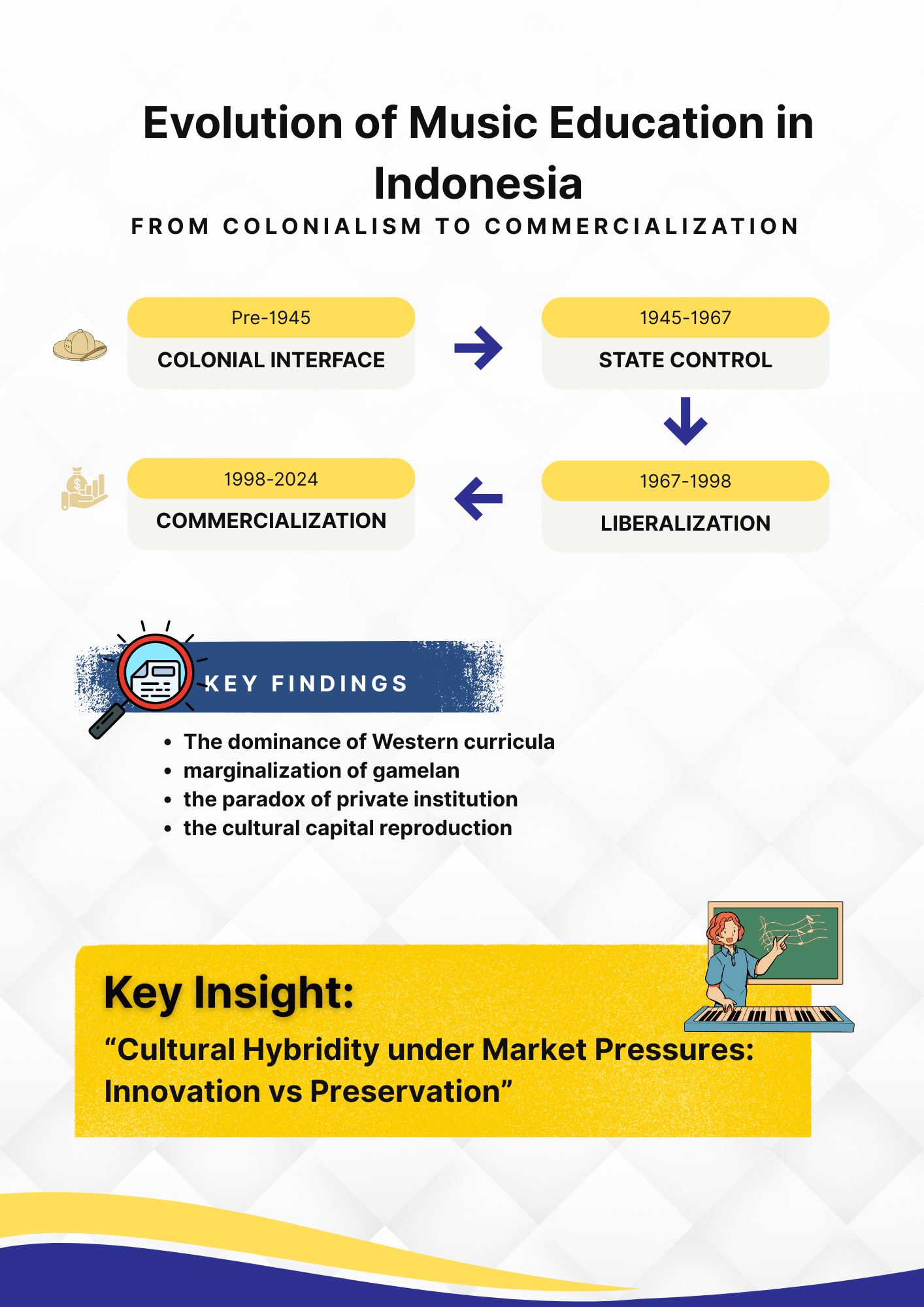
Results: The analysis identifies three distinct phases in Indonesian music education: strict governmental control under Sukarno (1945-1967), gradual liberalization during the Suharto era (1967-1998), and market-driven transformation in the Reform period (1998-present). The Yogyakarta Palace orchestra case illustrates how Western musical instruments were integrated with traditional gamelan, resulting in hybrid forms that reflected broader patterns of cultural exchange and negotiation. Western music entered through elite institutions and missionary activity, creating localized hybrid forms. The government systematically built a national music education framework, privileging Western classical music through institutions like the Indonesian Music School (SMI/1952), the Indonesian Music Academy (AMI/1961), and the Indonesian Institute of the Arts (ISI/1984) to serve nation-building objectives. A significant finding is the contemporary dominance of private institutions like Yamaha Music School and Purwacaraka Music Studio, which have displaced government-run establishments as primary providers of music education, reaching exponentially more students while standardizing curricula around Western frameworks.
Conclusions: The shift from state-controlled to commercially-driven music education reflects broader economic changes, including middle-class growth and urbanization. However, this transformation has created a democratization paradox: while commercial expansion has increased overall access, it has also erected significant economic barriers that exclude lower-income populations, raising questions about educational equity and the preservation of cultural heritage. The study contributes theoretical insights on cultural hybridity, Bourdieu’s cultural capital in postcolonial contexts, and the complexities of market-driven education systems. It reveals how music education functions as a contested field where cultural identity, economic interests, and political priorities intersect, with Western frameworks persistently positioned as the universal standard despite Indonesia's political independence. The findings underscore the need for deliberate policy intervention to address access inequalities, correct curricular imbalances favoring Western music, and support the preservation and innovation of traditional Indonesian musical heritage within a pluralistic educational ecosystem.
References
Abdullah, Johami. “Music Education in Malaysia: An Overview.” Visions of Research in Music Education 16, no. 1 (2021): Article 43.
Anderson, Benedict. Imagined Communities: Reflections on the Origin and Spread of Nationalism. London: Verso, 2006.
Aryandari, Citra. “Mozart Effect Allure, Industrial Promotion, and Lifestyle.” In The Southeast Asia Director of Music (SEADOM) Congress, Yangon, Myanmar, March 23-25, 2017.
Aryandari, Citra. “The Indonesian Popular Music Industry: Navigating Shadows of Politics and Cultural Uncertainty.” In Made in Nusantara: Studies in Popular Music, edited by Adil Johan and Mayco A. Santaella, 164-171. New York: Routledge, 2021. DOI: https://doi.org/10.4324/9780367855529-19
Asmono, Riska Indriani. “Music Course Management in Improving Students' Musical Abilities at the Purwacaraka Music Course, Villa Bukit Mas Surabaya Branch.” J+PLUS UNESA 4, no. 1 (2015): 1-8. (in Indonesian)
Barker, Joshua. Review of Fields of the Lord: Animism, Christian Minorities, and State Development in Indonesia, by Lorraine V. Aragon. Pacific Affairs 75, no. 1 (Spring 2002): 148-149. DOI: https://doi.org/10.2307/4127279
Benjamin, Walter. “The Work of Art in the Age of Mechanical Reproduction.” In A Museum Studies Approach to Heritage, edited by Sheila Watson, Amy Jane Barnes, and Katy Bunning, 226-243. New York: Routledge, 2018. DOI: https://doi.org/10.4324/9781315668505-19
Bhabha, Homi K. The Location of Culture. 2nd ed. London: Routledge, 1994.
Bourdieu, Pierre. “The Field of Cultural Production, or: The Economic World Reversed.” Poetics 12, no. 4-5 (1983): 311-356. DOI: https://doi.org/10.1016/0304-422X(83)90012-8
Braun, Virginia, and Victoria Clarke. “Using Thematic Analysis in Psychology.” Qualitative Research in Psychology 3, no. 2 (2006): 77-101. DOI: https://doi.org/10.1191/1478088706qp063oa
Denzin, Norman K., and Yvonna S. Lincoln. The SAGE Handbook of Qualitative Research. 4th ed. Los Angeles: SAGE, 2011.
Erben, Michael. Review of Reproduction in Education, Society and Culture, by Pierre Bourdieu and Jean-Claude Passeron. The British Journal of Sociology 30, no. 2 (June 1979): 257-258. DOI: https://doi.org/10.2307/589547
Foucault, Michel. “Discipline and Punish: The Birth of the Prison (an Excerpt).” In Coronavirus, Psychoanalysis, and Philosophy: Conversations on Pandemics, Politics and Society, edited by Fernando Castrillón and Thomas Marchevsky, 23-26. London: Routledge, 2021. DOI: https://doi.org/10.4324/9781003150497-3
Foucault, Michel. “Power/Knowledge.” In The New Social Theory Reader, edited by Steven Seidman and Jeffrey C. Alexander, 73-79. New York: Routledge, 2008. DOI: https://doi.org/10.4324/9781003060963-10
Freire, Paulo. Pedagogy of Indignation. Boulder, CO: Paradigm Publishers, 2004.
Gramsci, Antonio. Prison Notebooks: Volume I. New York: Columbia University Press, 1992.
Howard, Keith David. “Reviving Korean Identity through Intangible Cultural Heritage.” In The Oxford Handbook of Music Revival, edited by Caroline Bithell and Juniper Hill, 135-159. New York: Oxford University Press, 2014. DOI: https://doi.org/10.1093/oxfordhb/9780199765034.013.001
Kaestri, Veronica Yoni. “The Role of the Yogyakarta Sultanate Palace in the Development of Western Music in Yogyakarta.” Master’s thesis, Gadjah Mada University, 2004. (in Indonesian)
Kuhn, Thomas. “The Structure of Scientific Revolutions.” In Knowledge and Postmodernism in Historical Perspective, edited by Joyce Appleby, Elizabeth Covington, David Hoyt, Michael Latham, and Allison Sneider, 340-355. New York: Routledge, 1996.
Laovanich, Vitchatalum, and Somchai Trakarnrung. “Marginalization of Music as a Subject in Thai Basic Education Curriculum: An Archaeology of Knowledge Approach.” Fine Art International Journal, Srinakharinwirot University 17, no. 1 (January-June 2013): 35-51.
Muktaf, Zein Mufarrih. “Television and Visual Music.” In The Conference on Media, Communications, and Sociology 2014, Yogyakarta, September 7, 2014. 396-409. (in Indonesian)
Pieterse, Jan Nederveen. “Globalisation as Hybridisation.” International Sociology 9, no. 2 (1994): 161-184. DOI: https://doi.org/10.1177/026858094009002003
Said, Edward W. Orientalism. New York: Pantheon Books, 1978.
Setianjaya, Iwan, Rr. Paramitha Dyah Fitriasari, and Aton Rustandi Mulyana. “Organizational Hierarchy and Transmission of Knowledge of Performance Production Results in the Management of the Yogyakarta Royal Orchestra (Case Study: Yogyakarta Royal Orchestra's Raré Rumpaka Performance).” Sorai: Jurnal Pengkajian Dan Penciptaan Musik 16, no. 2 (December 2023): 97-113. (in Indonesian) DOI: https://doi.org/10.33153/sorai.v16i2.5704
Shi, Ke. “Music Education in China and the Philippines: The Exploration of Tradition and Integration.” International Journal of Education and Humanities 14, no. 2 (2024): 9-11. DOI: https://doi.org/10.54097/bj545n83
Tikly, Leon. “Education and the New Imperialism.” Comparative Education 40, no. 2 (May 2004): 173-198. DOI: https://doi.org/10.1080/0305006042000231347
Downloads
Published
How to Cite
Issue
Section
License
Copyright (c) 2026 College of Music

This work is licensed under a Creative Commons Attribution-NonCommercial-NoDerivatives 4.0 International License.
The copyright of the article belongs to the author. Published articles represent the views of the authors. The editorial team neither necessarily agree with nor take any responsibility for the article.