FROM THE RINGS TO THE REEDS: MUSIC COMPOSITIONS BASED ON THAI BOXING DANCE
DOI:
https://doi.org/10.65824/mmj.v9.282074Keywords:
Wai Kru Muay Thai, Thai Boxing Dance, Woodwind Instruments, Contemporary CompositionAbstract
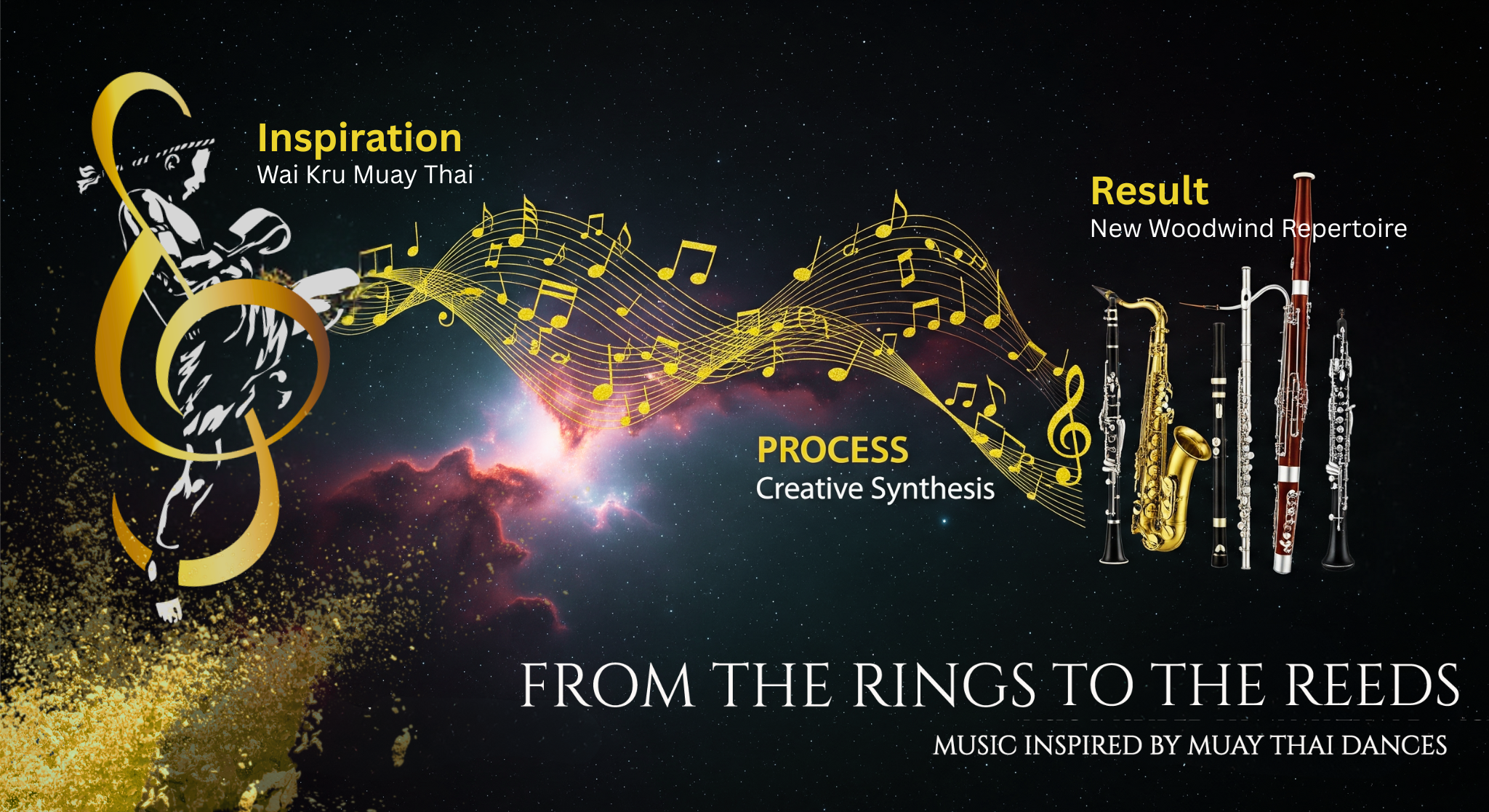
Background and Objectives: The research project “From the Rings to the Reeds: Music Compositions Based on Thai Boxing Dance” emerges from critical recognition of the profound aesthetic dimensions and cultural significance embedded within the Wai Khru Muay Thai, a ceremonial practice that constitutes an integral component of Thailand's intangible cultural heritage. The ritualistic performance tradition operates as a complex artistic system which combines musical elements with dance choreography and combat techniques to present vital aspects of Thai cultural heritage and philosophical beliefs. The Wai Khru ceremony presents an intricate combination of musical elements and bodily movements which performers maintain through oral tradition and physical execution while the Pi Klong ensemble provides its unique sound palette. Wai Khru Muay Thai exists as a sophisticated repository of cultural memory, encoding within its formal structures the philosophical principles undergirding Thai Buddhist cosmology, social hierarchies, and ethical frameworks. The ritualistic movements which honor teachers and ancestors and protective spirits function as cultural transmission performances through which practitioners demonstrate their connection to history while preserving their community's fundamental beliefs. The practice of Wai Khru enables participants to establish educational links with tradition which generates spiritual growth and artistic development and social consciousness that enables knowledge preservation between generations. Despite its long history and complex artistic value, Wai Khru Muay Thai has not received enough attention from modern composers who could use it as a base for their work. This study addresses this gap by interrogating possibilities for creative reinterpretation of musical essence distilled from Wai Khru Muay Thai within modern art music composition. The research aims to study the process of transforming Wai Khru Muay Thai into modern Western woodwind instrument compositions which would expand musical repertoire and create cultural exchange opportunities. The selection of woodwind instruments was based on their acoustic qualities and because their breath-based sound production creates direct physical contact between performer and instrument, which allows for precise dynamic control and expressive inflection that mimics human vocal emotional responses.
Methods: The methodological framework unites analytical research with artistic creation through a research-through-creation approach which allows theoretical analysis and compositional work to mutually support one another. The first stage involved a thorough examination of academic materials which studied Wai Khru Muay Thai and its ceremonial importance and musical heritage. The research identified essential rhythmic structures and melodic patterns and scalar systems and symbolic gestural elements which together form a complete set of musical components for composition development. The research study analyzed three main aspects, which included pitch organization and scalar construction, rhythmic structures and metric frameworks, and timbral characteristics and instrumental techniques. The research examined Pi Java's unique melodic shapes and modal characteristics and decorative elements together with Na Thap's intricate rhythmic cycles and accentual structures. The next compositional stage combined the traditional elements found through analysis with Western compositional methods, which included pan-triadic harmony and various formal structures and extended woodwind playing techniques such as multiphonics, flutter tonguing, and vocal-instrumental approaches. The selection of musical elements followed two guidelines, which aimed to increase expressive and structural complexity while maintaining clear links to Thai cultural heritage. The research maintained academic rigor and cultural authenticity through its use of structured interviews with expert practitioners and scholars who specialized in Thai music and ritual practice. The finished works became available through three distribution methods, which included public concerts, analytical studies, and digital platforms that provide free access to scores and recordings with interpretive explanations.
Results: The research produced fourteen new musical works which successfully combined Thai ceremonial dance elements with Western classical music components. The three representative works, including Echoes of Grace and Valor, Sacred Homage, and Celestial Serenade, show how the gestural language and melodic development and rhythmic intricacy and tonal elements of Wai Khru Muay Thai translate into woodwind performance techniques. The modern woodwind repertoire receives important additions through these compositions which introduce performers to culturally unique pieces that test their technical skills while delivering fresh listening experiences through genuine cultural materials. The compositions received major public attention because they were performed at national and international venues which earned positive reviews from professional musicians and academic experts. The project reached wider audiences through its strategic distribution across academic conferences as well as digital score libraries and streaming services and curated playlists, which made both artistic content and theoretical materials accessible to the public.
Conclusions: This research demonstrates that Thai traditional dance and music embody substantial artistic and theoretical value for contemporary compositional practice, offering rich source material providing genuine insights into alternative organizational principles and expressive possibilities. The research shows that protecting cultural heritage needs more than just keeping records because traditional knowledge systems need creative methods to stay alive when they interact with modern artistic settings. The project develops a repeatable research method which researchers can use in future studies while building long-term facilities to protect and develop and promote Thai musical heritage worldwide. The research shows how traditional knowledge systems unite with modern compositional techniques to build international intercultural musical exchanges which protect Thai artistic heritage for contemporary cultural production.
References
Binson-Sumrongthong, Bussakorn. “Rites and Beliefs of Music in the Thailand’s Lanna Region.” Fontes Artis Musicae 56, no. 3 (July-September 2009): 299-313.
Brattico, Elvira, and Thomas Jacobsen. “Subjective Appraisal of Music: Neuroimaging Evidence.” Annals of the New York Academy of Sciences 1169, no. 1 (July 2009): 308-317. DOI: https://doi.org/10.1111/j.1749-6632.2009.04843.x
Fuks, Leonardo. “Blowing and Breathing in the Woodwinds: Generation and Control of Input Parameters.” The Journal of the Acoustical Society of America 105, no. 2_Supplement (February 1999): 941. DOI: https://doi.org/10.1121/1.426336
Gemolo, Matteo. “Extended Techniques on the Traverso: The Case of the Glissando and the Flattement.” ÍMPAR: Online Journal for Artistic Research in Music 2, no. 2 (2018): 30-47.
Hatten, Robert S. “Four Semiotic Approaches to Musical Meaning: Markedness, Topics, Tropes, and Gesture.” Musicological Annual 41, no. 1 (2005): 5-30. DOI: https://doi.org/10.4312/mz.41.1.5-30
Ishii, Reiko. “The Development of Extended Piano Techniques in Twentieth-Century American Music.” DM diss., The Florida State University, 2005. https://www.proquest.com/docview/304996511/abstract/4850A81E1C93413APQ/1.
Landry, Steven. “Interactive Sonification Strategies for the Motion and Emotion of Dance Performances.” PhD diss., Michigan Technological University, 2019.
Photiphanya, Kunlakan, and Manus Kaewbucha. “Sacred Dance of Homage to Spiritual Worship in THAI’s Boxing: Coherences and Overriding.” Music and Performing Arts Journal 7, no. 1 (January-June 2021): 48-61.
Pidokrajit, Narongchai. “Thai Traditional Music in the Wai Khru Ceremony.” Fine Arts International Journal, Srinakharinwirat University 15, no. 1 (January-June 2011): 10-20.
TM-TU. “Sarama Thai by Khru Paitoon Unhaka; Thai Music Melody Project.” YouTube Video, 5:30. September 14, 2016. https://www.youtube.com/watch?v=KTVGRatDFUA.
Zbikowski, Lawrence M. “Metaphor and Music.” In The Cambridge Handbook of Metaphor and Thought, edited by Raymond W. Gibbs, Jr., 502-524. Cambridge: Cambridge University Press, 2008. DOI: https://doi.org/10.1017/CBO9780511816802.030
Downloads
Published
How to Cite
Issue
Section
License
Copyright (c) 2026 College of Music

This work is licensed under a Creative Commons Attribution-NonCommercial-NoDerivatives 4.0 International License.
The copyright of the article belongs to the author. Published articles represent the views of the authors. The editorial team neither necessarily agree with nor take any responsibility for the article.