EFFECTS OF MUSIC THERAPY ON DYSARTHRIA REHABILITATION IN PARKINSON'S DISEASE PATIENTS
DOI:
https://doi.org/10.65824/mmj.v9.282450Keywords:
Parkinson's Disease, Dysarthria, Music Therapy, Neurologic Music TherapyAbstract
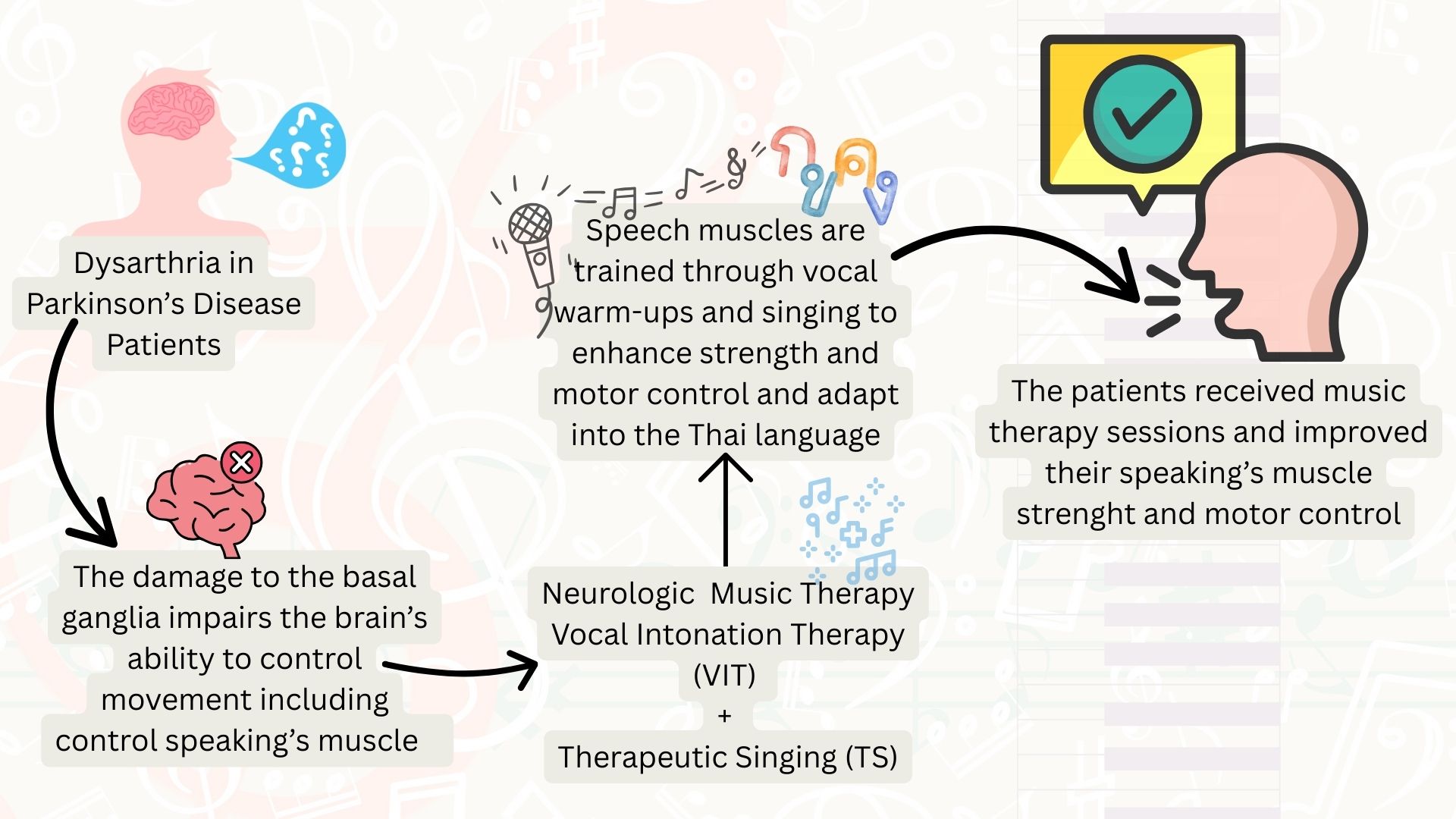
Background and Objectives: This study aimed to investigate the effects of music therapy on dysarthria rehabilitation in Parkinson’s disease patients. Dysarthria in these patients was typically characterized by disrupted speech patterns, impaired vocal resonance, articulation difficulties, reduced speech intelligibility, and irregular speech rhythm. These symptoms arose from the brain’s inability to control the muscles involved in speech production effectively. Various underlying conditions could lead to dysarthria, including stroke, brain infections, and neurodegenerative diseases such as Parkinson’s disease, which affected brain regions responsible for motor control and muscular coordination. Conventional rehabilitation for dysarthria primarily involved speech therapy, wherein speech-language pathologists assessed individual cases and designed personalized training programs, typically focusing on strengthening the patient’s respiratory system and articulatory muscles. In addition to speech therapy, music therapy has emerged as a complementary intervention that has gained considerable recognition, particularly in Western countries. A growing body of research supports the positive impact of music therapy in improving speech-related symptoms among individuals with Parkinson’s disease, suggesting its potential as an effective adjunct to traditional therapeutic approaches. Music therapy is a therapeutic approach that utilizes musical elements to achieve individualized goals. The interventions employed in music therapy are evidence-based and facilitated by trained professionals who had completed specialized certification programs in the field. A review of the literature revealed that, in Thailand, research on music therapy for Parkinson’s disease remains limited, particularly with respect to both physical and speech rehabilitation. Furthermore, the application of music therapy in the Thai language context warrants further investigation due to the unique tonal and phonetic features of Thai, which differed substantially from English, the primary language of most existing international studies. Research conducted abroad showed that music therapy has yielded positive outcomes for Parkinson’s patients with dysarthria, including improvements in speech clarity, breath support, vocal intensity, and pitch modulation. Most of these studies have utilized Neurologic Music Therapy (NMT) approaches, particularly techniques such as Vocal Intonation Therapy (VIT) and Therapeutic Singing (TS). However, these interventions were largely applied in English-speaking populations. Given that a significant number of Parkinson’s patients with dysarthria are also found in Thailand, this study was designed to examine the effects of music therapy on dysarthria rehabilitation among Thai patients with Parkinson’s disease, employing the principles of Neurologic Music Therapy (NMT). The objective was to provide additional therapeutic options for patients and their families by using music therapy to manage dysarthria. Moreover, the study sought to generate in-depth knowledge on music therapy practices for professionals in the field and to contribute to the academic development of this underexplored area.
Methods: This study employed a multiple-case study design to examine the effects of music therapy on dysarthria rehabilitation in Parkinson’s disease patients. The interventions were based on the principles of Neurologic Music Therapy (NMT), emphasizing the use of Vocal Intonation Therapy (VIT) and Therapeutic Singing (TS) techniques. A total of three participants, all individuals diagnosed with Parkinson’s disease, voluntarily participated in the study after being recruited through a poster and Facebook announcements. The music therapy sessions consisted of ten sessions in total. The assessment tools included PRAAT, software designed to analyze vocal quality, and a speech fluency evaluation form. A speech therapist evaluated the participants before and after the music therapy sessions. For the data analysis, the researcher conducted a mean-difference analysis alongside a qualitative analysis of interview transcripts and music therapy session notes.
Results: The findings indicated that the average speech volume level before receiving music therapy was 75.62 decibels for all three participants. Following the music therapy sessions, the average volume increased to 80.73 decibels. Regarding speech fluency, the average number of utterances before the intervention was 18, which increased to 21 after the music therapy sessions. These results suggest that music therapy had a beneficial effect on dysarthria rehabilitation in Parkinson’s disease patients.
Conclusions: The findings of this study demonstrate that music therapy can effectively support the rehabilitation of dysarthria in individuals with Parkinson’s disease. Professional music therapists benefit from acquiring structured methods, procedures, and techniques specific to music therapy for the treatment of dysarthria, both in patients with Parkinson’s disease and in individuals experiencing similar speech impairments. Additionally, for those interested in this patient population, the study provides practical guidelines, relevant data, and insights into the application of music therapy, which could serve as a foundation for further research and development in future studies.
References
American Parkinson Disease Association. “What is Parkinson Disease?” Accessed October 9, 2022. https://www.apdaparkinson.org/what-is-parkinsons/.
Azekawa, Megumi, and A. Blythe Lagasse. “Singing Exercises for Speech and Vocal Abilities in Individuals with Hypokinetic Dysarthria: A Feasibility Study.” Music Therapy Perspectives 36, no. 1 (Spring 2018): 40-49. DOI: https://doi.org/10.1093/mtp/miw042
del Olmo, Miguel Fernandez, and Javier Cudeiro. “Temporal Variability of Gait in Parkinson Disease: Effects of a Rehabilitation Programme Based on Rhythmic Sound Cues.” Parkinsonism & Related Disorders 11, no. 1 (January 2005): 25-33. DOI: https://doi.org/10.1016/j.parkreldis.2004.09.002
Di Benedetto, P., M. Cavazzon, F. Mondolo, G. Rugiu, A. Peratoner, and E. Biasutti. “Voice and Choral Singing Treatment: A New Approach for Speech and Voice Disorders in Parkinson's Disease.” European Journal of Physical and Rehabilitation Medicine 45, no. 1 (March 2009): 13-19.
Elefant, Cochavit, Felicity A. Baker, Meir Lotan, Simen Krogstie Lagesen, and Geir Olve Skeie. “The Effect of Group Music Therapy on Mood, Speech, and Singing in Individuals with Parkinson's Disease — a Feasibility Study.” Journal of Music Therapy 49, no. 3 (Fall 2012): 278-302. DOI: https://doi.org/10.1093/jmt/49.3.278
Enderby, Pam. “Chapter 22 - Disorders of Communication: Dysarthria.” In Neurological Rehabilitation - Handbook of Clinical Neurology, Volume 110, edited by Michael P. Barnes and David C. Good, 273-281. Amsterdam: Elsevier, 2013. DOI: https://doi.org/10.1016/B978-0-444-52901-5.00022-8
Haneishi, Eri. “Effects of a Music Therapy Voice Protocol on Speech Intelligibility, Vocal Acoustic Measures, and Mood of Individuals with Parkinson's Disease.” Journal of Music Therapy 38, No. 4 (Winter 2001): 273-290. DOI: https://doi.org/10.1093/jmt/38.4.273
Moya-Galé, Gemma, and Erika S. Levy. “Parkinson’s Disease-Associated Dysarthria: Prevalence, Impact and Management Strategies.” Research and Reviews in Parkinsonism 9 (2019): 9-16. DOI: https://doi.org/10.2147/JPRLS.S168090
National Health Service. “Parkinson’s Disease.” Accessed October 10, 2022. https://www.nhs.uk/conditions/parkinsons-disease/.
Peachpunpisal, Chuanchom. “Caregiver in Parkinson’s Disease Patient.” Journal of Phrapokklao Nursing College 26, no. S1 (September 2015): 111-116. https://he01.tci-thaijo.org/index.php/pnc/article/view/117071. (in Thai)
Tamplin, Jeanette, and Denise Grocke. “A Music Therapy Treatment Protocol for Acquired Dysarthria Rehabilitation.” Music Therapy Perspectives 26, no. 1 (2008): 23-29. DOI: https://doi.org/10.1093/mtp/26.1.23
Thaut, Michael H., and Volker Heomberg. Handbook of Neurologic Music Therapy. Oxford: Oxford University Press, 2014.
Tjaden, Kris. “Speech and Swallowing in Parkinson's Disease.” Topics in Geriatric Rehabilitation 24, no. 2 (April-June 2008): 115-126. DOI: https://doi.org/10.1097/01.TGR.0000318899.87690.44
Yinger, Olivia Swedberg, and Leonard L. Lapointe. “The Effects of Participation in a Group Music Therapy Voice Protocol (G-MTVP) on the Speech of Individuals with Parkinson's Disease.” Music Therapy Perspectives 30, no. 1 (2012): 25-31. DOI: https://doi.org/10.1093/mtp/30.1.25
Downloads
Published
How to Cite
Issue
Section
License
Copyright (c) 2026 College of Music

This work is licensed under a Creative Commons Attribution-NonCommercial-NoDerivatives 4.0 International License.
The copyright of the article belongs to the author. Published articles represent the views of the authors. The editorial team neither necessarily agree with nor take any responsibility for the article.