DEVELOPING AN UNDERGRADUATE CURRICULUM FOR GUZHENG MAJORS IN SICHUAN PROVINCE (CHINA) TO CULTIVATE MUSIC INTERPRETATION SKILLS IN THE 21ST CENTURY
DOI:
https://doi.org/10.65824/mmj.v9.282488Keywords:
Guzheng Performance Education, Music Interpretation Skills, Interpretation-Based Pedagogy, Curriculum DevelopmentAbstract
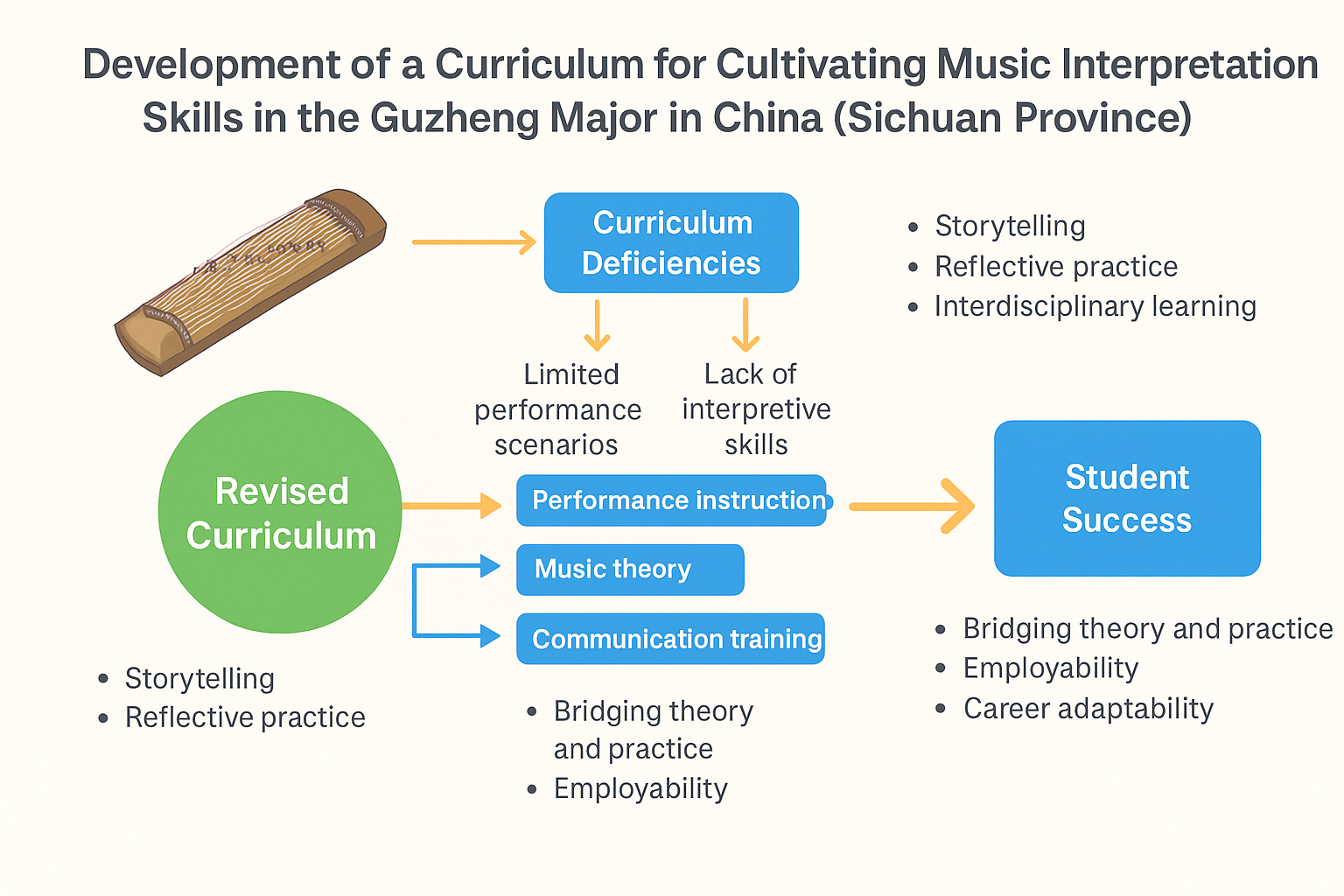
Background and Objectives: The rapid expansion of music performance programs in Chinese higher education has increased enrollment but has also intensified employment pressures for graduates, particularly among guzheng majors. Despite the 2018 National Standards emphasizing competency-based education, including artistic interpretation, expressive performance, cultural understanding, and professional readiness, most programs continue to prioritize technical skills over interpretive development. This study therefore aimed to examine the current state of interpretation training for undergraduate guzheng majors in Sichuan Province (China), identify deficiencies in interpretive competencies, and develop a curriculum explicitly designed to cultivate music interpretation skills in alignment with educational and labor-market needs. To strengthen alignment with the title, this study specifically emphasizes interpretation-centered problems as the core issue. In particular, the study identified several critical weaknesses in students’ interpretive abilities, including underdeveloped expressive nuance, insufficient timbre shaping, and limited narrative expression; a weak integration of theoretical knowledge such as form, motif, style, and cultural meaning with expressive performance; and a limited ability to articulate artistic intention, which collectively hinder students’ artistic growth and reduce their competitiveness within contemporary professional music environments.
Methods: A convergent parallel mixed-methods design was employed. Quantitative and qualitative data were collected concurrently, analyzed independently, and integrated during the interpretation phase. Quantitative data were collected from 300 students and instructors using a validated questionnaire (Cronbach’s = 0.885) to identify gaps in music interpretation skills. Qualitative data were obtained through semi-structured individual interviews with guzheng instructors, graduates, and employers, as well as focus group discussions with curriculum leaders and senior guzheng instructors from 14 universities. Thematic analysis revealed recurring challenges in expressive performance, stylistic literacy, and interpretive communication. The integration of quantitative findings and qualitative themes directly informed the design of a six-module interpretation-centered curriculum. The curriculum was grounded in Outcome-Based Education (OBE), Understanding by Design (UbD), Constructivist Learning Theory, and the Feynman Technique.
Results: Findings revealed three core deficiencies: (1) underdeveloped interpretive skills such as expressive nuance, timbre shaping, and narrative expression; (2) weak integration of theoretical knowledge including form, motif, style, and cultural meaning with expressive performance; and (3) limited ability to articulate artistic intention, indicating insufficient reflective and communicative competence. High-priority needs were identified for interpretive analysis, stylistic understanding, and performance communication. The integration of quantitative and qualitative results guided the design of a six-module interpretation-centered curriculum, including expressive interpretation, stylistic literacy, structural and narrative analysis, cultural interpretation, communication skills, and reflective practice. Innovative pedagogies such as peer critique, flipped instruction, and multimedia-supported interpretation were incorporated to strengthen interpretive learning outcomes.
Conclusions: The study concludes that current guzheng training models are insufficient in cultivating interpretation skills essential for contemporary professional performance. The proposed curriculum provides a targeted, interpretation-centered, and outcome-driven framework that effectively addresses the key skill gaps observed among learners. It strengthens expressive performance, enhances cultural and stylistic understanding, bridges theory and practice, and improves communicative competence. The six newly designed modules explicitly foster interpretive artistry and professional readiness, supporting national efforts to modernize music education and offering a replicable model for other performance-based disciplines within increasingly diverse musical learning environments. Future directions include pilot implementation, evaluation of module effectiveness, and expanded application in diverse teaching contexts.
References
Bartleet, Brydie-Leigh, Dawn Bennett, Ruth Bridgstock, Paul Drapes, Scott Harrison, and Huib Schippers. “Preparing for Portfolio Careers in Australian Music: Setting A Research Agenda.” Australian Journal of Music Education no. 1 (January 2012): 32-41.
Bennett, Dawn, and Ruth Bridgstock. “The Urgent Need for Career Preview: Student Expectations and Graduate Realities in Music and Dance.” International Journal of Music Education 33, no. 3 (August 2015): 263-277. DOI: https://doi.org/10.1177/0255761414558653
Bennett, Dawn. “Classical Instrumental Musicians: Educating for Sustainable Professional Practice.” Unpublished PhD diss., University of Western Australia, 2005.
Bennett, Dawn. “Staying Afloat: Skills, Attributes and Passion.” In Life in the Real World: How to Make Music Graduates Employable, edited by Dawn Bennett, 63-78. Champaign, IL: Common Ground Publishing, 2012. DOI: https://doi.org/10.18848/978-1-61229-079-9/CGP
Bridgstock, Ruth, and Greg Hearn. “A Conceptual Model of Capability Learning for the Twenty-First-Century Knowledge Economy.” In Handbook on the Knowledge Economy, Volume Two, edited by David Rooney, Greg Hearn, and Tim Kastelle, 105-120. Cheltenham, UK: Edward Elgar Publishing, 2012. DOI: https://doi.org/10.4337/9781781005132.00015
China Education Daily. “The Ministry of Education Announced the List of Undergraduate Majors with Low Employment Rates - 15 Majors on the List.” Last modified October 15, 2014. http://www.moe.gov.cn/jyb_xwfb/s5147/201410/t20141015_175978.html (in Chinese)
Chunmei, Jiao. “Analysis of the Current Layout and Scale of Music Undergraduate Programs in Chinese Universities.” Music Research 04 (2010): 59-69. (in Chinese)
Creswell, John W., and Vicki L. Plano Clark. Designing and Conducting Mixed Methods Research. 3rd ed. Thousand Oaks, CA: SAGE Publications, 2018.
Gaokao. “Music Performance.” Accessed May 12, 2026. https://www.gaokao.cn/special/325?sort=1&special_type=1&fromcoop=bdkp&provinceId=51. (in Chinese)
Haihong, Zhou. “Research on the Quality Standards and Evaluation Criteria for Performance Programs in Higher Music Institutions.” Journal of Tianjin Conservatory of Music 02 (2018): 5-18. http://doi.org/10.16274/j.cnki.cn12-1280/j.2018.02.001. (in Chinese)
Jie, Yu. “Construction of a Music Practical Teaching System in Normal Universities Aiming at Cultivating Applied Talents.” Journal of Hunan University of Science and Technology 44, no. 5 (2023): 110-113. http://doi.org/10.16336/j.cnki.cn43-1459/z.20231124.002. (in Chinese)
Jing, Lu. “Innovation and Exploration of Sichuan Guzheng Art in the New Century: A Study Based on Education and Artistic Practice.” Sichuan Drama 11 (2018): 148-151. (in Chinese)
Jing, Lu. “The Development History of Contemporary Zither Music Art in Sichuan.” Sichuan Drama 03 (2013): 99-105. (in Chinese)
Jingli, Liang. “Research on Teaching Models and Talent Cultivation Pathways for the Guzheng Major in Higher Vocational Colleges.” Craftsmanship 10 (2025): 48-50. (in Chinese)
Juslin, Patrik N., and Petri Laukka. “Communication of Emotions in Vocal Expression and Music Performance: Different Channels, Same Code?” Psychological Bulletin 129, no. 5 (September 2003): 770-814. DOI: https://doi.org/10.1037/0033-2909.129.5.770
King, Jean A., and Karen M. Evans. “Can We Achieve Outcome-Based Education?” Educational Leadership 49, no. 2 (October 1991): 73-75.
Krejcie, Robert V., and Daryle W. Morgan. “Determining Sample Size for Research Activities.” Educational and Psychological Measurement 30, no. 3 (1970): 607-610. DOI: https://doi.org/10.1177/001316447003000308
Lu, Zhang. “Teaching Reflections on the Guzheng Course at Nantong Normal College.” Master’s thesis, Shanghai Conservatory of Music, 2014. (in Chinese)
Mengjie, Zhang. “Teaching Exploration of ‘Balancing Cultural and Technical Aspects’ in the Guzheng Course for Higher Vocational Music Education.” Master’s thesis, Guizhou Normal University, 2023. (in Chinese)
Ministry of Education of the People’s Republic of China. “National Standards for Teaching Quality of Undergraduate Majors in Ordinary Colleges and Universities. Higher Education Department.” Last modified January 30, 2018. http://news.sina.com.cn/o/2018-01-31/doc-ifyremfz2387812.shtml. (in Chinese)
Piaget, Jean. Science of Education and the Psychology of the Child. New York: Viking Press, 1970.
Wenli, Wang, and Han Zhongling. “The Current Status, Nature, and Curriculum Reform of the Music Performance Major—Reflections Based on the Low Employment Rate of Music Performance Graduates.” People's Music 05 (2015): 61-63. (in Chinese)
Wiggins, Grant, and Jay McTighe. Understanding by Design. 2nd ed. Alexandria, VA: Association for Supervision and Curriculum Development, 2005.
Woody, Robert H. “Learning Expressivity in Music Performance: An Exploratory Study.” Research Studies in Music Education 14, no. 1 (June 2000): 14-23. DOI: https://doi.org/10.1177/1321103X0001400102
Xiaohong, Wang. “Reflections on Establishing a Modern Teaching Model for the Guzheng.” Journal of Jilin University of the Arts 02 (2000): 36-37. https://doi.org/10.13867/j.cnki.1674-5442.2000.02.012. (in Chinese)
Xiaosi, Qi. “Research on the Quality of Talent Cultivation in Music Programs at Higher Education Institutions.” PhD diss., East China Normal University, 2021. http://doi.org/10.27149/d.cnki.ghdsu.2021.000277. (in Chinese)
Yao, Zhang, Zhang Rongrong, and Ye Shanshan. “Analysis and Strategies on the Employment Status of Music Performance Majors in Comprehensive Universities.” Music Time and Space 01 (2016): 26-28. (in Chinese)
Yin, Hongxin, and Wei Li. The Feynman Learning Method. Nanjing: Jiangsu Phoenix Literary Publishing House, 2021. (in Chinese)
Downloads
Published
How to Cite
Issue
Section
License
Copyright (c) 2026 College of Music

This work is licensed under a Creative Commons Attribution-NonCommercial-NoDerivatives 4.0 International License.
The copyright of the article belongs to the author. Published articles represent the views of the authors. The editorial team neither necessarily agree with nor take any responsibility for the article.