ANALYSIS OF THE VIOLIN'S ROLE AND PERFORMANCE TECHNIQUES IN DMITRI SHOSTAKOVICH'S PIANO TRIO NO. 2 IN E MINOR, OP. 67, ALLEGRETTO
DOI:
https://doi.org/10.65824/mmj.v9.282579Keywords:
Piano Trio, Dmitri Shostakovich, Violin Technique, Twentieth Century MusicAbstract
Background and Objectives: Music research encompasses diverse approaches and methodologies, including historical musicology, ethnomusicology, pedagogy, and analytical studies. Among these, musical analysis serves as a crucial method for uncovering compositional logic, structural design, and expressive devices in musical works. Such analytical perspectives not only contribute to academic discourse but also provide invaluable resources for music education—particularly in courses like musical form and analysis, performance studies, and 20th-century music. The Piano Trio No. 2 in E minor, Op. 67 by Russian composer Dmitri Shostakovich is of particular interest due to its emotional depth, structural sophistication, and political resonance. The fourth movement of this quartet, Allegretto, is notable for its intense and aggressive musical expression. Scholars and performers have widely interpreted the movement as a representation of horror and suffering experienced by Jewish victims during the Holocaust. In particular, the movement alludes to atrocities committed in Nazi concentration camps such as Majdanek and Treblinka, where Jewish prisoners were reportedly forced to dig their own graves and dance on top of them before execution. These brutal realities are transformed into musical language through a blend of thematic development, harmonic tension, rhythmic instability, and instrumental color, with the violin playing a central role in shaping the movement’s dramatic arc. This study focuses specifically on the Allegretto movement of the piece, aiming to analyze its overall musical structure and context, as well as the violin’s role and performance techniques.
Methods: The study investigates relevant contexts surrounding Shostakovich’s Piano Trio No. 2, including characteristics of 20th-century music, the biography of Shostakovich, musical form, melody, harmony, and violin techniques. Related academic literature was reviewed, and the musical score was analyzed in detail to meet the research objectives. Findings were synthesized and interpreted to formulate scholarly insights.
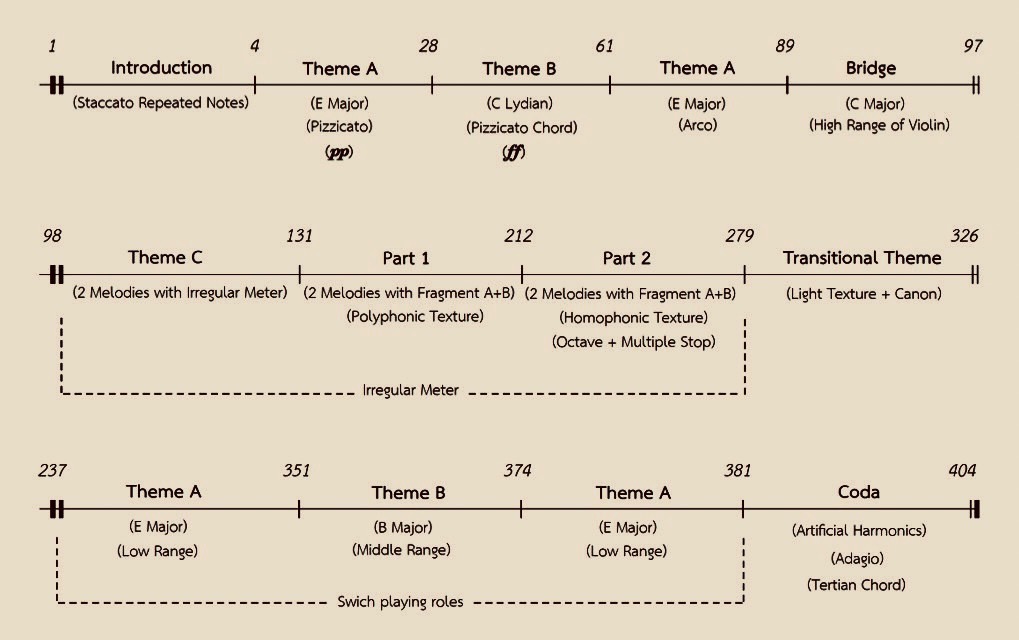
Results: Shostakovich’s Piano Trio No. 2 is structured in four movements, with the Allegretto functioning as the fourth and final movement. This movement, often referred to as a "Dance of Death," is composed in Sonata-Rondo form and consists of 404 measures. It contains three principal themes—A, B, and C—organized as follows: themes A, B, and A are presented in the exposition; theme C forms the development; and themes A, B, and A return in the recapitulation. Each section ends with transitional material and codas that help articulate formal boundaries. In the exposition (97 measures), Theme A is presented in E major, with the violin performing the melody using pizzicato technique, lending a dry, percussive character. Theme B then modulates to C Lydian mode, and the violin switches to a harmonic role, using chordal pizzicato that creates a homophonic texture and projects a heightened dynamic intensity. The development section (228 measures) is the most extended and complex part of the movement, featuring irregular meter, rapid shifts in rhythm, and contrapuntal interplay between piano and strings. This section also introduces two new subsidiary motifs, which are passed between instruments in a tightly woven polyphonic texture. The violin is required to execute multiple stops and articulate sharply defined gestures under dynamically extreme conditions. Elements of themes A and B are fragmented and transformed in this section. In the recapitulation (77 measures), Theme A returns in E major and is soon followed by Theme B in B major (the dominant key), and ultimately returns to Theme A in the tonic. The conclusion features a perfect authentic cadence in E major. Throughout the movement, instrumental roles alternate between melodic and harmonic functions. The violin’s writing is particularly expressive and technically demanding, incorporating techniques such as pizzicato, pizzicato chord, high-register playing, up or down bow stroke, multiple stops, staccato, and col legno (using the wooden part of the bow). Collectively, these techniques contribute to the movement’s grotesque character and dramatic tension, encapsulating Shostakovich’s fusion of structural precision and emotional intensity.
Conclusions: The Allegretto movement of Shostakovich’s Piano Trio No. 2 reveals a sophisticated fusion of 20th-century and 18th-century compositional approaches. Harmonic language is marked by dissonant chords, chromatic mediant relationships, and tritone intervals—hallmarks of 20th-century expression. Rhythmic structures include frequent meter changes and irregular patterns, intensifying the psychological tension of the work. The violin part demonstrates a wide range of extended techniques, such as col legno, aggressive multiple stops, pizzicato chords, and extreme dynamics. Interestingly, Shostakovich also incorporates classical techniques such as melodic repetition, imitation, and thematic variation, as well as a formal framework (Sonata-Rondo) typically associated with the 18th century. This hybridization suggests a neoclassical inclination, where traditional elements are revisited and reinterpreted within a modern context. The violin serves as a medium for conveying anguish, resistance, and fatalistic humor.
References
Adler, Samuel. The Study of Orchestration. 4th ed. New York: W. W. Norton, 2016.
Bampenyou, Rattanai. “Type 2 Sonata: 2 Case Studies from Haydn and Mozart.” Rangsit Music Journal 16, no. 1 (January-June 2021): 75-87. (in Thai)
Chaorattana, Pimorn, and Jetnipith Sungwijit. “Practice Procedures for Violin Performance in Antonin Dvorak's Sonatina in G Major, Op. 100.” In The 18th National Graduate Research Conference, Academic Year 2023, 623-632. (in Thai)
Farrell, Aaron Michael. “A Practical Guide to Twentieth-Century Violin Etudes with Performance and Theoretical Analysis.” DMA diss., Louisiana State University and Agricultural and Mechanical College, 2004. https://repository.lsu.edu/gradschool_dissertations/1263/.
Keller, James M. “Shostakovich: Trio No. 2 in E minor for Violin, Cello, and Piano, Opus 67.” SF Symphony. Accessed October 10, 2023. https://www.sfsymphony.org/Data/Event-Data/Program-Notes/S/Shostakovich-Trio-No-2-in-E-minor.
Kostka, Stefan, and Matthew Santa. Materials and Techniques of Post-Tonal Music. 5th ed. New York: Routledge, 2018. DOI: https://doi.org/10.4324/9781315229485
Levi, Erik. “Shostakovich Piano Trio No. 2: Everything You Need to Know.” Classical Music. Accessed October 10, 2023. https://www.classical-music.com/features/works/shostakovich-piano-trio-no-2-guide.
Pancharoen, Natchar. Dictionary of Musical Terms. 3rd ed. Bangkok: KateCarat, 2009. (in Thai)
Sudasna na Ayudhya, Julmanee. Western Music in the 20th Century. Bangkok: Upbeat Creation, 2022. (in Thai)
Trakulhun, Wiboon. Twentieth-Century Music. 2nd ed. Bangkok: Tana Press, 2024. (in Thai)
Downloads
Published
How to Cite
Issue
Section
License
Copyright (c) 2026 College of Music

This work is licensed under a Creative Commons Attribution-NonCommercial-NoDerivatives 4.0 International License.
The copyright of the article belongs to the author. Published articles represent the views of the authors. The editorial team neither necessarily agree with nor take any responsibility for the article.