FACTORS INFLUENCING PARENTS' SELECTION OF MUSIC SCHOOLS IN BANGKOK AND THE METROPOLITAN AREA
DOI:
https://doi.org/10.65824/mmj.v9.283417Keywords:
Private Music Schools, Factors Influencing Private Music School Selection, Factors Analysis, Marketing Mix 7Ps, ParentsAbstract
Background and Objectives: Parents play a pivotal role in sustaining and ensuring the success of their children’s music learning through school selection, financial support, time management, motivation, and progress monitoring. In Bangkok and its metropolitan area, where a large number of private music schools operate under intense market competition, parents face diverse choices and hold high expectations regarding instructional quality. Understanding the factors that influence their school selection decisions is therefore crucial. This study aims to (1) analyze the factor structure underlying the variables affecting parents’ selection of private music schools and (2) examine parents’ perceptions of the importance of these factors, in order to reflect current trends in urban parents’ decision-making toward music education.
Methods: This study employed a quantitative research design using a 38-item, five-point Likert scale questionnaire developed from the Marketing Mix 7Ps framework, comprising Product, Price, Place, Promotion, People, Process, and Physical Evidence. The questionnaire was validated for content accuracy (IOC = 0.96) and tested for reliability (Cronbach’s alpha = 0.83). The sample consisted of 530 parents whose children were enrolled in private music schools registered with the Office of the Private Education Commission (OPEC) in Bangkok and its metropolitan area. Data were collected through an online survey conducted between April and May 2025. Descriptive statistics and exploratory factor analysis (EFA) were employed for data analysis, using Principal Component Analysis (PCA) with Varimax rotation.
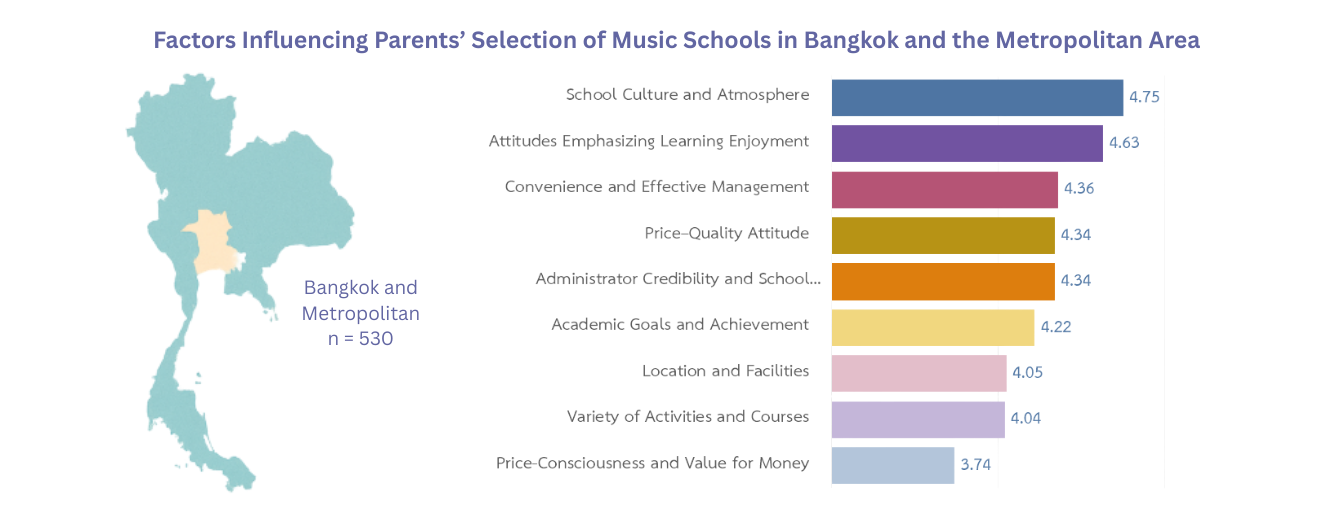
Results: The Kaiser-Meyer-Olkin value was 0.865, and Bartlett’s Test was significant (p < .001), confirming data suitability for EFA. Nine factors were extracted, accounting for 64.15% of the total variance: (1) Convenience and effective management, (2) Academic goals and achievement, (3) School culture and atmosphere, (4) Administrator credibility and school reputation, (5) Attitudes emphasizing learning enjoyment, (6) Variety of activities and courses, (7) Location and facilities, (8) Price-consciousness and value for money, and (9) Price-quality attitude. Perception ratings revealed that “School culture and atmosphere” ( = 4.75, SD = 0.39) and “Attitudes emphasizing learning enjoyment” ( = 4.63, SD = 0.52) received the highest mean scores, followed by “Convenience and effective management” ( = 4.36, SD = 0.57), “Price-quality attitude” ( = 4.34, SD = 0.67) and “Administrator credibility and school reputation” ( = 4.34, SD = 0.65). The next factors were “Academic Goals and Achievement” ( = 4.22, SD = 0.72), “Location and Facilities” ( = 4.05, SD = 0.86), and “Variety of Activities and Courses” ( = 4.04, SD = 0.81). Meanwhile, “Price Consciousness and Value for Money” received the lowest mean score among the factors ( = 3.74, SD = 0.84). These findings suggest that urban parents prioritize emotional and social quality dimensions over price-related considerations.
Conclusions: The findings reveal that urban parents place the highest importance on emotional and social quality factors, particularly the learning atmosphere, students’ happiness, and positive teacher-student relationships, rather than price competition. Next in importance include convenience and effective management, which align with the demands of fast-paced urban lifestyles. School reputation, credibility, and Price-Quality Attitude further reflect parents’ confidence and willingness to invest in higher-quality education. While academic goals and supplementary activities remain relevant, they are not decisive in school selection. Moreover, this study extends the applicability of the Marketing Mix 7Ps framework to the context of private music schools, indicating that the most influential components are associated with Product, People, and Physical Evidence—namely, teachers, curricula, instruction, and positive learning environments—which parents perceive as more valuable than price considerations alone.
References
Bartlett, Maurice S. “A Note on the Multiplying Factors for Various x^2 Approximations.” Journal of the Royal Statistical Society: Series B (Methodological) 16, no. 2 (July 1954): 296-298.
Booms, Bernard H., and Mary J. Bitner. “Marketing Strategies and Organizational Structures for Service Firms.” In Marketing of Services, edited by James H. Donnelly Jr. and William R. George, 47-51. Chicago: American Marketing Association, 1981.
Comrey, Andrew L., and Howard B. Lee. A First Course in Factor Analysis. 2nd ed. New York: Psychology Press, 1992.
Costello, Anna B., and Jason W. Osborne. “Best Practices in Exploratory Factor Analysis: Four Recommendations for Getting the Most from Your Analysis.” Practical Assessment Research & Evaluation 10, no. 7 (July 2005): 1-9.
Hair, Joseph F., William C. Black, Barry J. Babin, and Rolph E. Anderson. Multivariate Data Analysis. 7th ed. Upper Saddle River, NJ: Pearson Prentice Hall, 2010.
Hoover-Dempsey, Kathleen V., and Howard M. Sandler. “Why Do Parents Become Involved in Their Children’s Education?” Review of Educational Research 67, no. 1 (Spring 1997): 3-42.
Ivy, Jonathan. “A New Higher Education Marketing Mix: The 7Ps for MBA Marketing.” International Journal of Educational Management 22, no. 4 (2008): 288-299.
Kaiser, Henry F. “An Index of Factorial Simplicity.” Psychometrika 39, no. 1 (March 1974): 31-36.
Lertvittayatan, Araya. “The Influence of Marketing Mix towards the Overall Satisfaction of Parents on Franchised Music Schools in Bangkok.” Master’s thesis, Thammasat University, 2016. https://digital.library.tu.ac.th/tu_dc/frontend/Info/item/dc:92280.
Office of the Private Education Commission. Number of Private Music Schools Registered with the Ministry of Education, March 2025. Bangkok: Office of the Private Education Commission, 2025. (in Thai)
Pan, Yingying, Alfredo Bautista, and Siu-hang Kong. “Importance Attributed to Music Education by Hong Kong Parents and Prediction of Children’s Music Participation.” Education Sciences 15, no. 2 (February 2025): 250.
Pattananon, Nicha, Siriluk Charoenmongcolkij, and Krit Niramittham. “Factors in Parents' Decision to Choose Music Lessons for Young Children Aged 0-5 Years.” Journal of Roi Kaensarn Academi 9, no. 12 (December 2024): 3465-3470. https://so02.tci-thaijo.org/index.php/JRKSA/article/view/273754.
Phungbun na Ayudhya, Prasitsuppakarn. “Strategies of Services Marketing Mix Affective to Decision Taking Service in Private Music School Bangkok Area.” Master’s thesis, Silpakorn University, 2014. https://sure.su.ac.th/xmlui/handle/123456789/13537? (in Thai)
Shewaraksakul, Nattakrit. “The Study on Parents’ Criteria in Choosing a Primary School for Their Children in Thailand.” Master’s thesis, Thammasat University, 2016. http://ethesisarchive.library.tu.ac.th/thesis/2016/TU_2016_5802040591_6015_4541.pdf. (in Thai)
Srisompetch, Tanchanid. “Analysis of the Factors that Affect Parents’ Satisfaction in Choosing Music School for Their Children.” Thematic paper, Mahidol University, 2018. https://archive.cm.mahidol.ac.th/handle/123456789/3037. (in Thai)
Wu, Xiaoxin. “School Choice with Chinese Characteristics.” Comparative Education 48, no. 3 (August 2012): 347-366.
Youm, Hyun Kyung. “Parents’ Goals, Knowledge, Practices, and Needs Regarding Music Education for Their Young Children in South Korea.” Journal of Research in Music Education 61, no. 3 (October 2013): 280-302.
Downloads
Published
How to Cite
Issue
Section
License
Copyright (c) 2026 College of Music

This work is licensed under a Creative Commons Attribution-NonCommercial-NoDerivatives 4.0 International License.
The copyright of the article belongs to the author. Published articles represent the views of the authors. The editorial team neither necessarily agree with nor take any responsibility for the article.