OLIVIER MESSIAEN'S STYLE AND THE MUSIC COMPOSITION "TURANGALÎLA-SYMPHONIE"
DOI:
https://doi.org/10.65824/mmj.v9.283888Keywords:
Olivier Messiaen, Music Composition, Symphony, Twentieth-Century MusicAbstract
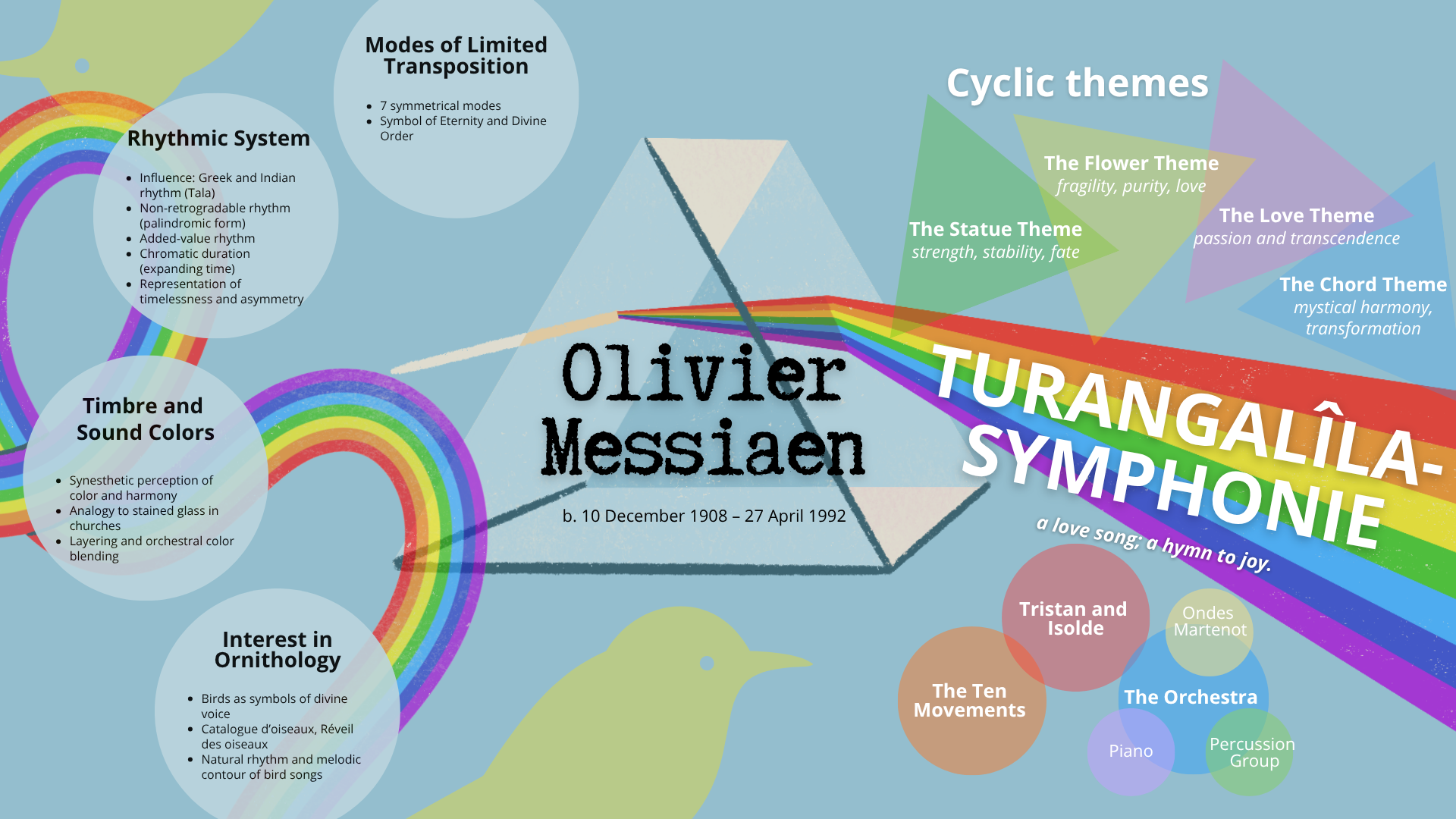
Background and Objectives: Olivier Messiaen (1908-1992) is one of the contemporary composers who played a significant role in the development of French music and Western art music in the twentieth century. One of his masterpieces is the Turangalîla-Symphonie (1946-1948), a large-scale symphony lasting over 85 minutes and consisting of ten movements. This work transcends the traditional symphonic framework through its use of an exceptionally large orchestra combined with solo piano and an early electronic instrument, the Ondes Martenot, the employment of complex rhythmic structures and modal systems, as well as the presentation of emotional and symbolic concepts rather than direct literary narration. This article aims to analyze and establish an overall framework for understanding Messiaen’s compositional style through an examination of the principal musical elements and distinctive characteristics found in each movement of the Turangalîla-Symphonie.
Methods: This study employs a qualitative methodology based primarily on literature synthesis and musical analysis. The sources include academic documents, music textbooks, interviews, as well as scores and performance recordings. The research process consists of two interrelated parts: 1) a study of Messiaen’s compositional style in four dimensions, including his interest in ornithology, the system and structure of modes, the rhythmic system, and the concept of sound color; and 2) an analysis of the Turangalîla-Symphonie, which presents structural details and the use of principal themes, as well as the overall characteristics of the musical elements in each movement.
Results: The results of the study are divided into two parts. 1) The study of Messiaen’s compositional style found that his musical language is unique and highly systematic. It did not occur by chance but resulted from the accumulation of life experience, education, and religious belief that were integrated together. Messiaen’s compositional style can be identified in several dimensions, both musical and philosophical. This study focuses on four main aspects: interest in ornithology, the system and structure of modes, the rhythmic system, and the concept of sound color. Each aspect reflects the composer’s perspective and intention to create a musical world distinct from other composers of his time. 2) The analysis of the Turangalîla-Symphonie concentrates on the musical components that reflect Messiaen’s compositional style. This work is not only a large-scale symphony but also a space in which the composer expressed his distinctive musical ideas, including the use of cyclical themes, the contrasting structural organization in each movement, and the integration of sound color with diverse and complex rhythmic movement. The result shows that this symphony does not narrate the legend of Tristan and Isolde directly but presents symbolic meanings of time, love, joy, and death, which form the central concept of Turanga and lîla, which are conveyed with artistic power.
Conclusions: The study found that Messiaen’s Turangalîla-Symphonie demonstrates the breaking of boundaries of the traditional symphonic form and the creation of a new compositional framework that reflects his individuality in both musical and philosophical dimensions. The outstanding features of this composition are not only its large-scale structure or the diverse use of instruments, but also its expression of the philosophy of love, life, death, and joy through a systematic organization of musical elements. The research results indicate that Messiaen succeeded in integrating religious experience, nature, and literature into contemporary musical creation, making this work one of the most influential compositions for later composers. It continues to be an important subject of academic study in the field of music today. Therefore, this study is significant in understanding one of the major compositions of the twentieth century and in providing a conceptual framework that can be applied to the analysis of contemporary musical works in the future.
References
Austbø, Håkon. “Visualizing Visions: The Significance of Messiaen’s Colours.” Music & Practice 2 (2015).
Dingle, Christopher. The Life of Messiaen. Cambridge: Cambridge University Press, 2007.
Hill, Peter, and Nigel Simeone. Messiaen. New Haven, CT: Yale University Press, 2005.
Medi Music. “Rhythmic Modes.” Accessed March 4, 2025. https://medi-music.weebly.com.
Messiaen, Olivier. Liner Notes for Olivier Messiaen. Turangalîla-Symphonie. Orchestre De La Bastille, Myung-Whun Chung, conductor, Paul Griffiths, translator. Recorded October, 1990. Deutsche Grammophon 431 781-2, 1991. CD.
Messiaen, Olivier. The Technique of My Musical Language. Paris: Alphonse Leduc, 1944.
Messiaen, Olivier, and Claude Samuel. Olivier Messiaen: Music and Color: Conversations with Claude Samuel. Translated by E. Thomas Glasow. Portland, OR: Amadeus Press, 1994.
Reindl, Tomáš. “Indian Rhythmic Systems as Sources of Inspiration for Western Composers.” Analytical Approaches to World Musics 11, no. 2 (2023): 1-22.
Shenton, Andrew. Olivier Messiaen’s Turangalîla-Symphonie: Elements in Music since 1945. Cambridge: Cambridge University Press, 2023. DOI: https://doi.org/10.1017/9781009165723
Weakland, Rembert. “The Rhythmic Modes and Medieval Latin Drama.” Journal of the American Musicological Society 14, no. 2 (Summer 1961): 131-146. DOI: https://doi.org/10.2307/829752
Downloads
Published
How to Cite
Issue
Section
License
Copyright (c) 2026 College of Music

This work is licensed under a Creative Commons Attribution-NonCommercial-NoDerivatives 4.0 International License.
The copyright of the article belongs to the author. Published articles represent the views of the authors. The editorial team neither necessarily agree with nor take any responsibility for the article.