THE DEVELOPMENT OF WESTERN VOCAL PEDAGOGICAL TRANSMISSION IN THAILAND AFTER THE POLITICAL TRANSITION (1932-1988)
DOI:
https://doi.org/10.65824/mmj.v9.284112Keywords:
Development and Transmission of Western Vocal Music, Schools of Western Vocal Thought, After the Political TransitionAbstract
Background and Objectives: Western vocal pedagogy in Thailand has been influenced by Western singing traditions since the reign of King Rama V. This influence led to a transition in Thai singing styles toward modern Thai song (Phleng Thai Sakon) and has continued to develop to the present. However, the developmental processes and mechanisms for the “transmission” of such vocal pedagogical knowledge lack clear systematic evidence. Furthermore, there is an absence of concrete research explaining the models, methods, and strategies of transmission amidst social and political changes. Therefore, this research aims to investigate the development of Western vocal pedagogy transmission in Thailand between 1932 and 1988. This period marks a significant era following the political transition that substantially impacted the nation’s cultural landscape and educational system.
Methods: This study employs historical research methodology by collecting and analyzing primary and secondary sources. These sources include 20 textbooks and teaching documents related to singing and music, as well as biographies of vocal and music instructors from the studied period. Additionally, in-depth interviews were conducted with 22 key informants, divided into two groups: (1) teachers and instructors who directly transmitted the knowledge, and (2) students who were recipients of such knowledge. The analysis focuses on synthesizing teaching principles, training methods, and knowledge transmission mechanisms within the context of the teacher-student relationship.
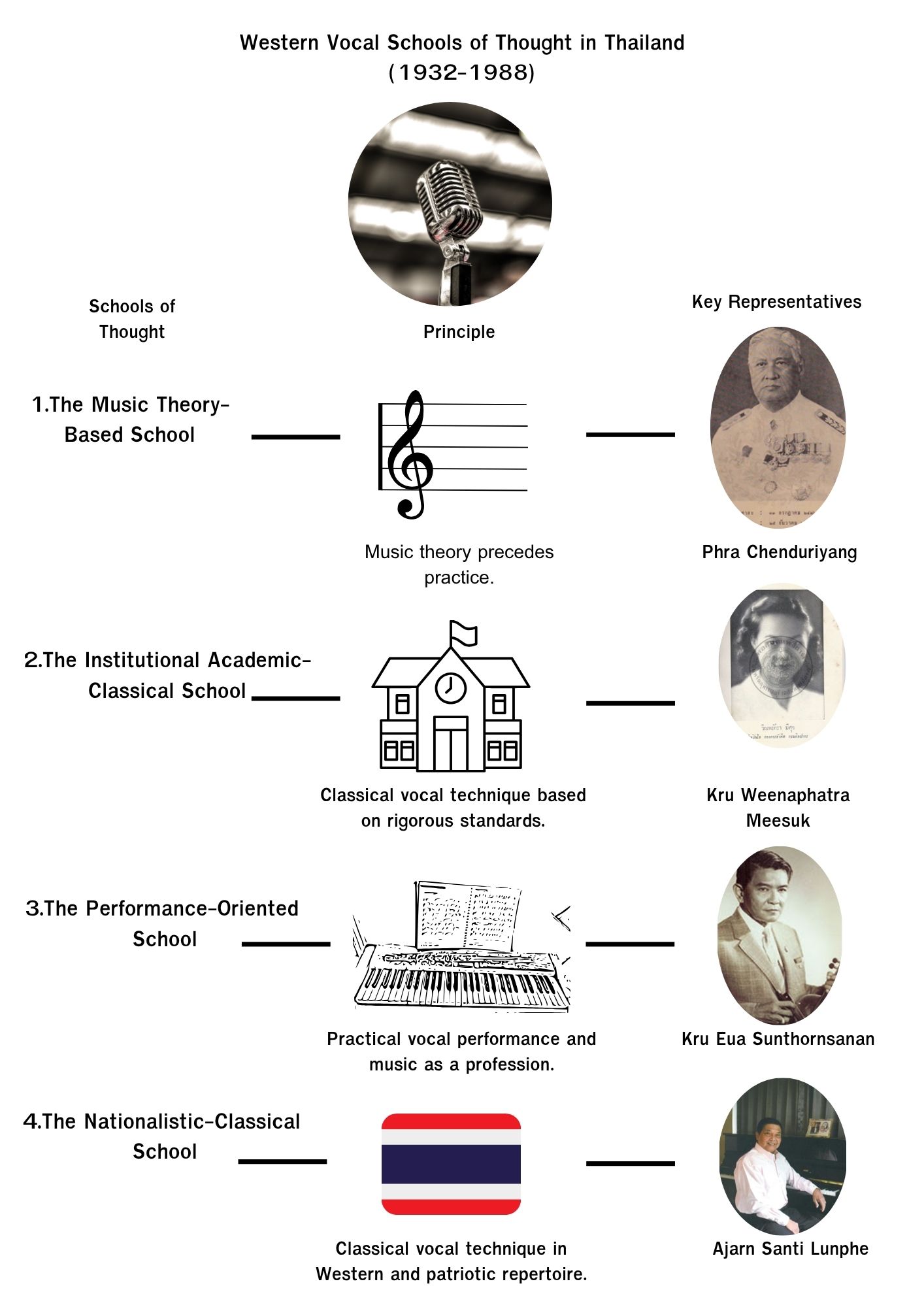
Results: The findings reveal that the development of Western vocal pedagogy transmission in Thailand between 1932 and 1988 can be categorized into three key eras based on the socio-political context: (1) The Foundational Era (1932–1957): The state played a crucial role in determining instructional direction through nationalist policies and the establishment of music institutions. (2) The Era of Educational System Integration (1958-1972): Western vocal instruction was systematically integrated into higher education levels. (3) The Developmental Era (1973-1988): Continuous knowledge transmission occurred from pioneer teachers to a new generation of students, resulting in a clearer pedagogical lineage. Furthermore, the synthesis of transmission principles and concepts identified four main “schools of vocal pedagogy”: the Music Theory-Based School, the Institutional Academic-Classical School, the Performance-Oriented School, and the Nationalistic-Classical School. Key instructors served as the core centers of transmission for each school.
Conclusions: The research results indicate that the development of Western vocal pedagogy transmission in Thailand was not merely a passive reception of Western influence. Instead, it was a process of adapting and applying knowledge through the mechanism of transmission from teacher to student in each era. Understanding these transmission strategies helps elucidate the transition from Western teaching concepts to the Thai context and reflects the essential foundations of vocal instruction in Thai educational institutions today.
References
Althusser, Louis. “Ideology and Ideological State Apparatuses (Notes towards an Investigation).” In Lenin and Philosophy, and Other Essays, translated by Ben Brewster, 127-186. New York: Monthly Review Press, 1971.
Aphaiphonrob, Phra. Music Reading Practice, Volume 1. Phra Nakorn: Sophon Phiphat Thanakorn Printing House, 1912. (in Thai)
Arunwong, Nittaya. “The Development of Western Vocal Pedagogical Transmission in Thailand after The Political Transition (1932-1988).” Interview by Awasdakan Poomee, June 21, 2025.
Banomyong-Buntasnakul, Dusdi. “The Development of Western Vocal Pedagogical Transmission in Thailand after The Political Transition (1932-1988).” Interview by Awasdakan Poomee, August 17, 2025.
Beasley, Kimberly. “An Exploration of Pedagogical Ancestry.” CS Music. June 1, 2014. https://www.csmusic.net/content/an-exploration-of-pedagogical-ancestry/.
Bodhivesa, Teekar. “The Development of Western Vocal Pedagogical Transmission in Thailand after The Political Transition (1932-1988).” Interview by Awasdakan Poomee, June 17, 2025.
Chantavanich, Supang. Data Analysis in Qualitative Research. Bangkok: Chulalongkorn University Press, 2016. (in Thai)
Chenduriyang, Phra. Principles of Music and Singing. Bangkok: Kurusapa Printing House, 1949. (in Thai)
Chenduriyang, Phra. The Memoirs of Phra Chenduriyang (Piti Vadyakara). Bangkok: Amarin Printing Group, 1990. (in Thai)
College of Dramatic Arts. “History of the College.” Last modified 2025. http://cda.bpi.ac.th/prawat.html. (in Thai)
College of Music, Bansomdejchaopraya Rajabhat University. “History.” Last modified 2021. http://music.bsru.ac.th/about-us/. (in Thai)
Daniel, Ryan, and Kelly Parkes. “The Apprentice to Master Journey: Exploring Tertiary Music Instrument Teachers' Reflections on Their Experiences as Learner.” Journal of Arts and Humanities 4, no. 3 (March 2015): 52-63.
Gies, Stefan. “The Birth of the Oslo Conservatoire out of the Spirit of the Master-Apprentice Model.” In Higher Music Education: Historical Perspectives, edited by Øivind Varkøy, Ellen M. Stabell, and Bjørnar Utne-Reitan, 15-37. Oslo: Cappelen Damm academic, 2023. DOI: https://doi.org/10.23865/noasp.199.ch2
Gramsci, Antonio. Selections from the Prison Notebooks. Edited and translated by Quintin Hoare and Geoffrey Nowell Smith. New York: International Publishers, 1971.
Hin-on, Tharanat. “Lakorn Rong Gramophone Records: Reflection of Entertainment Culture from 1905 to 1931.” Journal of Humanities, Social Sciences and Arts 2, no. 1 (January-June 2020): 68-82. (in Thai)
Inkhong, Nutthan. “Development, Characteristics and Knowledge of Thai Popular Singing.” PhD diss., Mahidol University, 2016. (in Thai)
Khambunrat, Kanchani. “The Culture of the Leader (Field Marshal P. Pibulsonggram) Caused Hardship for Middle-Aged and Elderly Women.” Silpawattanatham. August 20, 2022. https://www.silpa-mag.com/culture/article_1453. (in Thai)
Khanthasiri, Kowit. “The Development of Western Vocal Pedagogical Transmission in Thailand after The Political Transition (1932-1988).” Interview by Awasdakan Poomee, August 3, 2025.
Klickstein, Gerald. “The Master-Apprentice Model Is Dead.” Musician's Way Blog. April 29, 2013. https://www.musiciansway.com/blog/2013/04/the-master-apprentice-model-is-dead/.
Laddaklom, Wanee. “The Development of Western Vocal Pedagogical Transmission in Thailand after The Political Transition (1932-1988).” Interview by Awasdakan Poomee, June 27, 2025.
Laovanich, Vitchatalum, and Monsikarn Laovanich. “The Processes and Challenges in Achieving Uniformity of Vowels and Diction in Thai Choral Singing: A Case Study of Suanplu Chorus.” Journal of Interdisciplinary Voice Studies 8, no. 2 (December 2023): 159-178. DOI: https://doi.org/10.1386/jivs_00081_1
Laovanich, Vitchatalum, and Somchai Trakarnrung. “Marginalization of Music Subject in Thai Basic Education Curriculum: An Archaeology of Knowledge Approach.” Fine Art International 17, no. 1 (2013): 35-51.
Long, Marion, Andrea Creech, Helena Gaunt, and Susan Hallam. “Conservatoire Students' Experiences and Perceptions of Instrument-Specific Master Classes.” Music Education Research 16, no. 2 (2014): 176-192. DOI: https://doi.org/10.1080/14613808.2013.859659
Memorial Book for the Royal-Sponsored Cremation of Sara Kasemsri Na Ayudhaya. Bangkok: n.p., 2015. (in Thai)
Memorial Book for the Royal-Sponsored Cremation of Sub Lieutenant Santi Lunphe. Bangkok: n.p., 2025. (in Thai)
Memorial Book for the Royal-Sponsored Cremation of Uea Sunthonsanan. Bangkok: P. Samphan Phanit, 1982. (in Thai)
Meyer, Andrew D. “Twentieth Century Nationalism in the Music of Janacek, Britten, Revueltas, and Harrison.” Last modified March 29, 2020. https://andrewdmeyer.com/2020/03/29/twentieth-century-nationalism-in-the-music-of-janacek-britten-revueltas-and-harrison/.
Music Division, Fine Arts Department. Historical Play: Memorial Book for the Cremation of Mrs. Weenaphatra Meesuk. Bangkok: Thai Watana Panich, 1955. (in Thai)
Music Division, Fine Arts Department. Twelve Stories of Opera. Bangkok: Phra Chan Printing Press, 1952. (in Thai)
Naismith, Marisa Lee, host. “#91. The Master-Apprentice Model: A Powerful Hierarchy with Travis Sherwood.” A Voice and Beyond. November 28, 2022. Podcast, 01:11:36. https://drmarisaleenaismith.com/91-the-master-apprentice-model-a-powerful-hierarchy-with-travis-sherwood/.
Natchanawakul, Nachaya. “Western Music in Siam: The Development between A.C. 1841-1941.” PhD diss., Mahidol University, 2012. (in Thai)
Nuntasukon, Francis. “The Siamese Historical Music Transcription of ‘Phra Aphaipholrop’: The Pioneer Musicologist of Thailand.” Silpakorn University Journal 41, no. 5 (September-October 2021): 57-69. (in Thai)
Ogawa, Masafumi. “The Development of Music Education in Japan.” The Quarterly Journal of Music Teaching and Learning 2, no. 3 (1991): 54-59.
Orden, Kate van. “Domestic Music.” In The Cambridge History of Sixteenth-Century Music, edited by Iain Fenlon and Richard Wistreich, 335-378. Cambridge: Cambridge University Press, 2019. DOI: https://doi.org/10.1017/9780511675874.011
Podhisita, Chai. The Science and Art of Qualitative Research. 9th ed. Bangkok: Amarin Printing and Publishing, 2021. (in Thai)
Sawamiphakdi, Puengchit. “The Development of Western Vocal Pedagogical Transmission in Thailand after The Political Transition (1932-1988).” Interview by Awasdakan Poomee, December 11, 2025.
Suksiripornrit, Pralongsit. “The Development of Western Vocal Pedagogical Transmission in Thailand after The Political Transition (1932-1988).” Interview by Awasdakan Poomee, June 21, 2025.
Suttachitt, Narutt. Music Education: Principles and Essence. 10th ed. Bangkok: Chulalongkorn University Press, 2018. (in Thai)
Wangnaitham, Napha. “The Development of Western Vocal Pedagogical Transmission in Thailand after The Political Transition (1932-1988).” Interview by Awasdakan Poomee, July 31, 2025.
Downloads
Published
How to Cite
Issue
Section
License
Copyright (c) 2026 College of Music

This work is licensed under a Creative Commons Attribution-NonCommercial-NoDerivatives 4.0 International License.
The copyright of the article belongs to the author. Published articles represent the views of the authors. The editorial team neither necessarily agree with nor take any responsibility for the article.