SIMPLE AND PRACTICAL WARM-UP ROUTINES FOR DEVELOPING FUNDAMENTAL BOW-ARM TECHNIQUES FOR YOUNG VIOLIN AND VIOLA STUDENTS IN THAILAND
DOI:
https://doi.org/10.65824/mmj.v9.284124Keywords:
Violin, Viola, String Pedagogy, Tone Production, Bow-Arm TechniquesAbstract
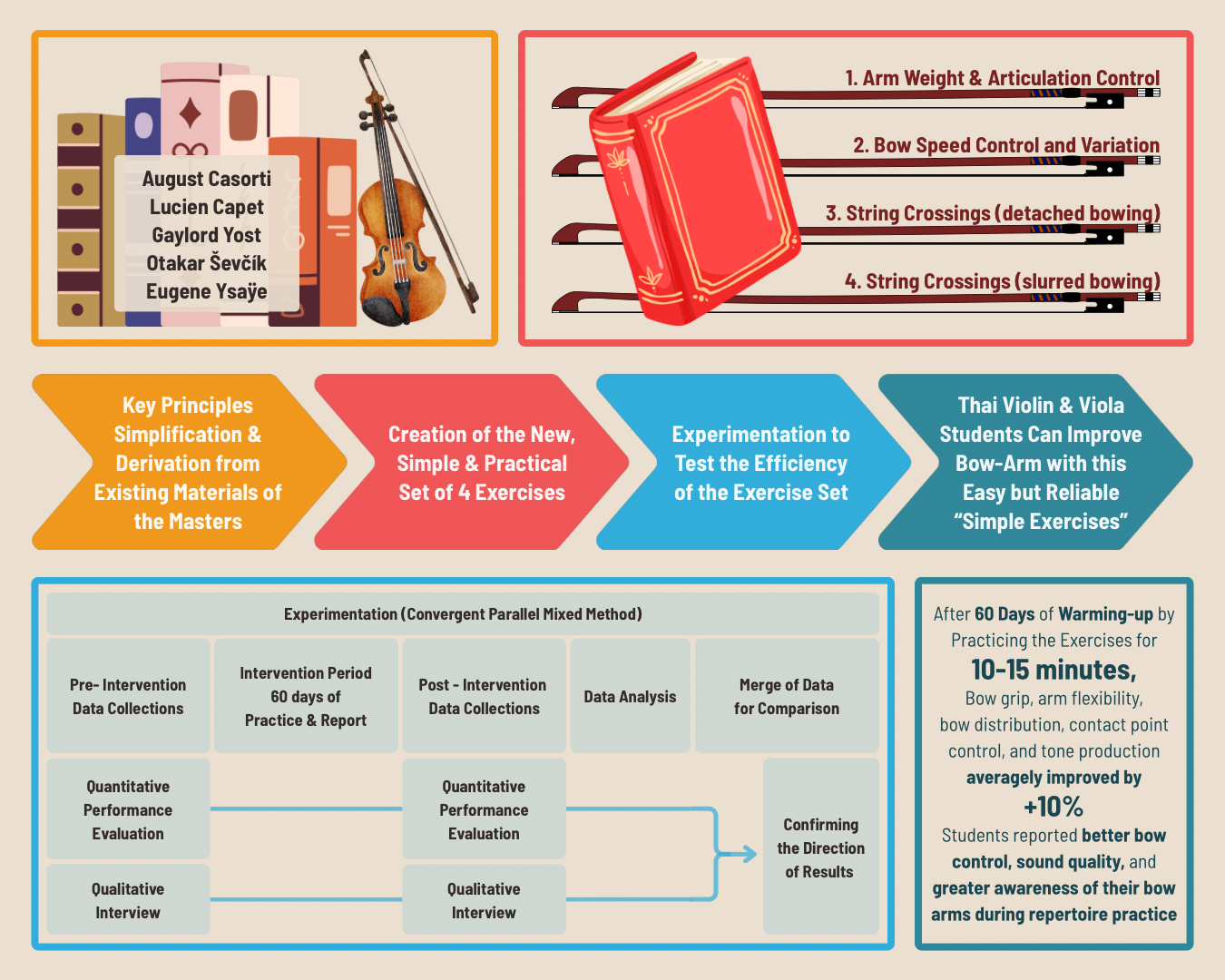
Background and Objectives: Tone production is a crucial foundation that directly affects musical expression, technical facility, as well as intonation development. In Thailand, consistent and systematic training of the bow-arm is known to be essential but is often underemphasised in early study. Many existing resources by legendary violin pedagogues are either too extensive or complex, making them impractical for young players to use daily. This research aims to design a concise and accessible set of warm-up exercises targeting the essential components of tone production for violin and viola students in Thailand. The exercises specifically address four critical aspects of bow-arm development: bow weight balance, bow speed control, detached-bow string crossing, and slurred-bow string crossing. The objectives are twofold: first, to create a simple and compact daily warm-up routine that develops the basic foundations of tone production; second, to evaluate the effectiveness of these exercises through experimentation. Ultimately, the goal is to provide students with a reliable and efficient tool to support their progress in repertoire studies by strengthening their tone production skills at a university level.
Methods: The exercise set was designed by surveying and adapting principles from major pedagogues and treatises. These ideas were derived into four short, progressive exercises to be played exclusively on open strings, thereby eliminating left-hand distractions and enabling students to focus entirely on sound quality and bow control. The experimental study then followed a convergent parallel mixed methods design, combining quantitative adjudicator assessments with qualitative student interviews. Students enrolled in university violin or viola programs at various institutions in Thailand were recruited as participants. Each was instructed to integrate the exercises into their daily practice for sixty consecutive days. Prior to and after the program, participants were evaluated by a panel of three expert adjudicators. In addition, semi-structured interviews were conducted with each participant before and after the trial to document their self-perceived challenges, progress, and experiences with the exercises.
Results: After a 60-day period of practising the designed bow-arm exercises, the nine participants demonstrated an average improvement of 10.4% in foundational bow-arm techniques, as measured by adjudicators evaluations across 16 technical subjects. Individual improvement rates ranged from 7.1% to 14.5%, with the most notable gains observed in bow contact with strings, contact point control, and bow straightness. Post-practice interviews indicated that participants developed greater awareness of their bow arms, improved bow control, and achieved more relaxed posture and sound production. Most participants reported improvements in specific areas such as bow control at the frog, long tone strokes, and pinky finger relaxation. Feedback also confirmed that the exercises were manageable and effective for integrating into daily practice.
Conclusions: This study demonstrates that this set of four very easy, short, structured bow-arm exercises can effectively improve the foundational technical skills of Thai violin and viola students. Over a 60-day period, participants showed an average improvement of approximately 10% across all key aspects, including bow grip, arm flexibility, bow distribution, contact point control, and tone production. Students reported better bow control, enhanced sound quality, and greater awareness of their bow arms during repertoire practice. The exercises, requiring only 10-15 minutes daily and focused solely on open strings, provide a practical, progressive, and low-risk approach to technical development. These results suggest that integrating such exercises into regular practice routines can support skill acquisition, reduce early-stage technical challenges, and elevate overall playing standards in Thai violin and viola education.
References
Auer, Leopold. Violin Playing as I Teach It. London: Duckworth, 1921.
Capet, Lucien. La technique supérieure de l’archet. Paris: Maurice Senart, 1916. https://ks15.imslp.org/files/imglnks/usimg/5/56/IMSLP939482-PMLP219389-La_technique_superieure_de_larchet.pdf.
Casorti, August. The Technique of Bowing, Op. 50. Bremen: August Cranz, 1880. https://imslp.org/wiki/The_Techniques_of_Bowing,_Op.50_(Casorti,_August).
Creswell, John W., and Timothy C. Guetterman. Educational Research: Planning, Conducting, and Evaluating Quantitative and Qualitative Research. 6th ed. Boston: Pearson, 2019.
Fischer, Simon. Warming Up: Complete Warm-Up Sequence for the Violin. London: Fitzroy Music Publications, 2011.
Flesch, Carl. Urstudien: Daily Exercises for the Violin. New York: Carl Fischer, 1911.
Galamian, Ivan. Principles of Violin Playing and Teaching. New York: Dover Publications, 2013.
Kayser, Heinrich Ernst. 36 Violin Etudes, Op. 20. New York: G. Schirmer, n.d.
Kreutzer, Rodolphe. 42 Studies for Violin. Mainz: Schott, n.d.
Lankovsky, Masha, ed. The Russian Violin School: The Legacy of Yuri Yankelevich. New York: Oxford University Press, 2016. DOI: https://doi.org/10.1093/acprof:oso/9780199917600.001.0001
Letz, Hans. “The Technique of Bowing.” In Violin Mastery: Interviews with Heifetz, Auer, Kreisler, and Others, edited by Frederick H. Martens, 85-88. Mineola, NY: Dover Publications, 2007.
Mannes, David. “The Philosophy of Violin Teaching.” In Violin Mastery: Interviews with Heifetz, Auer, Kreisler, and Others, edited by Frederick H. Martens, 89-97. Mineola, NY: Dover Publications, 2007.
Mazas, Jacques-Féréol. Études Spéciales, Études Brillantes, Études d’Artistes (Op. 36: Complete Edition). New York: G. Schirmer, n.d.
Ševčík, Otakar. 40 Variations, Op. 3, edited by Jaroslav Foltýn. Kassel: Bärenreiter, 2001.
Yanshinov, Aleksey. Daily Violin Exercises, Op. 27. Moscow: Muzgiz, 1939. https://imslp.org/wiki/Daily_Violin_Exercises,_Op.27_(Yanshinov,_Aleksey).
Yost, Gaylord. Key to Mastery of Bowing. Pittsburgh: Volkwein Brothers, 1938. https://imslp.org/wiki/Key_to_Mastery_of_Bowing_(Yost,_Gaylord).
Ysaÿe, Eugène. Exercises and scales. Mainz: Schott, 1967.
Downloads
Published
How to Cite
Issue
Section
License
Copyright (c) 2026 College of Music

This work is licensed under a Creative Commons Attribution-NonCommercial-NoDerivatives 4.0 International License.
The copyright of the article belongs to the author. Published articles represent the views of the authors. The editorial team neither necessarily agree with nor take any responsibility for the article.