CHINESE FOLK INFLUENCES: TCHEREPNIN’S STRATEGY OF IMITATION AND INNOVATION IN CYCLE OF SEVEN CHINESE FOLKSONGS, OP. 95
DOI:
https://doi.org/10.65824/mmj.v9.284213Keywords:
Alexander Tcherepnin, Chinese Folk Music, Cross-Cultural Synthesis, Cycle of Seven Chinese Folksongs, Op. 95Abstract
Background and Objectives: Alexander Tcherepnin’s Cycle of Seven Chinese Folksongs, Op. 95—commissioned for the Chinese bass Yi-Kwei Sze—constitutes a focused experiment in intercultural composition. Drawing on Chinese poetry and regional folk melodies, the cycle reflects Tcherepnin’s sustained engagement with Chinese musical idioms. This study investigates his strategies of imitation and innovation in four representative songs of Op. 95: “West River Moon” (No. 1), “Love Song of the Wagon Driver” (No. 2), “Dance of the Little Bird of Youth” (No. 6), and “Working Song” (No. 7). Specifically, it analyzes three dimensions: (1) timbral evocation of traditional Chinese instruments via pianistic techniques; (2) scene and motion evocation through pentatonic resources and rhythmic-textural design; and (3) textural innovation, including melodic-accompaniment interaction. The findings demonstrate how Tcherepnin articulates Chinese modal characteristics within Western harmonic and pianistic idioms, evoking traditional Chinese musical aesthetics while achieving novel artistic outcomes.
Methods: This qualitative study employs document and score analysis to examine four selected songs from Op. 95. Part 1 surveys cultural context and compositional design through a systematic review of primary sources, historical documents, and musical scores. Part 2 applies three analytic dimensions: (1) timbral evocation (register, articulation) associated with traditional instrumental sonorities; (2) scene and motion evocation (pentatonic organization and rhythmic-textural structure); and (3) textural innovation (melodic-accompaniment writing and contrapuntal layering). Across both the melody and accompaniment parts, the study evaluates how traditional Chinese elements are reframed within Western tonal and pianistic frameworks, considering aspects of tonality, melodic trajectory, and accompaniment.
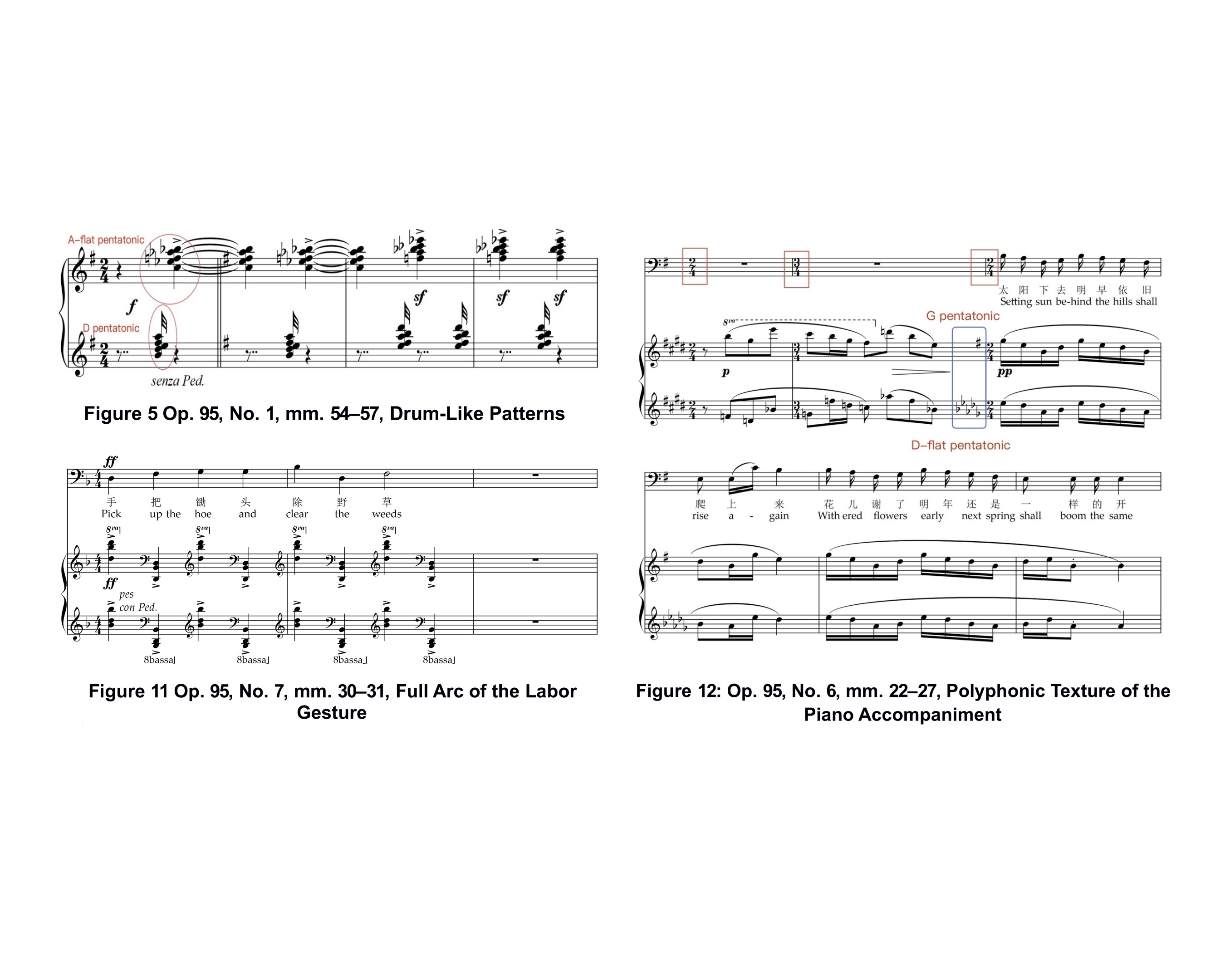
Results: The findings are presented along the same three dimensions. First, in “West River Moon,” Tcherepnin evokes traditional instrumental timbres through strategic register placement, articulation, and pedaling, suggesting the ban gu (wooden clapper) and yang qin (hammered dulcimer) while remaining sounds idiomatic to the Western piano. Second, in “Love Song of the Wagon Driver,” he integrates pentatonic resources within chromatic progressions and combines a steady rhythmic fabric with staccato articulation, producing a dance-like propulsion that suggests carriage movement; in “Working Song,” distinctive rhythmic patterns and polyrhythmic layering, with targeted accentuation and textural contrast, emulate the cadence and momentum of coordinated fieldwork. Third, “Dance of the Little Bird of Youth” demonstrates an innovative melodic-accompaniment technique: the piano assumes an independent, line-bearing role, weaving complementary pentatonic strands to generate polyphonic textures while preserving characteristic Chinese modal traits.
Conclusions: Drawing on evidence from four songs in Op. 95, this study shows how Tcherepnin synthesizes idiomatic Chinese sonorities with Western harmonic and pianistic practices through: (1) timbral evocation via pianistic techniques; (2) scene and motion evocation through pentatonic-centered rhythmic-textural design; and (3) innovations in textural writing through melodic-accompaniment procedures. These pieces demonstrate that traditional materials can be respectfully recontextualized while generating new artistic outcomes. Taken together, Tcherepnin’s strategies suggest that effective musical translation requires deep engagement with source traditions alongside technical ingenuity to mediate between distinct musical systems. This historical case offers a framework for contemporary composers and analysts in today’s interconnected musical environment, with insights that may inform pedagogy, historically informed performance, and future intercultural compositional design.
References
Arias, Enrique A. Alexander Tcherepnin: A Bio-Bibliography. New York: Greenwood, 1989.
Chang, Chi-Jen. “Alexander Tcherepnin: His Influence on Modern Chinese Music.” EdD diss., Columbia University, 1983. https://www.proquest.com/openview/c30702b8d4436fb6b6dc99b7a93550bc/1?pq-origsite=gscholar&cbl=18750&diss=y.
China National Radio. “China in Songs: Youth Dance.” Last modified May 5, 2020. https://weibo.com/ttarticle/p/show?id=2309404501131408572582. (in Chinese)
Collection of Chinese Folk Songs: Jiangsu Volume. Beijing: China ISBN Center, 1998. (in Chinese)
Jiang, Dingxian. “In Memory of Tcherepnin.” In Essays for the International Forum of Tcherepnin and Chinese Musical Culture, edited by Qian Renkang, 151-164. Shanghai: Shanghai Conservatory of Music Press, 2016. (in Chinese)
Li, Fangqi. “The Artistic Characteristics of Xinjiang Uyghur Folk Song ‘Girl of Daban City.’” Art Panorama, no. 1 (2023): 10-12. (in Chinese)
Liu, Huanqun. “Tao Xingzhi and Teahouses.” Agricultural Archaeology, no. 4 (2003): 270. (in Chinese)
Ruan, Tangming. “A New Study on Li Bai’s ‘Three Qingping Diao Poems.’” Journal of Suzhou University of Science and Technology (Social Science) 36, no. 5 (September 2019): 54-60. (in Chinese)
Shen, Nalin. “The Integration of Chinese Opera Traditions into New Musical Compositions.” PhD diss., Victoria University of Wellington, 2010. https://doi.org/10.26686/wgtn.16985476. DOI: https://doi.org/10.26686/wgtn.16985476
Songguang, Zhao, ed., Chinese Music Dictionary. Beijing: People’s Music Publishing House, 2001.
Sze, Alexander J. “Yi-Kwei Sze.” Accessed October 11, 2025. http://www.yi-kweisze.com/biography.html.
Tcherepnin, Alexander. “Alexander Tcherepnin: A Short Autobiography (1964).” Tempo, no. 130 (September 1979): 12-18. DOI: https://doi.org/10.1017/S0040298200030709
Tcherepnin, Alexander. “Cycle of Seven Chinese Folksongs Op. 95.” Manuscript, 1956.
Tcherepnin, Alexander. “Cycle of Seven Chinese Folksongs Op. 95.” Manuscript, 1962.
Tcherepnin Society. “Basic Elements of My Musical Language.” Accessed October 11, 2025. https://www.tcherepnin.com.
Thrasher, Alan R. “Bangu.” In Grove Music Online, edited by Deane Root. Accessed October 11, 2025. https://doi.org/10.1093/gmo/9781561592630.article.L2274804. DOI: https://doi.org/10.1093/gmo/9781561592630.article.L2274804
Thrasher, Alan R. “Yangqin.” In Grove Music Online, edited by Deane Root. Accessed October 11, 2025. https://doi.org/10.1093/gmo/9781561592630.article.45375. DOI: https://doi.org/10.1093/gmo/9781561592630.article.45375
Wuellner, Guy Snyder. “The Complete Piano Music of Alexander Tcherepnin.” DMA diss., University of Iowa, 1975.
You, Mengxi. “A Comprehensive Study of Alexander Tcherepnin’s Op. 71, Seven Songs on Chinese Poems with Musical Analysis and Historical Context.” DMA diss., Boston University, 2024. https://www.proquest.com/openview/c6101e329a3536a2630df73e3ca005bf.
Zhu, Shikui. “Songs on the Golden and Silver Beach: A Documentary of Wang Luobin’s Visit to Qinghai in Spring 1988.” China’s Tu Nationality, no. 3 (2020): 37-38. (in Chinese)
Downloads
Published
How to Cite
Issue
Section
License
Copyright (c) 2026 College of Music

This work is licensed under a Creative Commons Attribution-NonCommercial-NoDerivatives 4.0 International License.
The copyright of the article belongs to the author. Published articles represent the views of the authors. The editorial team neither necessarily agree with nor take any responsibility for the article.