
Judgment of International Court of Justice on Preah Vihear Temple Case : A Chance to Peacefully Benefit each other between Thailand and Cambodia
Article Sidebar
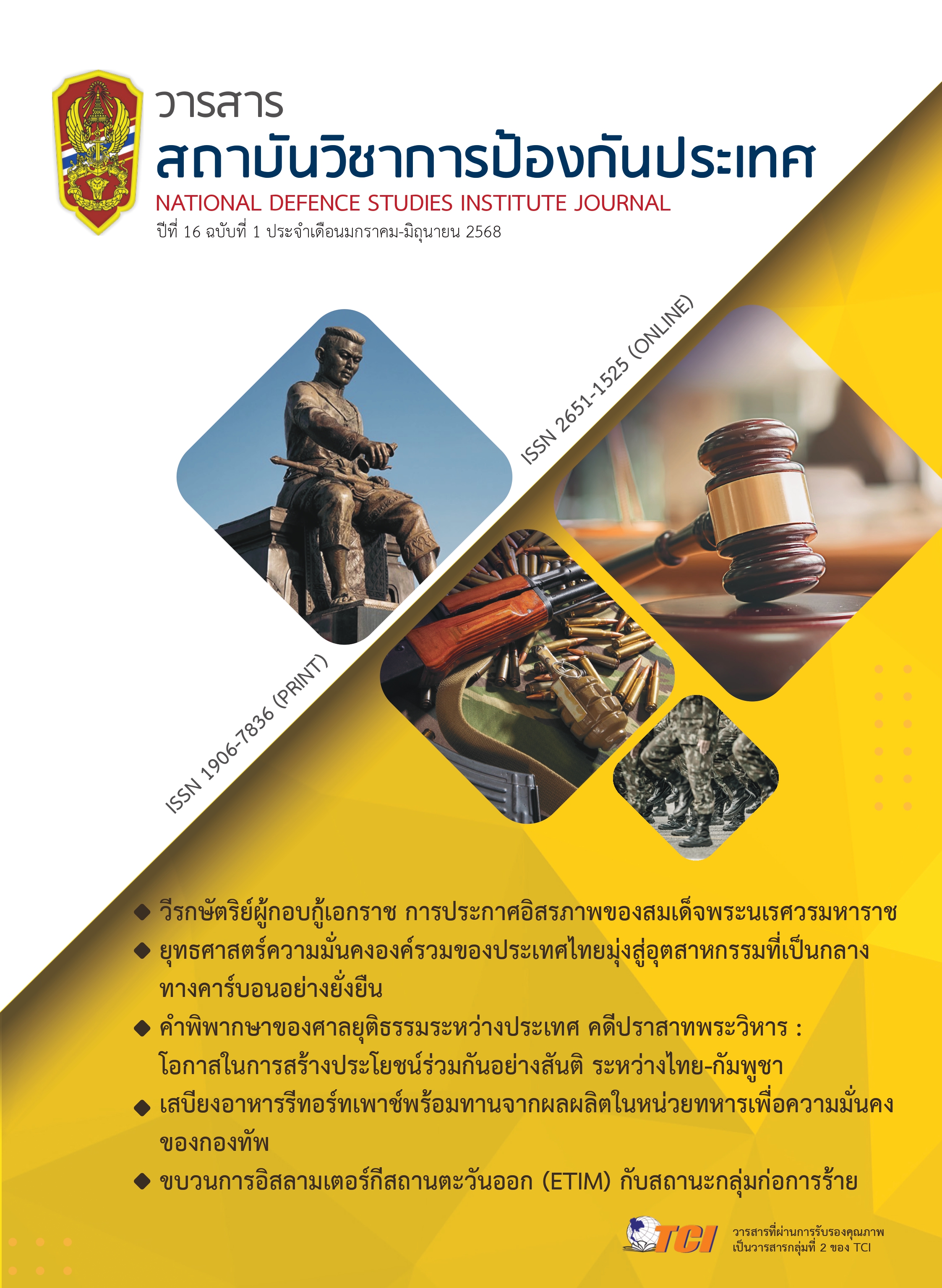
Main Article Content
Abstract
The border problem between Thailand and Cambodia of Preah Vihear Temple had been put in judgement by international court of justice twice. In 1962, The judge came to a decision that Preah Vihear Temple was in Cambodia’s area of sovereignty. In 2016, the court decided on how to interpret the area around Preah Vihear Temple or its vicinity according to the previous judgment. The court explained that the area was small and determined by geography, not by borderline and excluding Phu Ma Khue hill. The court advised both countries continue discussing in detail through bilateral mechanism. However, to put an end to the dispute, the area needs to be utilized for people’s benefit especially in tourism economy. This will improve people’s quality of life around the border of both countries.
This article aims to analyze the implementation of the judgment of the International Court of Justice on Preah Vihear Temple case between Thailand and Cambodia, to end the conflict permanently and turns a crisis into an opportunity to create mutual benefits peacefully. which the author has studied by collecting facts and problem environment then use the SWOT Analysis principle to determine the action model.
The results of the study showed that the appropriate model should interpret the Tem ple of Preah Vihear vicinity according to the inter pretation of the judgment of the International Court of Justice dated 11 November 2013 as a buffer zone. Withdraw troops from both sides from the vicinity and leave only the staff necessary for taking care of the people who come to travel. For other areas in the overlapping zone of 4.6 square kilometers It should be processed in the same manner but without any combatant deployment. At the same time, two border checkpoints should be opened to enter the area of the Temple of Preah Vihear from Thai side, namely, a checkpoint for tourism which allowing tourists from Thai side walkable through the iron gate up to the Temple of Preah Vihear by using a temporary border pass. And also, the Chong Ta Thao border checkpoint which is located on east side of the temple, to allow travelling across the border to a third coun try and able to transport goods through customs clearance protocol. As for the journey from Cam bodian side, they can travel via Kan Mha path to the temple as usual. However, both countries should focus on their benefits as the main goal. To implement this process, discussions should be arranged by the leaders of both countries with the existing bilateral mechanism or a newly established mechanism for specific cases and agencies at all levels should have their respective communication channels setting up for people’s diplomacy as an augmentation.
Article Details

This work is licensed under a Creative Commons Attribution-NonCommercial-NoDerivatives 4.0 International License.
The articles, images, tables, graphs, written content, and opinions published in this journal are solely those of the authors and do not necessarily reflect the views or positions of the National Defence Studies Institute or its academic affiliates.
References
กระทรวงการต่างประเทศ. (2565). ข้อมูลที่ประชาชนไทยควรทราบ เกี่ยวกับกรณีปราสาทพระวิหาร และการเจรจาเขตแดนไทย-ก้มพูชา. http://www.mfa.mo.th/th/content/sd5bccc5f15e39c306000b6d2?cate=5bcb4e15e39c3060006827
ฉัตรศิริ เพียรพยุห์เขตต์. (2559). การศึกษาเปรียบเทียบนโยบายต่างประเทศไทยต่อกัมพูชา กรณีปราสาทพระวิหารระหว่างรัฐบาล ทักษิณ ชินวัตร และรัฐบาลอภิสิทธิ์ เวชชาชีวะ. มหาวิทยาลัยธรรมศาสตร์.
ธีรรัตน์ วินิจสกุลไทย. (2556). ปัญหาการดีความคำพิพากษาของศาลยุติธรรมระหว่างประเทศ : กรณีศึกษา คำขอตีความคำพิพากษาลงวันที่ 15 มิถุนายน 1962 เกี่ยวกับปราสาทพระวิหาร. มหาวิทยาลัยธรรมศาสตร์.
นพดล โชติศิริ. (2556). เขตแดนไทย. จุลสารความมั่นคงศึกษา, (119).
ปณิธัศร์ ปทุมวัฒน์. (2551). ปราสาทพระวิหาร มหาสถานบนรอยเขตอธิปไตย. จุลนิติ, 5(6), 141-155.
ศักดิภัท เชาวน์ลักณ์สกุล และ สุภัทรา อำนวยสวัสดิ์. (2560). สยามกับการล่าอาณานิคมสมัยรัชกาลที่ 5 (พ.ศ.2411-2453). วารสารช่อพะยอม, 28(1), 71-78.
Charnvit Kasetsin. (2003). Thailand and Combodia: A Love-Hote Relationship. https://kyotoreview.org/issue-3-nations-and-stories/a-love-hate-relationship/
